
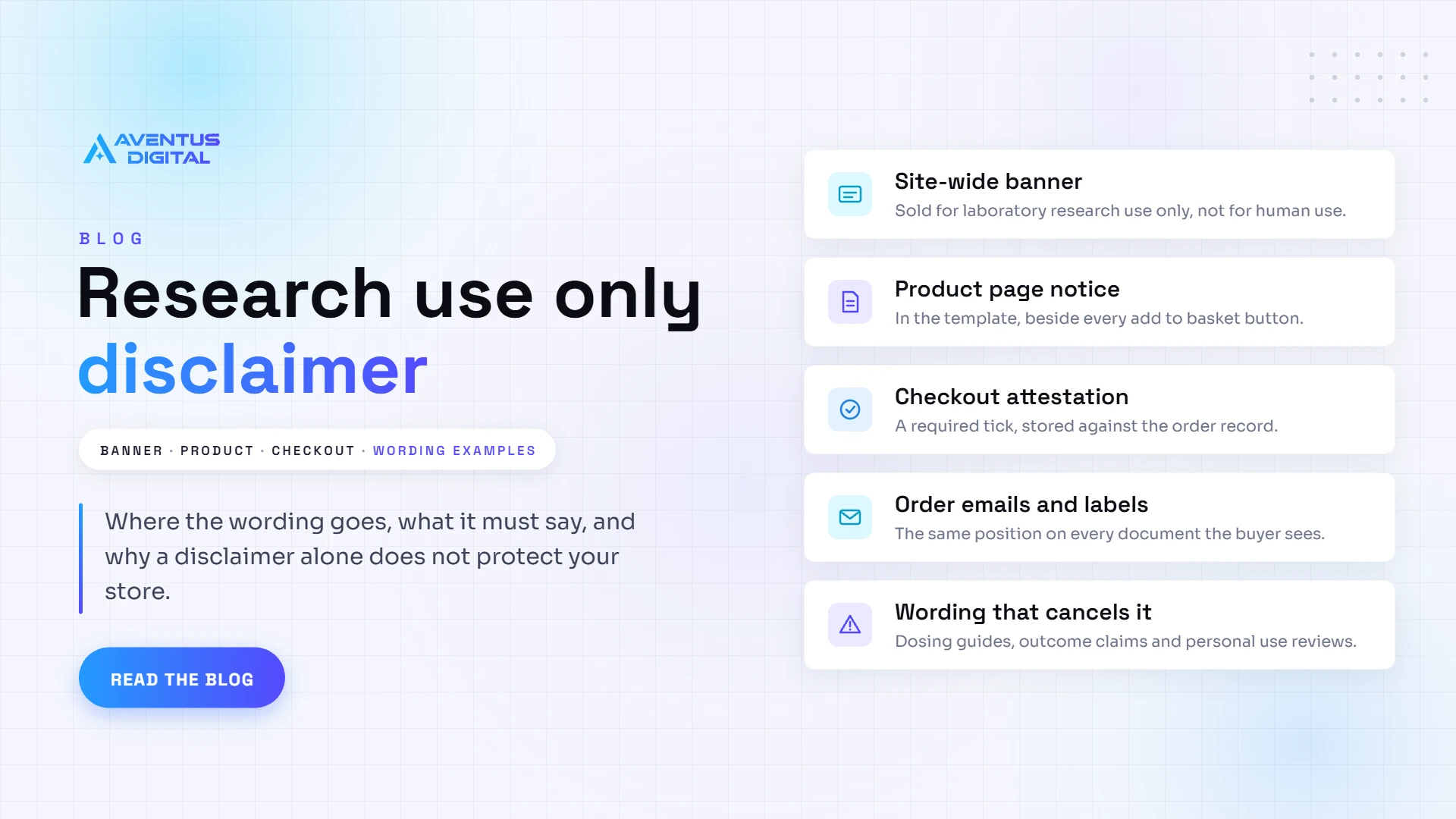
Research use only disclaimer: wording examples for peptide stores
A research use only disclaimer tells buyers a product is sold for laboratory research and not for human or veterinary use. It belongs in the header, on every product and at checkout. It does not protect a store on its own: regulators in the US, Canada and Australia judge the whole website.
The wording is the easy part. The hard part is keeping it consistent. When we read the public product data on five research stores we build or maintain on 6 October 2026, 97 of 113 product descriptions carried a research use only statement. The 16 that did not were all on stores where the wording lived in free text instead of the product template, so it was simply forgotten when products were added.
We are Aventus Digital. We have built 50+ research peptide stores for brands in the UK, the US and beyond, and every one ships with its research use only wording built into the store rather than pasted into it. This guide gives example wording, shows where it goes, and explains what it can and cannot do. It is not legal advice.
What a research use only disclaimer is, and what it is not
A research use only disclaimer, often shortened to RUO, is a statement that a product is supplied for laboratory research and is not intended for use in people or animals. On a well run research store it is one part of a consistent position: who the store sells to, what it sells and how it describes it.
What it is not is a licence, an exemption or a shield. A “not for human consumption” line does not change what a product is if the rest of the website treats it as something to take. Regulators, payment processors and courts all look past the label to the business behind it.
Research use only disclaimer examples
These three examples cover the places that matter most. Treat them as starting points and have your lawyer review them for each market you sell to.
Site-wide banner (example wording, review with a lawyer)
All products on this website are sold for laboratory research use only. They are not medicines, foods, cosmetics or supplements, and are not for human or veterinary use.
Product page (example wording, review with a lawyer)
For research use only. Not for human or veterinary use. Supplied with a lot matched certificate of analysis.
Checkout attestation (example wording, review with a lawyer)
I confirm I am buying for legitimate laboratory research, and that these products will not be used in people or animals.
Short, plain and identical everywhere is better than long and clever. If the banner, the product page and the checkout each say something slightly different, an underwriter reads that as a store that has not decided what it is.
Where to place a research use only disclaimer
The disclaimer has to appear wherever a buyer, an underwriter or a regulator could form a view of the product. That is more places than most stores cover.
| Place | What it should sayExample wording, review with your lawyer | How Aventus builds itOn every peptide store |
|---|---|---|
| Header or site-wide banner | All products are sold for laboratory research use only, not for human or veterinary use. | A fixed banner outside the age gate, so visitors and Google read it before anything else. |
| Product and category pages | For research use only. Not for human or veterinary use. Supplied with a lot matched certificate of analysis. | A field in the product template beside the add to basket button, so no product can publish without it. |
| Cart and checkout | A required attestation that the buyer is purchasing for laboratory research. | A required tick box, saved against the order with the terms version and a timestamp. |
| Order emails and invoices | The same research use only statement, with the batch reference. | Added to the WooCommerce email templates and invoice layout, not typed by hand. |
| Product labels and COA pages | Research use only wording that matches the website exactly. | Label copy and COA page wording checked against the site at handover. |
| Terms of sale | Who you sell to, what the products are not for, and the conditions of purchase. | A standalone research use policy page on a clean URL, linked from the footer and checkout. |
| Example wording is for illustration only. It is not legal advice and does not make any sale lawful on its own. Have a lawyer review your wording for every market you sell to. | ||
The certificate of analysis matters here too. A COA that matches the lot number on the vial is what makes a research position believable, because it shows the store is documenting a material, not marketing an effect.
Why a disclaimer alone does not protect you
United States. The FDA judges a product by its intended use, read from the labelling, the marketing and the whole website. Its warning letters dated 31 March 2026 and the five dated 24 August 2026 went to online sellers that used research use only or not for human use wording. The FDA said the websites still showed the products were intended for people, pointing to things like dosing calculators and bacteriostatic water sold alongside the peptides.
Canada. Health Canada regulates injectable peptides as prescription drugs. In June 2026 a Quebec court granted it a permanent injunction against an online peptide seller, and calling a product a research peptide does not on its own take it outside Health Canada’s reach.
Australia. Unapproved peptides are not on the Australian Register of Therapeutic Goods, and in June 2026 the TGA and the Chief Medical Officer warned about their growing supply. Australian health guidance makes clear that a research use only or not for human consumption label does not make them lawful.
The UK follows the same logic. The MHRA decides whether something is a medicine on its claims and presentation, and its borderline products guidance names websites, social media and customer reviews among the things it reads.
Wording that cancels your disclaimer
These are the things we find on stores that have a disclaimer and still fail a review. Any one of them tells a reader the research position is not real.
- Outcome claims: anything describing what a product does in a person, including weight loss, recovery, performance or anti ageing, in copy, headings, image text or alt text.
- Dosing content: dosing or reconstitution calculators, mixing guides and “how to use” pages.
- Reviews describing personal use: a customer’s account of their own results, published under a research product, counts against the store.
- Injection supplies: bacteriostatic water, syringes or pens sold or bundled alongside research compounds.
- Images that imply use: physique photos, clinical settings, injection imagery or anything that reads as a before and after.
- Social posts and influencer content: consumer marketing on your own accounts, or by people you pay, is part of how the business presents itself.
Our peptide website compliance checklist goes through each of these against the 2026 FDA letters.
Does the wording change by country?
The core wording can stay the same in every market. What changes around it is the translation, the consumer rights text, the returns policy and the terms that apply in each country. A disclaimer translated badly, or contradicted by a local language product description, is no better than none. Read our guide to selling peptides internationally before you open a new country at checkout.
How we build the disclaimer into a store
On every peptide store we build, the research use only position is part of the structure, not a sentence someone has to remember:
- The wording is a field in the product template, so a new product cannot publish without it.
- The checkout attestation is required and saved against the order, ready for a chargeback or an audit.
- Order emails, invoices and the research use policy page repeat the same wording.
- Reviews are moderated before they publish, with a written rule for anything describing personal use.
- Every maintenance visit includes a check of the wording on key pages.
Where we come in: if you are launching, our peptide website development service builds all of this in from day one, with a free homepage mockup first. If you already trade, start with the free checker below.
Free peptide compliance checker
Check your current wording
Run the free compliance snapshot to see where your research use only wording is missing, contradicted or cancelled out, page by page. Your score and top three issues arrive by email.
A risk assessment, not legal advice. Have a lawyer review your final wording.
A research use only disclaimer is worth having, worded plainly and placed everywhere a buyer forms a view. It only protects you when the rest of the website tells the same story.
You might also like
- Peptide website compliance checklist: what the 2026 FDA letters mean for your store.
- Selling peptides internationally: rules by country, and what changes on your website.
- Is it legal to sell peptides?: UK and US rules, side by side.
- Peptide merchant account application pack: what underwriting reads before your form.
- How to build a peptide website: the 7 step process behind 50+ stores.

Author
Zubayed Feroz
Founder of Aventus Digital. 7 plus years building WordPress and WooCommerce stores, including more than 50 for research peptide brands in the UK, the US and the EU.
General information, not legal advice. Example wording on this page is for illustration only and does not make any sale lawful. Requirements differ by product and country and change over time, so have a lawyer qualified in each market review your wording. Responsibility for your products, claims and regulatory position sits with you as the business owner.
Published 18 November 2026. Last reviewed 17 November 2026.
Frequently asked questions
Is a research use only disclaimer legally required?
Not as a single rule everywhere, but payment processors and regulators expect clear research use only wording on research compound stores, and it is part of every store we build. It only helps when the rest of the website agrees with it.
Does “not for human consumption” make selling peptides legal?
No. The FDA, Health Canada and Australian health authorities all look at how the whole business presents its products, not only the label. In 2026 the FDA sent warning letters to sellers that used exactly that wording.
Where should the disclaimer appear?
In the site header or banner, on every product and category page, at checkout as a required attestation, in order emails and invoices, and on product labels and COA pages.
Can I use the same disclaimer in every country?
The core wording can stay the same, but translations, policies and consumer rights text change by market. Take advice in each country you sell to.
What wording cancels a research use only disclaimer?
Outcome claims, dosing or reconstitution guides, reviews describing personal use, injection supplies sold alongside research compounds and images that imply use in people.
Related blogs
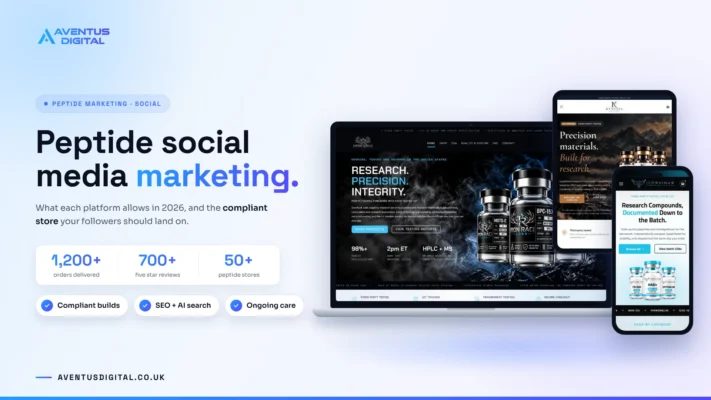
Peptide social media marketing: what each platform allows in 2026
Peptide social media marketing in 2026: what Meta and TikTok allow, what to post without [...]
Nov
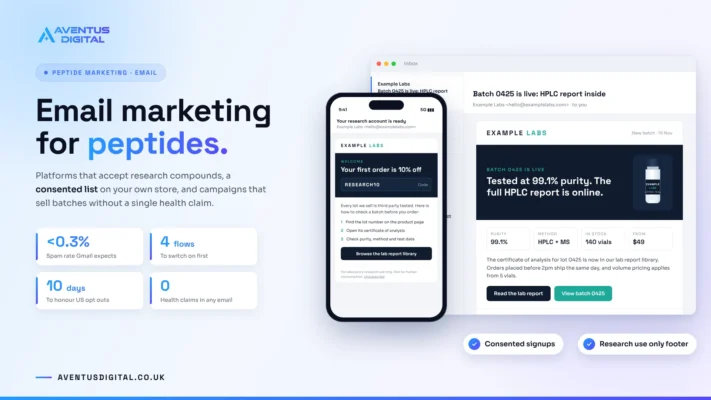
Email marketing for peptides: how research stores build a list that lasts
Email marketing for peptides: which platforms allow research compounds, how to build a consented list, [...]
Nov
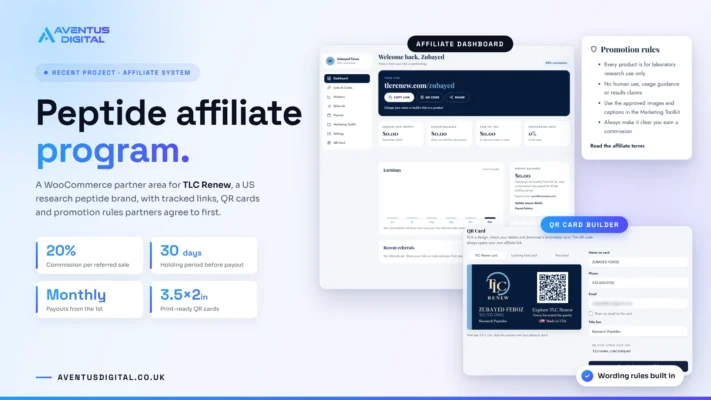
Peptide affiliate program: how to set one up without losing control
How to run a peptide affiliate program on WooCommerce: software, commission and cookie settings, wording [...]
Nov
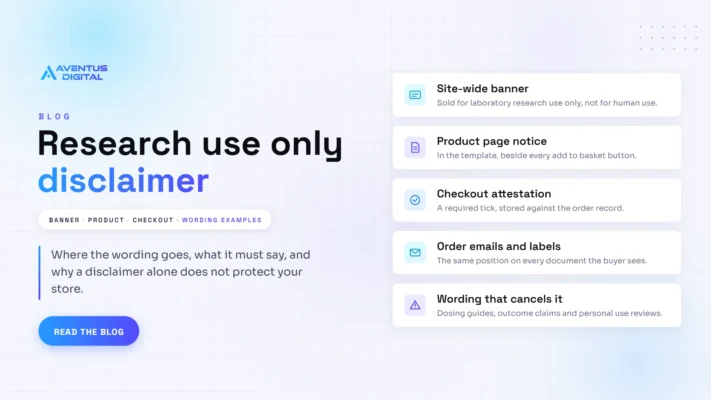
Research use only disclaimer: wording examples for peptide stores
A research use only disclaimer tells buyers a product is sold for laboratory research and [...]
Nov
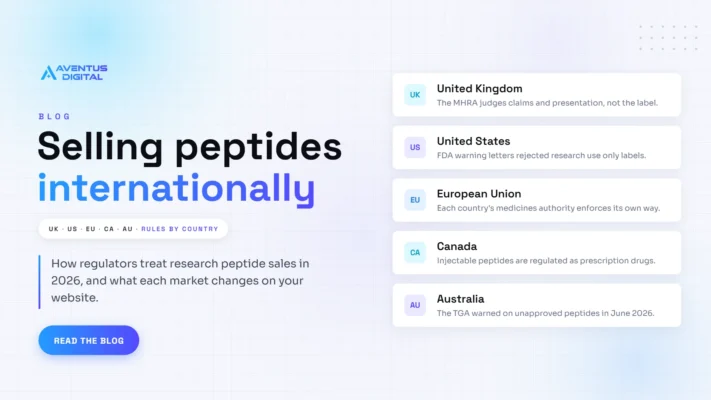
Selling research peptides internationally: rules by country
Research peptide rules are set country by country, and in 2026 regulators in the US, [...]
Nov
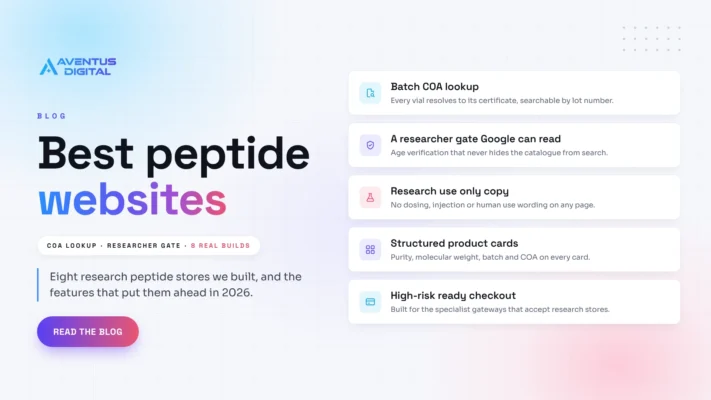
Best peptide websites in 2026
The best peptide websites in 2026 make purity something a researcher can check rather than [...]
Nov
Gym website guide: what yours needs, from a real 2026 build
What a gym website needs in 2026, from prices and class booking to coaches and [...]
Nov
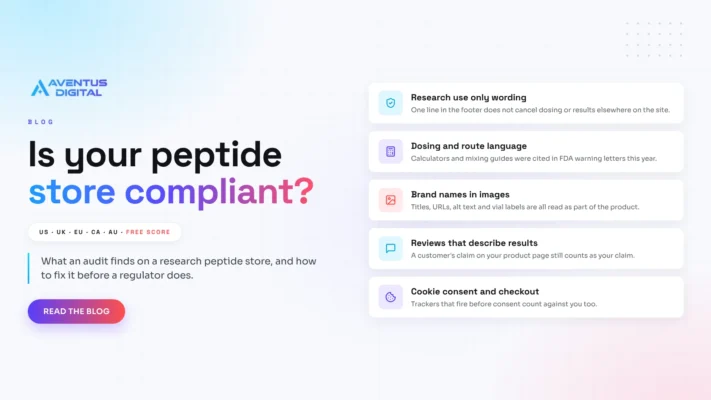
Is your peptide website compliant?
Peptide compliance means every part of a research peptide store, from product titles and vial [...]
Nov