
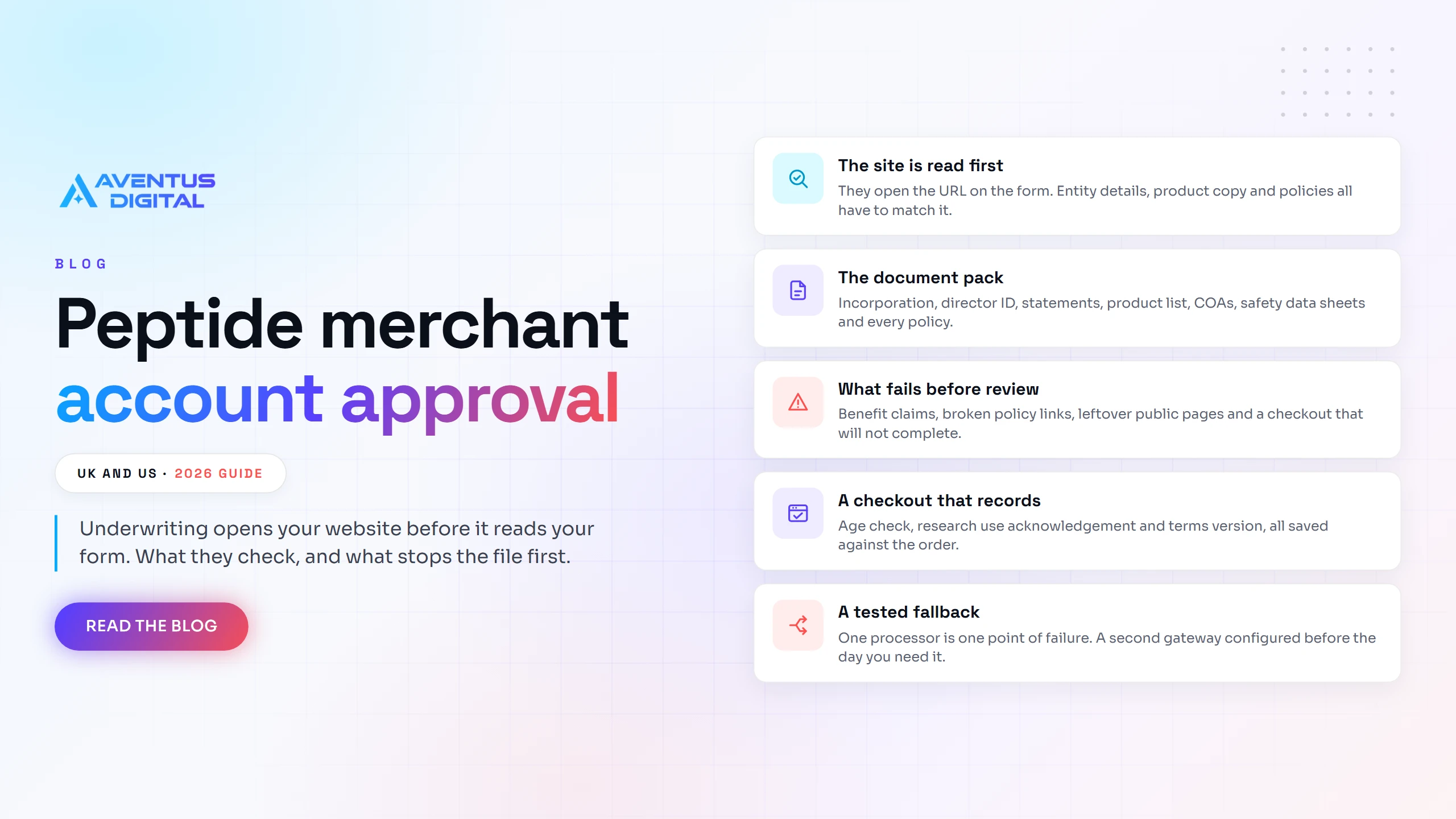
The peptide merchant account application pack that gets approved first time
Short answer: a peptide merchant account is won on evidence, not on wording. Underwriting opens your website before it reads your form, so the site has to match the application: real company details, a consistent research use only position, published COAs, working policies, an age check, and a checkout that records what the buyer agreed to.
On 23 September 2026 we pulled the public page list from five research supply stores we build or maintain. All five had a contact page and an FAQ. Four published terms, four a privacy policy, four a certificate of analysis archive. Two had a standalone research use only or compliance policy, and two a shipping and returns page. Only one of the five had the full set, and one published none of those documents at all. That last store is a weak application, and nothing to do with its catalogue: there is nothing on the site for an underwriter to read.
We are Aventus Digital, and we build and maintain WooCommerce stores for research peptide brands in the UK, the US and the EU, including Crew Labs, Zyvara Life and Solix Labs. Across 7 plus years we have delivered 600 plus websites in 40 plus countries, with 700 plus five star reviews behind us. We are the website partner, not your legal adviser and not a payments broker. Responsibility for your products, your claims and your regulatory position sits with you as the business owner.
Underwriting reads your website before it reads your peptide merchant account application
An application arrives as a form and a folder. The first thing the underwriter does is open the URL on the form and look at the store. They are not scoring your design. They are checking one thing: does the business described on the form exist on this website.
That test sits behind most of the declines we are asked to fix. The form says a limited company in Manchester, the footer says nothing at all. The form says research materials sold to laboratories, the product pages read like consumer wellness copy. None of it is fraud. It is a site that does not corroborate its own application.
- Legal entity name, company number and registered address in the footer and on the terms page, matching the application exactly.
- A real contact route, a business email on your own domain, and a billing descriptor the buyer will recognise on a statement.
- A catalogue that matches the product list in the pack, with nothing live that is not declared.
- Presentation consistent with research use everywhere, including the blog, the FAQ and text inside product images.
That last point is the one owners underestimate. In the UK, classification under the Human Medicines Regulations 2012, shown as up to date to 22 September 2026, turns on intent and presentation rather than on a label, and the MHRA takes the same view of website copy. In the US, the FDA has been issuing warning letters to online sellers where research use only labelling sits next to marketing that indicates human use, with letters to Gram Peptides in March 2026 and Wholesale Peptide in June 2026 both following a review of the company’s website. Those letters are published, so underwriters and customers can find them.
Where we come in: before anything is submitted we go through the store the way an underwriter would, from the URL inwards, and hand back the list in the order that will stop the file. That is the same pass as our free website audit, back within 48 hours and free.
The document pack, item by item, and what each one is for
Acquirers ask for different things, but the underlying questions are the same four: who are you, what are you selling, how do you prove it, and what happens when a customer complains. Build the folder around those.
- Certificate of incorporation, company number and proof of business address. Confirms the entity holding the account is the one named on the site.
- Photo ID and proof of address for every director and beneficial owner. Missing documents for a minority shareholder stall more files than a patchy trading history does.
- Three to six months of business bank statements, plus processing statements if you have them. They show the volume on the form is the volume you do.
- A full product list with SKUs, prices and quantities. Checked against the live catalogue. Anything on the site and not on the list is a problem.
- Certificates of analysis, by batch, each showing the batch reference and the date it was issued.
- Safety data sheets for the catalogue, which support the research use position in a way a disclaimer cannot.
- Your research use only policy, as a published page, stating who you sell to, what the material is not for, and the conditions of purchase.
- Terms, privacy, shipping and refund policies. All published, all reachable before payment, all consistent with each other.
- Supplier and fulfilment detail. Who manufactures, who stores, who ships and from where. Shipping from a third country changes the risk profile, so declare it.
- Projected monthly volume, average order value and chargeback history. Give the real numbers. Underwriting compares them with the catalogue and the statements.
Where we come in: everything in the pack has to agree with the website, and the published side is ours. We build the research use only policy, the terms, the shipping and refund pages and the COA archive as real pages with real URLs, so you can paste those links straight into the application. That is standard on every one of our peptide store builds.
| Checkpoint | What failsSeen on declined files | What passesWhat the reviewer needs | How Aventus builds itOn every peptide store |
|---|---|---|---|
| Business identity | No company details on the site, or a name and address that do not match the application form. | Legal entity, company number and registered address in the footer and on the terms page, identical to the form. | Entity details set once in the theme and pulled into the footer, terms and order emails, so they cannot drift apart. |
| Product page copy | Benefit language describing what a compound does in a person, usually inherited from a template or an old supplier feed. | Identity, purity, batch, format and storage. Nothing about effects, use or outcomes. | A fixed product template with the specification fields, so a new product cannot be published with claim copy in it. |
| Research use only position | A single line in the footer, contradicted by the blog, the FAQ or consumer facing marketing elsewhere on the site. | A published policy page, repeated in the product template and at checkout, consistent with every other page. | The policy page, the template notice and the checkout wording written as one set, then checked across the whole site. |
| Proof of quality | COAs promised in the copy but not published, or a single PDF covering an unnamed batch. | An archive organised by batch, each document showing the batch reference and the date it was issued. | A COA archive with the batch reference and date in the file name and a link from every product page. |
| Checkout record | No age check, no acknowledgement, or a tick box that is displayed and then never stored. | Age confirmation, a required research use acknowledgement and a separate terms acceptance, all saved against the order. | Acknowledgement and terms version written to the order meta and shown on the WooCommerce order screen for representment. |
| Policy set | Footer links to a 404 or a placeholder, or policies naming a different company or country. | Terms, privacy, shipping and refunds published, reachable before payment, and consistent with each other. | Policy pages built with real URLs you can paste into the application, and link checks on every maintenance pass. |
| Payment continuity | One gateway, no alternative, and no way to take an order the day an account is paused. | A tested fallback card gateway and a non card method, both configured before they are needed. | Fallback gateway configured and left disabled, a bank transfer method wired in, and both re tested every month. |
| Checkpoints reflect what acquirers and their reviewers have asked for on builds we have prepared, as at 23 September 2026. Criteria are set by each acquirer and differ between them. This is website guidance, not legal advice. Responsibility for your products, claims and regulatory position sits with you as the business owner. | |||
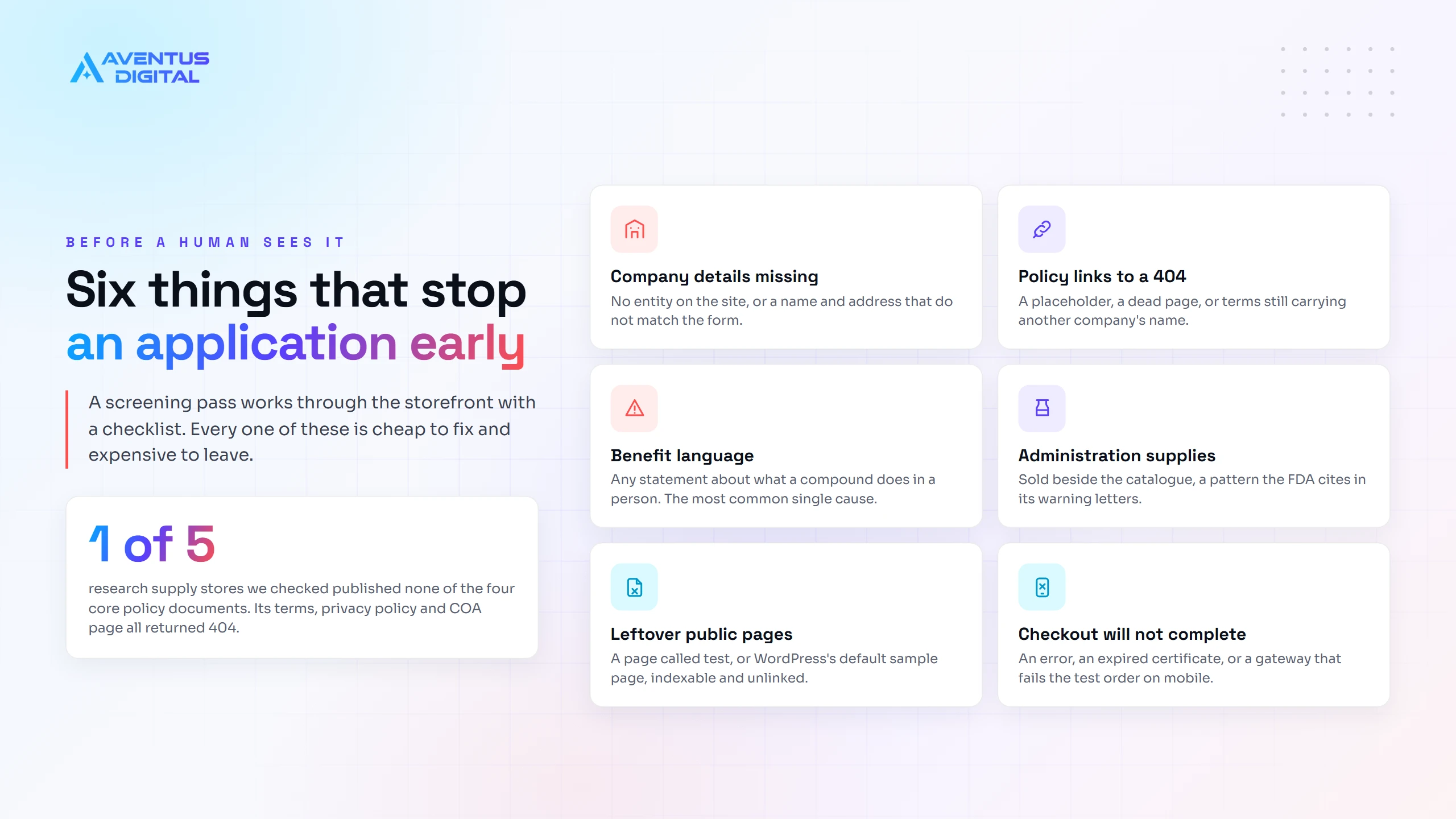
The site features that fail an application before a human sees it
Some checks happen before underwriting proper. A screening tool, or an analyst with four minutes and a checklist, works through the storefront and marks the obvious failures. Cheap to fix, expensive to leave.
- No company details anywhere on the site, or details that do not match the application.
- Policy links in the footer that lead to a 404, a placeholder, or a page still carrying another company’s name.
- Benefit language on product pages, meaning any statement about what a compound does in a person. The most common single reason a peptide store is declined, and usually inherited from a template.
- Administration adjacent supplies sold beside the catalogue, a pattern the FDA cites in its letters.
- Leftover pages in the public list. On two of those five stores we found one each, a page called test on one and WordPress’s default sample page on the other. Neither was in a menu, both were public and indexable.
- Checkout errors, an expired certificate, or a gateway that fails on mobile. If the analyst cannot complete a test order, the file goes back.
Where we come in: every item on that list makes a store harder to read, and this is what a rebuild is for. Our website redesign work on an inherited peptide store starts with the public page list, the footer, the policy set and the product copy, before a single visual decision gets made. Where the store is sound and only the upkeep has slipped, website maintenance from £49 a month keeps the page list clean and the checkout tested.
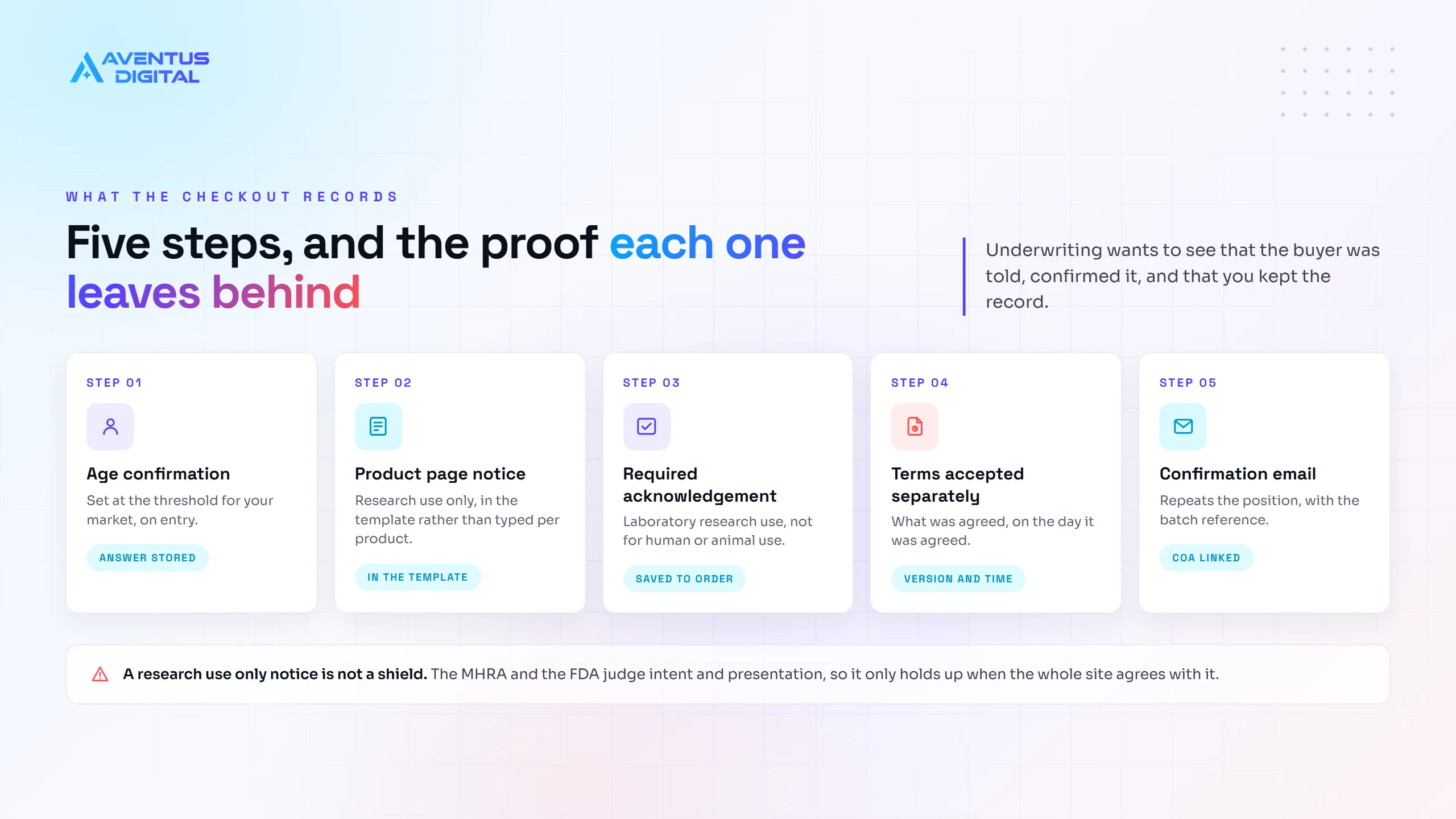
The checkout sequence underwriters expect to find, and what it records
The checkout is where an application is either evidenced or exposed. Underwriting wants to see that the buyer was told what they were buying, confirmed it, and that you kept the proof. In WooCommerce that is five steps.
- Age confirmation on entry, set at the threshold for your market, with the answer stored rather than shown once and forgotten.
- A research use only notice on the product page itself, placed in the template rather than typed into each description, where it eventually gets missed.
- A required acknowledgement at checkout, confirming the buyer is purchasing for laboratory research use and not for human or animal use, saved against the order.
- Terms accepted separately, with the version and timestamp stored, so you can show what was agreed on the day.
- An order confirmation email that repeats the position, with the batch reference and a link to the COA for that batch.
The record is the part that counts in a dispute. When a chargeback arrives, the stored acknowledgement, the terms version, the delivery confirmation and the COA link are your representment evidence, and dispute ratios feed straight back into your standing with the acquirer.
Be clear about what the wording does. A research use only notice is not a shield. Both the MHRA and the FDA judge intent and presentation, so it only holds up when the whole site agrees with it: copy, imagery, FAQ, blog, and what you sell alongside the catalogue.
Where we come in: we build that sequence into the store rather than stacking plugins on top of it, so it survives updates. Our ecommerce website builds write the acknowledgement to the order meta and show it on the WooCommerce order screen, which is where you will need it.
The fallback gateway, and why one processor is a single point of failure
Approval is not the finish line. High-risk accounts get reviewed, reserved against and occasionally closed, and when the only gateway stops, the store stops with it. We set out the economics of that in our comparison of peptide payment processors, with published rates and reserve terms and the date each was checked.
Two things protect trading. A second card gateway, configured, tested and switched off, so a live account can be enabled the same day. And a non card method, usually bank transfer or pay by bank, with clear instructions and automatic order status updates. Both take an afternoon while the site is healthy, and both are close to impossible to arrange in the week an account closes.
One thing not to do: splitting volume across two accounts to keep each under a threshold. That is misrepresentation to both acquirers, and a termination for it can put the business on the card scheme terminated merchant file, where a listing lasts five years.
Where we come in: we set the fallback up during the build and test it again on every maintenance pass, because an untested gateway is not a fallback, it is a guess.
What to fix, in what order, before you reapply
After a decline the instinct is to look for a friendlier processor. Fix the file first: the same pack goes to the next acquirer, and the same website gets opened.
- One. Remove every benefit claim from product pages, category pages, the FAQ, the blog and image text.
- Two. Put the legal entity, company number and registered address in the footer and on the terms page, matching the application.
- Three. Publish the missing policies as real pages: research use only, terms, privacy, shipping and refunds.
- Four. Publish the COA archive by batch, with the batch reference and date in the file name.
- Five. Build the age check and the checkout acknowledgement, then confirm the acknowledgement is saved to the order.
- Six. Clean the public page list, fix every broken link, and complete a test order on a phone.
- Seven. Rebuild the pack so every figure matches the statements and the catalogue, then resubmit as the same company, disclosing the earlier decline if asked.
Work through those in order and the second application is a different document, because the website behind it is a different website.
What we build into every peptide store
Every store we hand over is built to be read by an underwriter as well as by a customer. Included as standard:
- Company details, full policy set and research use only policy as published pages with clean URLs.
- A product template carrying a fixed research use position, the batch reference and the COA link, and a COA archive that stays organised as batches are added.
- Age confirmation and a recorded checkout acknowledgement stored on the order.
- Primary and fallback gateways configured and tested, plus a non card method.
- SEO, GEO and AEO built in from day one, and a handover pack with the links your application asks for.
Builds start at £399 and full custom stores from £1,999, fixed price and quoted before work begins, with maintenance from £49 a month. Most stores go live in two to three weeks. The full specification sits on our peptide websites page.
Peptide and research supply ecommerce
Get a quote for a compliant RUO peptide website
See the builds, the full specification and what is included, then request a fixed price quote. If you already have a site, send us the URL and we will tell you what is triggering the declines before you spend anything.
Fixed price from £399. Website work only: we do not arrange or guarantee payment processing.
Applying soon and unsure what the underwriter will see? Take the free website audit and we will send the list back within 48 hours. If the store needs rebuilding first, our website redesign route starts from the page list and the policy set. Starting from nothing, ask for the free 72 hour homepage mockup.
You Might Also Like
- Peptide websites: how we build and maintain research peptide stores, with pricing.
- Peptide payment processors compared: published rates, reserves and approval odds, dated.
- Getting approved for payments: the eight checkpoints underwriting works through.
- Building a compliant peptide website: the full build guide for 2026.
- Free website audit: what an underwriter sees on your store, back within 48 hours.

Author
Zubayed Feroz
Founder of Aventus Digital
General website guidance, not legal or financial advice. Requirements vary by product and jurisdiction and they change, so take advice from a qualified solicitor on your own catalogue. Underwriting criteria are set by individual acquirers: we do not arrange or guarantee payment processing. Named services are referenced for comparison only, correct to the best of our knowledge on the date below.
Published 26 September 2026. Last reviewed 26 September 2026.
Frequently Asked Questions
How do I get a peptide merchant account?
You apply to a high-risk acquirer, either directly or through an ISO, with a document pack and a live website that agrees with it. Get the site right first: entity details, a published research use only policy, the full policy set, a COA archive and a recorded checkout. Then submit the pack. Underwriting criteria are set by each acquirer, and we do not arrange or guarantee payment processing.
What do underwriters check on a peptide website?
Whether the website is the business described on the form. In practice that means company details that match, product copy with no benefit claims, a research use only position that holds across every page, published COAs, a complete policy set that works before payment, and a checkout that records the buyer’s acknowledgement. Our guide to getting approved for payments walks through the checkpoints one by one.
Why was my application declined?
Most of the declines we are asked to fix come down to the website contradicting the form. Benefit language on product pages is the most common single cause, followed by missing or broken policy pages and company details that do not match the applicant. Acquirers rarely give a detailed reason, so read the decline as a prompt to review the store rather than the catalogue.
How long does approval take?
It varies by acquirer and by how complete your pack is. On the builds we prepare, the delay is almost never the underwriter reading slowly, it is a missing document or a site change that has to be made mid review. Submitting a complete pack against a finished website is the only part of the timeline you control.
What is a rolling reserve and how long is it held?
A rolling reserve is a percentage of your settlements held back by the acquirer as cover against chargebacks and refunds, then released after a set period. Published examples sit around 5% to 10% held for 90 to 180 days, with the figures and dates set out in our comparison of peptide payment processors. Your own terms are set at underwriting and can be reviewed after a clean trading period.
Can I reapply after a decline?
Yes, as the same company, with the problems fixed and the earlier decline disclosed if you are asked about it. Reapplying under a different name or entity to get past screening is misrepresentation, and a termination recorded on the card scheme terminated merchant file lasts five years and follows the business and its directors. Fix the site and the pack, then go again.
Does a research use only notice protect my application?
Not on its own. The MHRA in the UK and the FDA in the US both assess intent and presentation, not the label, so a notice sitting above consumer facing copy weakens the file rather than saving it. The notice works when the whole site agrees with it, which is a build decision rather than a wording decision. This is website guidance and not legal advice: take advice from a qualified solicitor on your own catalogue.
Related Blogs
Which Hosting Is Best for Peptide Websites?
Short answer: Hostinger is what we put research peptide stores on, and our link takes [...]
Oct
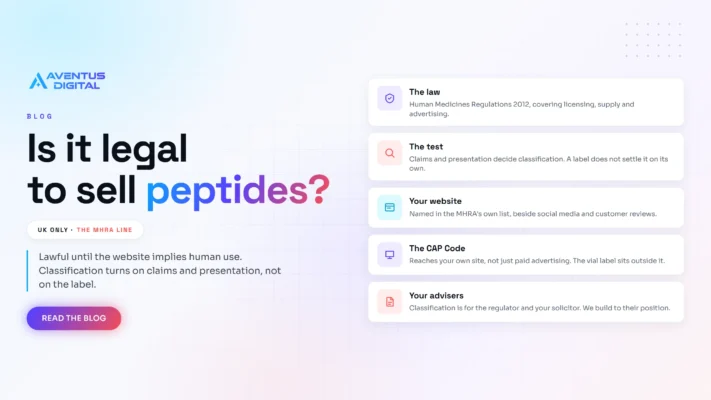
Is It Legal to Sell Research Peptides in the UK? The MHRA Line, Explained for Store Owners
Short answer: selling research peptides in the UK is lawful in itself, and it stops [...]
Oct
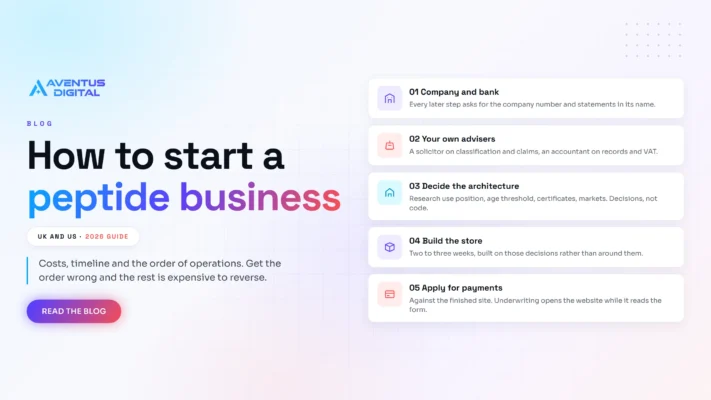
How to Start a Peptide Business in 2026: Costs and Steps
Short answer: to start a peptide business you register the company, open the bank account, [...]
Oct
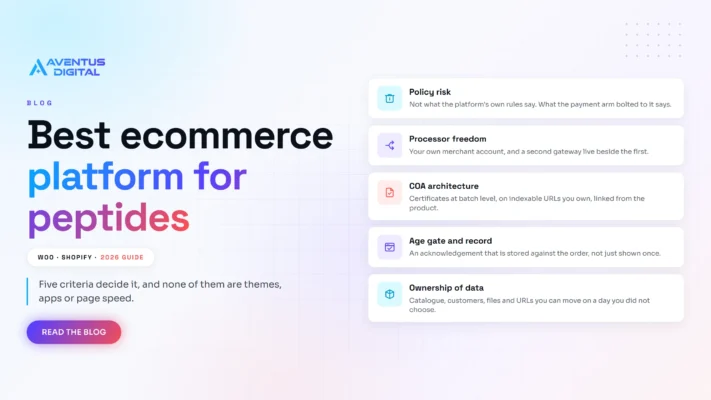
Best Ecommerce Platform for a Peptide Store (2026)
Short answer: the best ecommerce platform for peptides is a self-hosted WooCommerce store. Hosted platforms [...]
Oct
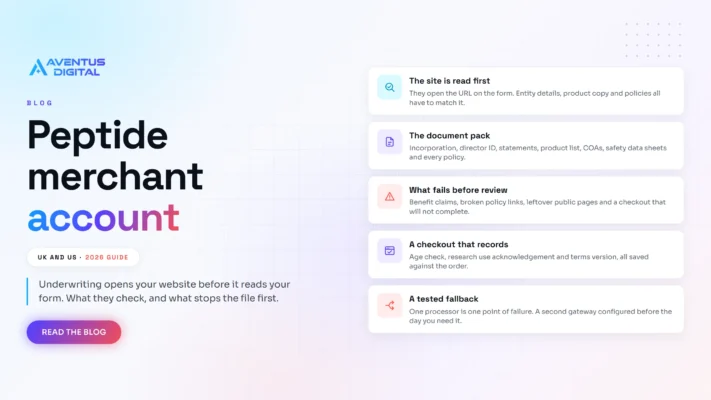
The peptide merchant account application pack that gets approved first time
Short answer: a peptide merchant account is won on evidence, not on wording. Underwriting opens [...]
Sep
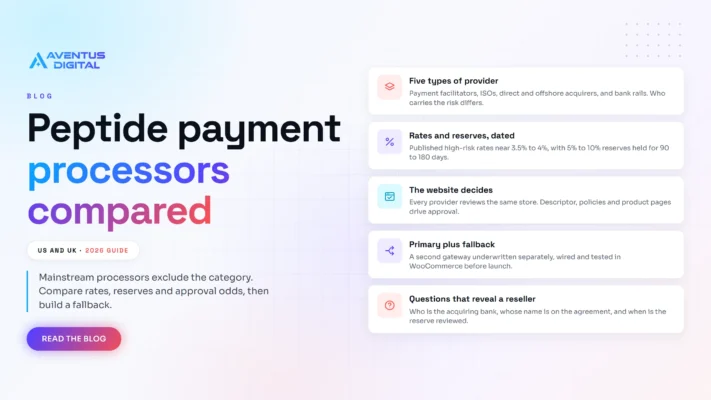
Peptide Payment Processors Compared: US and UK 2026
Short answer: mainstream processors such as Stripe, PayPal and WooPayments exclude the category, so a [...]
Sep
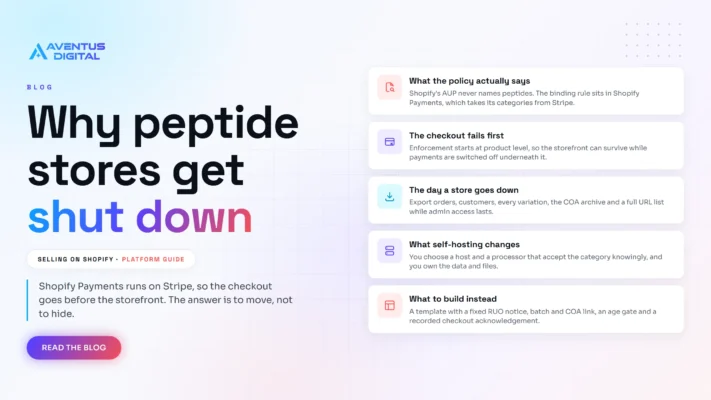
Selling Peptides on Shopify: Why Stores Get Shut Down
Short answer: not for long. You can open a store and sell peptides on Shopify, [...]
Sep
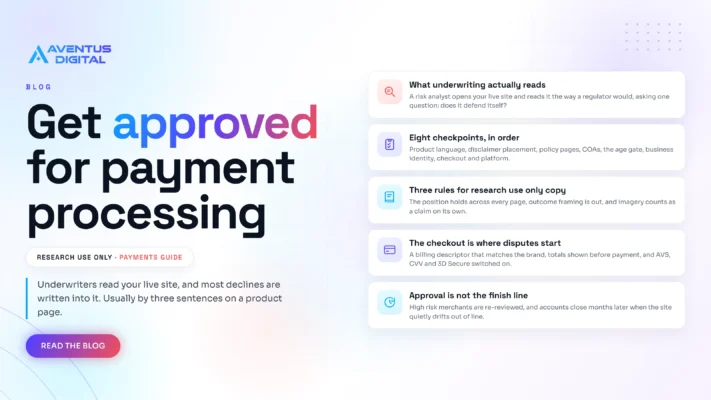
Peptide website compliance and how to get approved for payments
Short answer: peptide website compliance is decided on four things. A research use only position [...]
Sep