
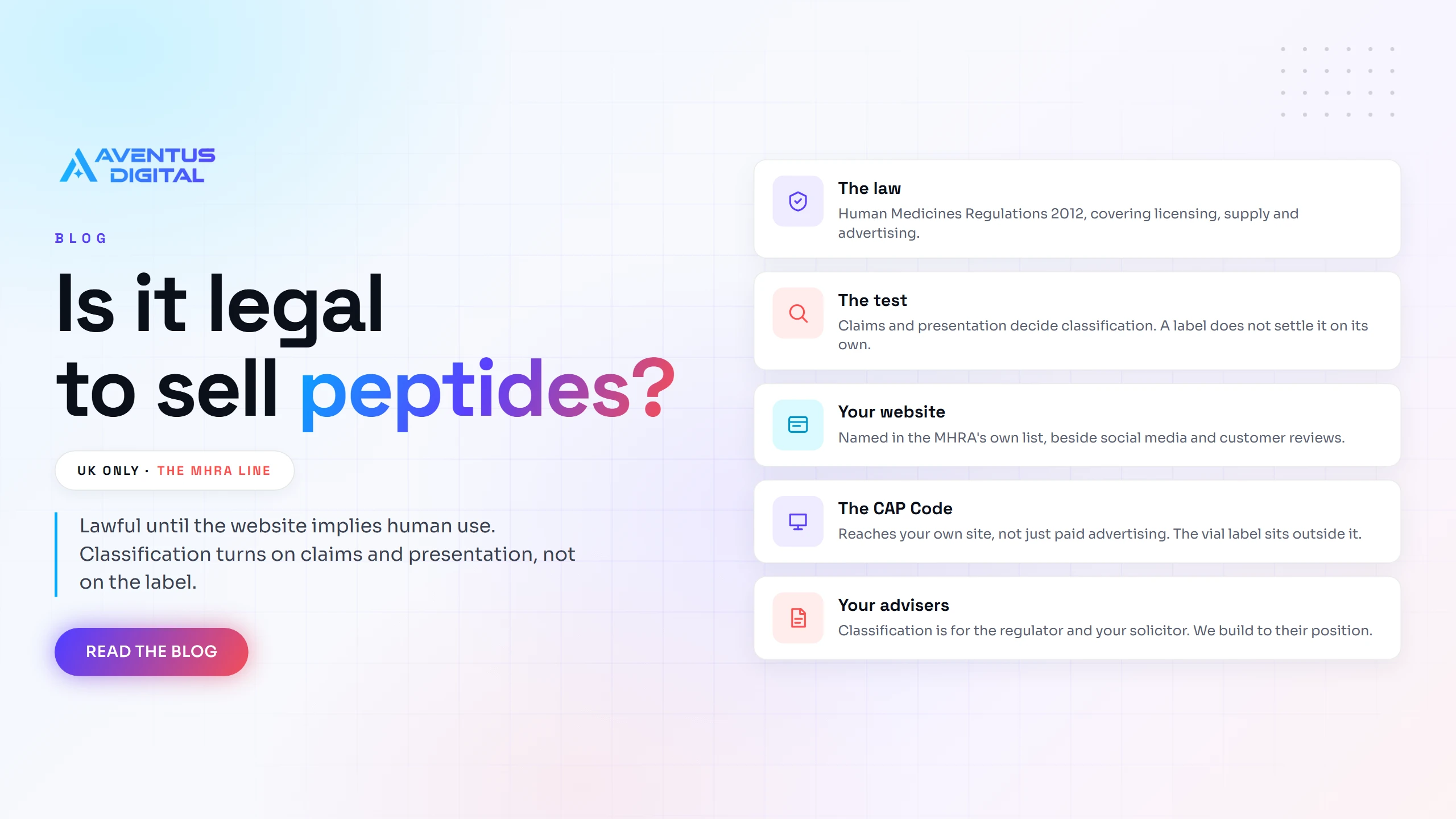
Is it legal to sell research peptides in the UK? The MHRA line, explained for store owners
Short answer: selling research peptides in the UK is lawful in itself, and it stops being lawful the moment your website presents a product as treating, preventing or diagnosing something in people. The MHRA decides classification on claims and presentation rather than on the label, so your site copy is the exposure.
On 6 October 2026 we read the public product data on the five research supply stores we build or maintain. Between them they publish 113 products, and 97 of those product descriptions carry a research use only statement. Of the rest, one store carries no such statement on any of its 14 products, and on another store two products out of 28 went live without one. Nobody chose that. It is what happens when the wording sits in the description rather than in the template.
We are Aventus Digital, and we build and maintain WooCommerce stores for research peptide brands in the UK, the US and the EU, including Crew Labs, Zyvara Life and Solix Labs. Across 7 plus years we have delivered 600 plus websites in 40 plus countries, with 700 plus five star reviews behind us. This post explains what the UK regulators say and what it means for how a store is built. We are the website partner, not your legal adviser, and responsibility for your products, your claims and your regulatory position sits with you as the business owner.
Is it legal to sell peptides in the UK? What the Human Medicines Regulations 2012 test
The question almost never turns on the substance in the vial. It turns on what your website says the substance is for. The Human Medicines Regulations 2012 (SI 2012/1916) govern the licensing, supply and advertising of medicinal products in the UK. If a product is a medicinal product, supplying it without a marketing authorisation is unlawful, and whether it is one is a classification question rather than a labelling question.
The MHRA publishes the factors it weighs. Its borderline products guidance, last updated on 2 July 2026, says the agency looks at:
- “the claims about what the product does (explicit and implicit)”
- “the pharmacological, metabolic or immunological properties of the ingredients”
- “the primary intended purpose of the product or the manner in which it would be used”
- “whether there are any similar licensed or registered products on the market”
- “how it is presented to the public through labelling, packaging, promotional literature, advertisements, websites, social media and customer reviews”
Read that last factor twice, because it is the whole post. Websites, social media and customer reviews are named in the regulator’s own list, as at 2 July 2026. Your product page is evidence. So is the review a customer left on it, and so is the caption under the photo you posted in March. The guidance is explicit that classification is decided case by case, and the MHRA runs a borderline advice route for exactly that: if you want a view on your own catalogue, the regulator is the place to ask, and the guidance explains how.
Where we come in: we build the site so that the position your solicitor gives you is the position every page states, which is why our peptide store builds start with the architecture conversation and not with a colour palette.
Presentation and intent, not the label
The most expensive belief in this sector is that a line of small print at the bottom of a product page settles the question. It does not. It is one input among several, and it only carries weight when everything around it agrees with it. A page that says research use only at the bottom and implies a human outcome at the top has not protected itself. It has documented the contradiction, in public, on a URL anyone can read, including an underwriter and a regulator.
This is why we treat the research use position as a structural field rather than a sentence someone remembers to paste. The audit above is the proof: four of the five stores carry the statement on every product, and the two gaps we found were both in stores where the wording lives in free text. Put it in the template and the gap cannot happen.
Here is what the presentation test looks like in practice, element by element, for a UK store.
| Website element | What reads as a contradictionThe pattern we are called in to fix | What reads consistentlyThe same position everywhere | How Aventus builds itOn every peptide store |
|---|---|---|---|
| Product title and description | A benefit statement inherited from a supplier feed or a template, with a research use line added at the bottom of the page. | Specification, purity, batch reference and intended research context only, with the position stated in the same place on every product. | The research use position and the batch reference are fields in the product template, so no product can publish without them. |
| Category and navigation naming | Menu labels and collection names borrowed from consumer wellness retail, which frame the catalogue before a visitor reads a word of copy. | Categories named by compound class, format or research area, so the navigation says the same thing the product pages say. | We name categories with you at the architecture stage and keep the URLs stable, because renaming them later costs redirects and rankings. |
| Customer reviews and testimonials | Published reviews describing personal use and outcomes, sitting directly under a research use only product. The MHRA names customer reviews in its own list of what it reads. | Reviews moderated before publication, on service, delivery and documentation, with anything describing human use left unpublished. | Reviews are set to manual approval, with a written moderation rule handed over so whoever runs the store applies it the same way every time. |
| Educational content and blog | Articles written for search volume that drift into outcomes, dosing or protocols, then link straight to a buy button. | Content about handling, storage, documentation, certificates and laboratory practice, with no outcome framing and no route from a claim to a basket. | We plan the content around questions the store can answer safely, and SEO, GEO and AEO are built into those pages from day one. |
| Images, artwork and PDFs | A claim that was cut from the copy surviving inside a banner graphic, a packaging render or an uploaded document, where nobody reviews it again. | Every asset reviewed on the same terms as the copy, because a PDF on your domain is as public as a paragraph. | Image and document review is part of handover, and the certificate archive is the only place documents are published. |
| Policy pages and URLs | Terms and privacy missing or buried in a page builder block, with no standalone research use policy to point anyone at. We found two of our five stores publishing a dedicated research use or compliance policy, and one publishing 13 pages with no terms page at all. | Terms, privacy, shipping, returns and a research use policy, each a real page on a clean URL you can paste into any form or application. | The full policy set is part of the build, published as real pages, with the registered company name, number and address on them. |
| Age confirmation and checkout record | An age popup that sets a cookie and proves nothing, with no record of what the buyer agreed to when they ordered. | A threshold and an acknowledgement the buyer actively gives, stored against the order so the record exists months later. | Age confirmation and a required checkout acknowledgement, both written to the order record rather than to the browser. |
| The MHRA factors quoted above are from its borderline products guidance as last updated on 2 July 2026, and classification is decided case by case, so confirm the current position before you rely on it. Nothing here tells you what you may sell or supply: that is for the regulator and your own solicitor. This is website guidance, not legal advice. Responsibility for your products, claims and regulatory position sits with you as the business owner. | |||
Where we come in: an inherited store usually fails the consistency test in three or four places at once, which is why our free website audit comes back within 48 hours with the list in that order, and a website redesign starts with the product template rather than the homepage.
Do ASA rules reach your own website? Yes, and this is the clause
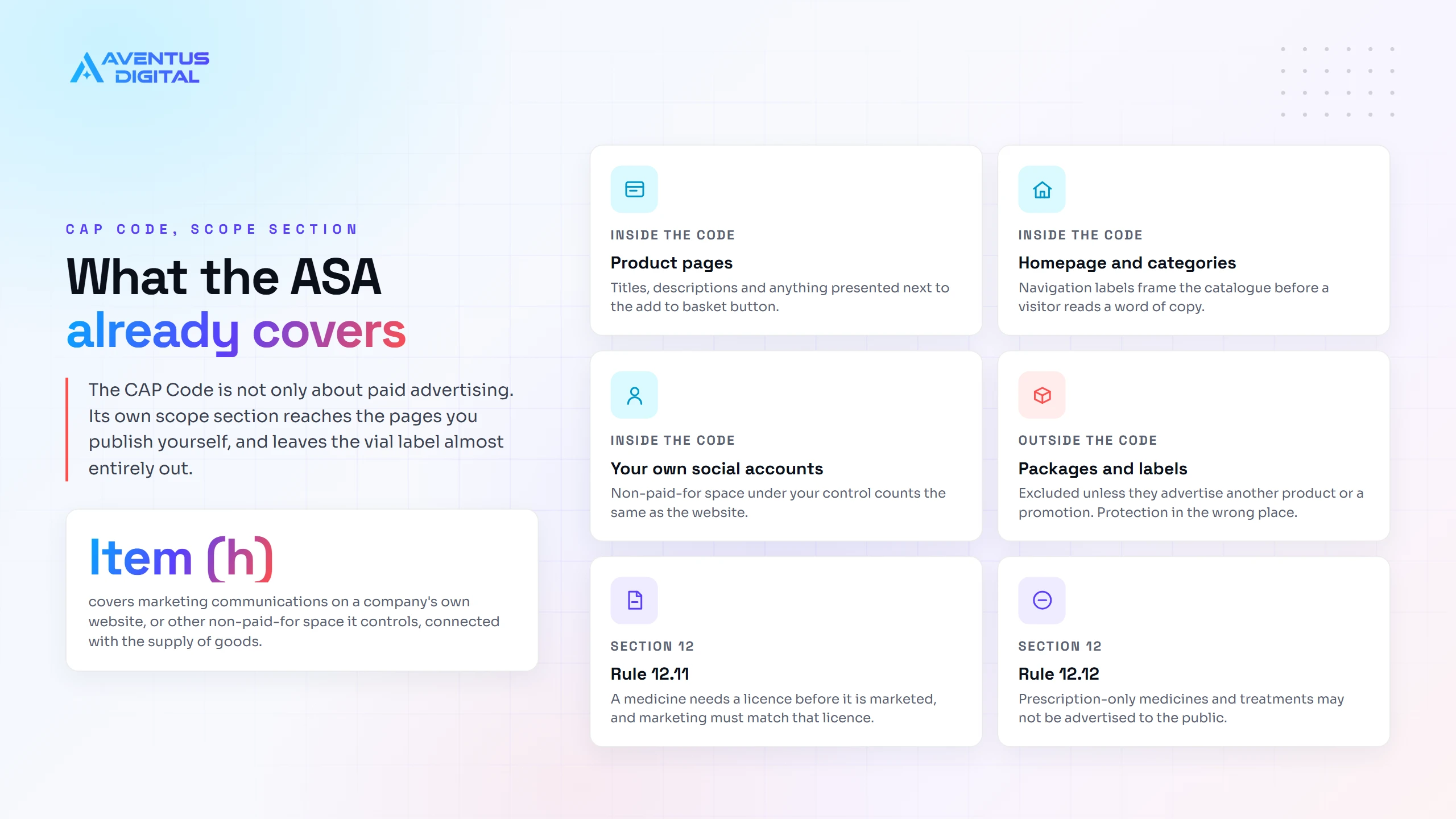
Owners often assume the Advertising Standards Authority only looks at paid advertising. The CAP Code sets out its own scope, and item (h) covers “advertisements and other marketing communications by or from companies, organisations or sole traders on their own websites, or in other non-paid-for space online under their control, that are directly connected with the supply or transfer of goods, services, opportunities and gifts”. Your product pages are inside that. So is your homepage, and so are your own social accounts.
The same scope section says the Code does not apply to “packages, wrappers, labels, tickets, timetables and price lists unless they advertise another product or a promotion”. That is worth sitting with for a second. The physical label on the vial is largely outside the CAP Code. The page selling it is inside. Anyone whose compliance plan rests on the label has put their protection in the one place the advertising rules do not reach.
Section 12 of the CAP Code is the medicines section, and three rules matter most to a store like yours:
- Rule 12.11. Medicines “must have a licence from the MHRA, VMD or under the auspices of the EMA before they are marketed”, and marketing must conform to that licence. No licence means no medicinal claim, in any wording.
- Rule 12.2.1. Marketing communications for medicinal products must not offer to “provide a diagnosis or suggest a treatment by correspondence”. Live chat, contact forms and direct messages are correspondence.
- Rule 12.12. “Prescription-only medicines or prescription-only medical treatments may not be advertised to the public.” That rule bites on how a page is framed, not on what you believe the product is.
ASA rulings are published and indexed, which is the part owners miss. A ruling against your domain is a public document that a processor, a competitor or a journalist can find in one search, and it will outlive the campaign that caused it. We have written about what underwriting reads in our post on the merchant account application pack, and a published ruling is the kind of evidence that ends an application quietly.
Where we come in: the moderation rules, the content plan and the contact page wording are all build decisions on our ecommerce website projects, and website maintenance from £49 a month is where they stay enforced after launch.
What this means for how the store is built, template by template
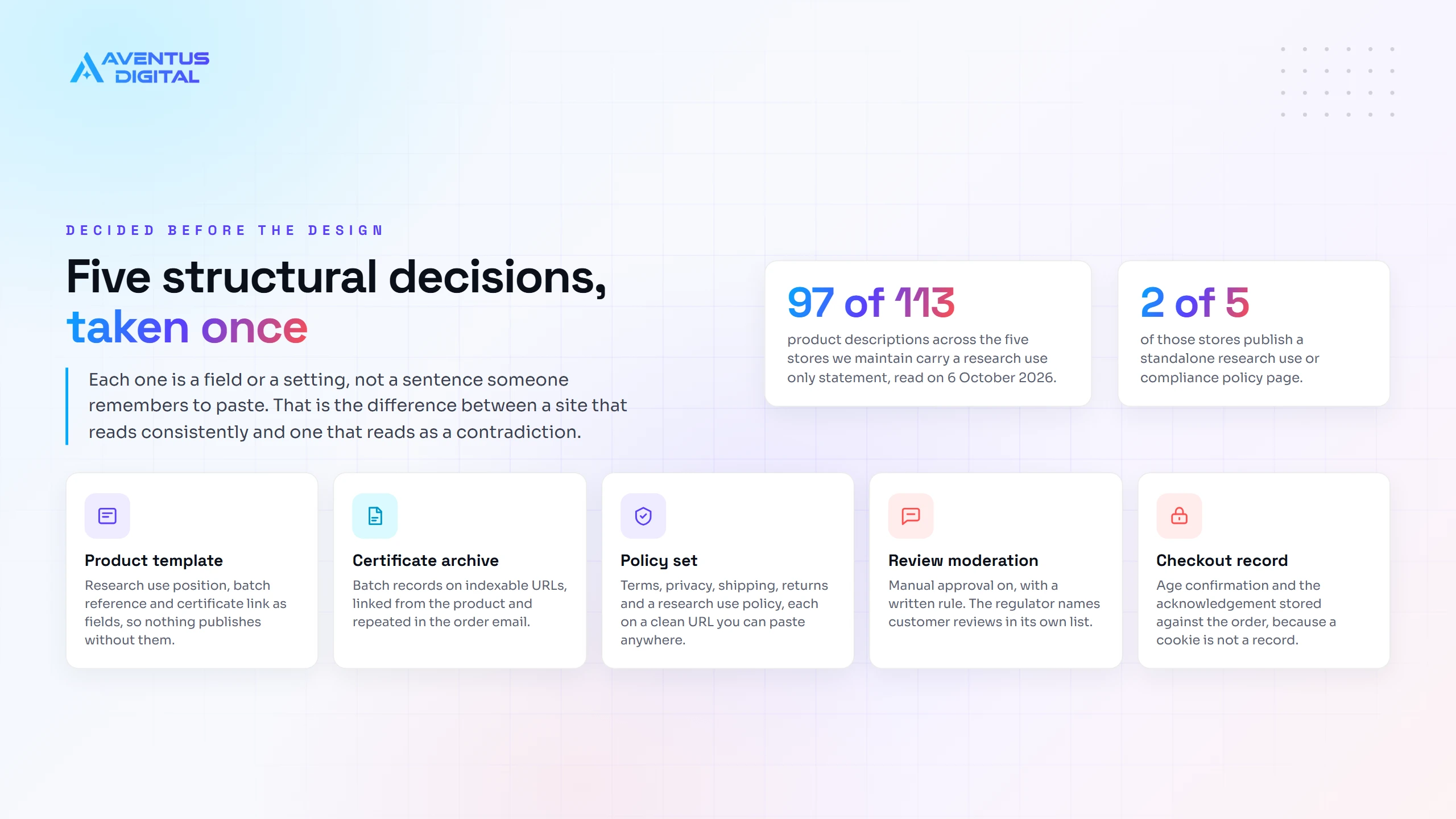
Everything above lands in the same place: a small number of structural decisions, taken once, that make the whole site say one thing. This is the list we work through on a UK build.
- The product template. Research use position, batch reference and a link to that batch’s certificate as fields, not free text. This is the single change that closes the gap our audit found.
- The certificate archive. Batch records on indexable URLs, linked from the product and repeated in the order email, so documentation is part of the presentation rather than an attachment nobody can find.
- The policy set. Terms, privacy, shipping, returns and a standalone research use policy, each on its own clean URL. Only two of the five stores we looked at on 6 October 2026 publish a dedicated research use or compliance policy page, and four of five publish terms and privacy. One publishes 13 pages with none of the three.
- Review moderation. Manual approval on, with a written rule about what gets published. The regulator names customer reviews in its own list, so an open review form is an open door.
- Age confirmation and the checkout record. Stored against the order, because a cookie is not a record.
None of that is cosmetic and none of it is quick to retrofit, which is why we take these decisions before the design. If you are at the start, the order to do things in is set out in our guide to starting a peptide business, and the full build specification is in how to build a compliant peptide website in 2026.
Where we come in: every item on that list is standard on an Aventus peptide build, and the free 72 hour homepage mockup shows you the direction before you commit anything.
Where website work ends and legal advice begins
We will not tell you whether your catalogue is lawful, because nobody honest can tell you that from the outside. Classification is decided case by case, on your products and your presentation, and the only two people whose view counts are the regulator and your own solicitor. What we can do is make sure the website is not the thing that answers the question for you.
Three other UK bodies sit around this:
- The MHRA on medicines, including advertising. Its guidance on advertising medicines, last updated on 11 April 2025, states that a breach of the medicine advertising regulations “is a criminal offence with a possible penalty of a fine and imprisonment for up to 2 years”, and that the agency can require an advert to be amended, withdrawn or corrected.
- Trading Standards and the Competition and Markets Authority on misleading commercial practices. The protection from unfair trading provisions now sit in Part 4 of the Digital Markets, Competition and Consumers Act 2024, which restated the 2008 regulations from 6 April 2025. The CMA’s own guidance, CMA207, was published on 4 April 2025 and updated on 18 November 2025, and it covers misleading actions and misleading omissions, which is exactly what an inconsistent product page is.
- The Information Commissioner’s Office on data. Registration, the privacy policy and what you actually collect at checkout have to match each other.
Take your own legal advice on where your catalogue sits, ask the MHRA where you want a regulator’s view, and treat the website as the place that reflects those answers rather than the place that invents them.
Where we come in: we give you the website side in writing, so your solicitor can read what the site states and tell you whether it matches the position they have advised. The payment side of the same problem is covered in our post on compliance and payment approval.
What every Aventus peptide store includes
Built to be read by a regulator, an underwriter and a customer:
- A product template carrying a fixed research use position, the batch reference and a link to that batch’s certificate.
- A certificate archive organised by batch, on indexable URLs, that stays organised as batches are added.
- The full policy set plus a standalone research use policy, published as real pages with clean URLs and your registered company details on them.
- Age confirmation and a required checkout acknowledgement, both stored against the order.
- Review moderation set to manual approval, with a written rule for whoever runs the store.
- SEO, GEO and AEO built in from day one, and a handover pack with the links an application or a query will ask you for.
Builds start at £399 and full custom stores from £1,999, fixed price and quoted before work begins, with peptide store maintenance from £49 a month. Most stores go live in two to three weeks.
Peptide and research supply ecommerce
Get a quote for a compliant RUO peptide website
See the builds, the full specification and what is included, then request a fixed price quote. If you already have a site, send us the URL and we will tell you what is triggering the declines before you spend anything.
Fixed price from £399. Website work only: we do not arrange or guarantee payment processing.
If you already have a store and you are not sure what it currently says about itself, the free website audit comes back within 48 hours with the contradictions listed in the order they matter. If the answer is a rebuild, our website redesign route starts at the product template. If you are building from nothing, ask for the free 72 hour homepage mockup and you will see the direction before you spend anything.
You Might Also Like
- Peptide websites: how we build and maintain research peptide stores, with pricing.
- Building a compliant peptide website: the full build specification for 2026.
- How to start a peptide business: the order of operations, with real costs and a timeline.
- The merchant account application pack: what underwriting reads before it reads your form.
- Best ecommerce platform for peptides: the five criteria that decide the platform, scored.

Author
Zubayed Feroz
Founder of Aventus Digital
General website guidance, not legal or regulatory advice. Requirements vary by product and jurisdiction and they change, so take advice from a qualified solicitor on your own catalogue. Underwriting criteria are set by individual acquirers: we do not arrange or guarantee payment processing. Named services are referenced for comparison only, correct to the best of our knowledge on the date below.
Published 6 October 2026. Last reviewed 6 October 2026.
Frequently Asked Questions
Is it legal to sell research peptides in the UK?
Selling research materials to laboratories and institutions is lawful in itself. What makes it unlawful is presenting a product as a medicine without a marketing authorisation, and under the Human Medicines Regulations 2012 that is judged on claims and presentation rather than on a label. Classification is decided case by case, so take advice from a solicitor on your own catalogue and ask the MHRA where you want a regulator’s view. Our part is making sure the website states the position you have been advised to take.
What does the MHRA actually say?
Its borderline products guidance, last updated on 2 July 2026, lists what it weighs: the claims made about the product, the properties of the ingredients, the primary intended purpose, whether similar licensed products exist, and “how it is presented to the public through labelling, packaging, promotional literature, advertisements, websites, social media and customer reviews”. Websites, social media and customer reviews are named by the regulator itself, which is why we treat the product template and the review settings as compliance architecture rather than marketing.
Does a not for human consumption label protect me?
Not on its own, and anyone selling it to you as protection is wrong on the facts. It is one input among several, and it only holds when the whole site agrees with it. A page that carries the line at the bottom and implies a human outcome at the top has recorded a contradiction on a public URL. The label is also largely outside the CAP Code, which does cover your product pages, so it is protection in the one place the advertising rules do not look.
Do ASA rules apply to my own website?
Yes. The CAP Code’s scope covers “advertisements and other marketing communications by or from companies, organisations or sole traders on their own websites, or in other non-paid-for space online under their control, that are directly connected with the supply or transfer of goods”. That is your product pages, your homepage and your own social accounts. Section 12 then sets the medicines rules, including that medicinal claims need a licence and that prescription-only medicines may not be advertised to the public. ASA rulings are published, so one against your domain is findable for years.
Where does Trading Standards come into it?
Through consumer protection law rather than medicines law. The protection from unfair trading provisions now sit in Part 4 of the Digital Markets, Competition and Consumers Act 2024, which restated the 2008 regulations from 6 April 2025, and the CMA’s guidance CMA207 (published 4 April 2025, updated 18 November 2025) covers misleading actions and misleading omissions. A product page that overstates what something is, or leaves out what a buyer needs to make a decision, is a consumer law question as much as a medicines one.
Can I publish customer reviews on product pages?
You can, with moderation on. The MHRA names customer reviews in its list of what it reads, so an unmoderated review form lets a third party write claims onto your product page. We set reviews to manual approval and hand over a written rule: service, delivery and documentation yes, anything describing personal use no. It is a two minute setting that removes a whole category of risk.
Does an age gate or a research use checkbox change the legal position?
They do not change classification, and they are not a defence. What they do is create a record of what the buyer was told and what they confirmed, which matters when a processor, an insurer or your own solicitor asks months later. The useful version stores the acknowledgement against the order. A popup that only sets a cookie proves nothing, which is why we build the check into the checkout rather than over the top of it.
Who decides whether my product is a medicine?
The MHRA, case by case, and ultimately a court. The agency publishes a borderline advice route for exactly this question, and it is the right place to take a catalogue you are unsure about. We are the website partner, so we will show you what your pages currently state and build to the position your advisers give you, but we do not give an opinion on classification and you should be wary of any agency that does.
Related Blogs
Which Hosting Is Best for Peptide Websites?
Short answer: Hostinger is what we put research peptide stores on, and our link takes [...]
Oct
Is It Legal to Sell Research Peptides in the UK? The MHRA Line, Explained for Store Owners
Short answer: selling research peptides in the UK is lawful in itself, and it stops [...]
Oct
How to Start a Peptide Business in 2026: Costs and Steps
Short answer: to start a peptide business you register the company, open the bank account, [...]
Oct
Best Ecommerce Platform for a Peptide Store (2026)
Short answer: the best ecommerce platform for peptides is a self-hosted WooCommerce store. Hosted platforms [...]
Oct
The peptide merchant account application pack that gets approved first time
Short answer: a peptide merchant account is won on evidence, not on wording. Underwriting opens [...]
Sep
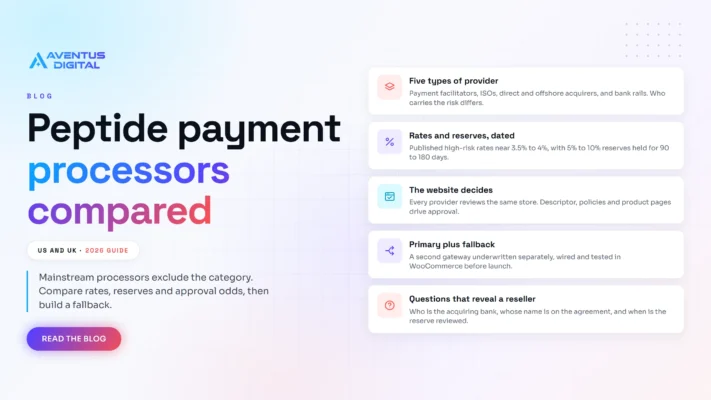
Peptide Payment Processors Compared: US and UK 2026
Short answer: mainstream processors such as Stripe, PayPal and WooPayments exclude the category, so a [...]
Sep
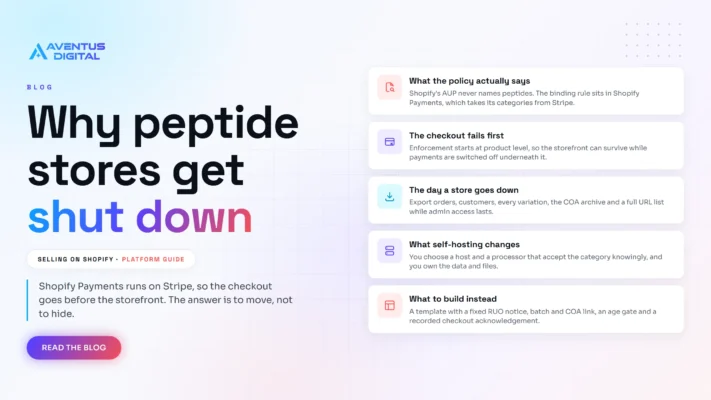
Selling Peptides on Shopify: Why Stores Get Shut Down
Short answer: not for long. You can open a store and sell peptides on Shopify, [...]
Sep
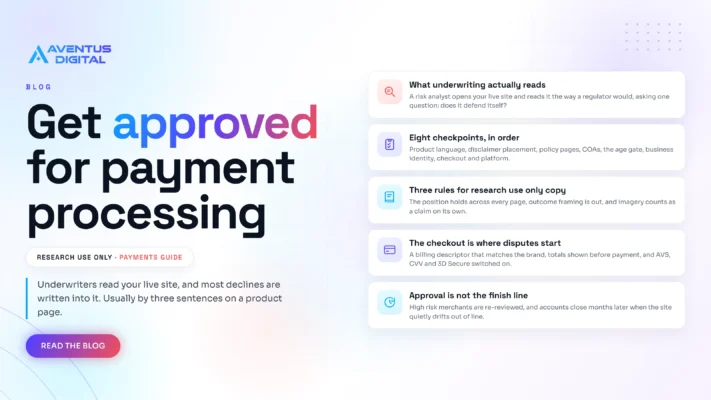
Peptide website compliance and how to get approved for payments
Short answer: peptide website compliance is decided on four things. A research use only position [...]
Sep