
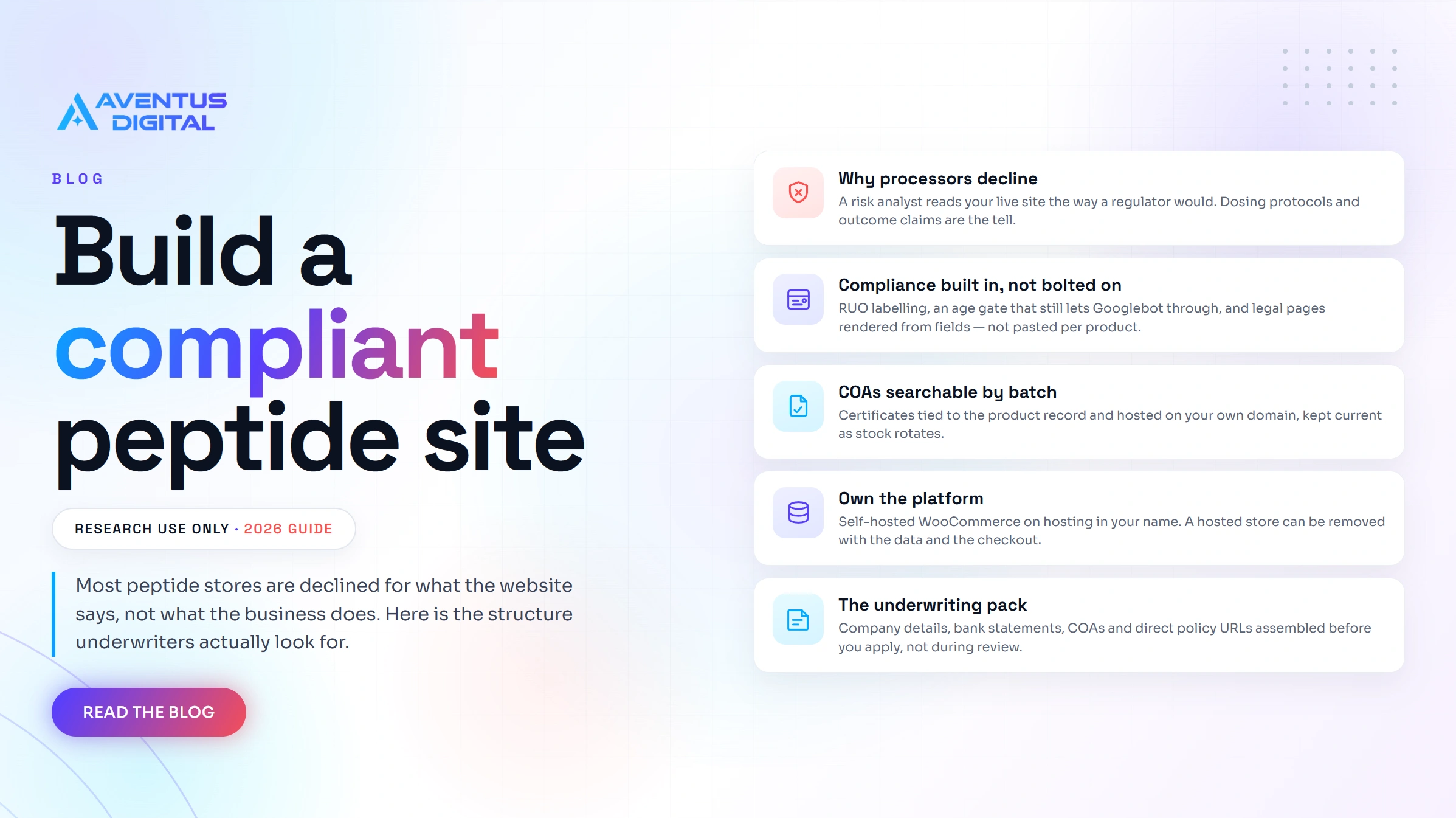
How to build a compliant peptide website
Short answer: a compliant peptide website is one that holds a genuine research use only position on every page, carries no health or dosing claims, publishes certificates of analysis, gates access by age and eligibility, and runs on a platform you own. Get that right and payment approval follows. Get it wrong and nothing else matters.
Almost every peptide business that comes to us has already been declined by a payment processor, usually with no explanation. The stock is in the warehouse, the branding is finished, the products are live, and the application comes back rejected. In nearly every case the blocker was not the business model. It was the website.
Aventus Digital has built research supply stores for Crew Labs, Zyvara Life, Solix Labs, Endura Research and Vyon Biolabs, so treat this as a view from inside the work rather than a general overview. We are the website partner, not your legal adviser, and the legal responsibility for what you sell and what you claim sits with you. Take your own advice on your specific product list before you launch anything.
Why payment processors decline peptide websites
Underwriting is not a form check. A risk analyst opens your live site and reads it the way a regulator would. They look at the homepage promise, three or four product pages, your terms of sale, your refund policy, your shipping restrictions, your company details, and whatever your blog says. They are answering one question: if this merchant is challenged by a card scheme or a regulator, does the site defend itself, or does it hand over the evidence?
Aggregators such as Stripe and PayPal are the fastest decline, because they onboard first and review later. Their published policy on prohibited and restricted businesses puts unlicensed pharmaceutical and nutraceutical products in scope, and once an automated review flags your model, settlements are usually held before you are told why. A peptide store should never launch on an aggregator and hope.
The tells that trigger a decline are consistent:
- Dosing protocols, cycle lengths or reconstitution instructions on product pages
- Outcome language such as fat loss, recovery, healing or muscle growth
- Testimonials describing personal results, or before and after images
- No terms of sale, no refund policy, no company number, no working contact route
- No certificates of analysis, or COA files that have not been updated in months
Where we come in: the first thing we run on a peptide project is a page by page compliance read crossed with a technical audit. Every URL is checked for the language that triggers a decline, every legal page is checked for existence and accuracy, and the output is a fix list rather than a score. It is the same free SEO and GEO audit we give away on any site, and on peptide stores it usually finds the reason for the decline inside an hour. Send us the URL and you get the findings back within 48 hours in plain English.
The compliance layer has to be built in, not bolted on
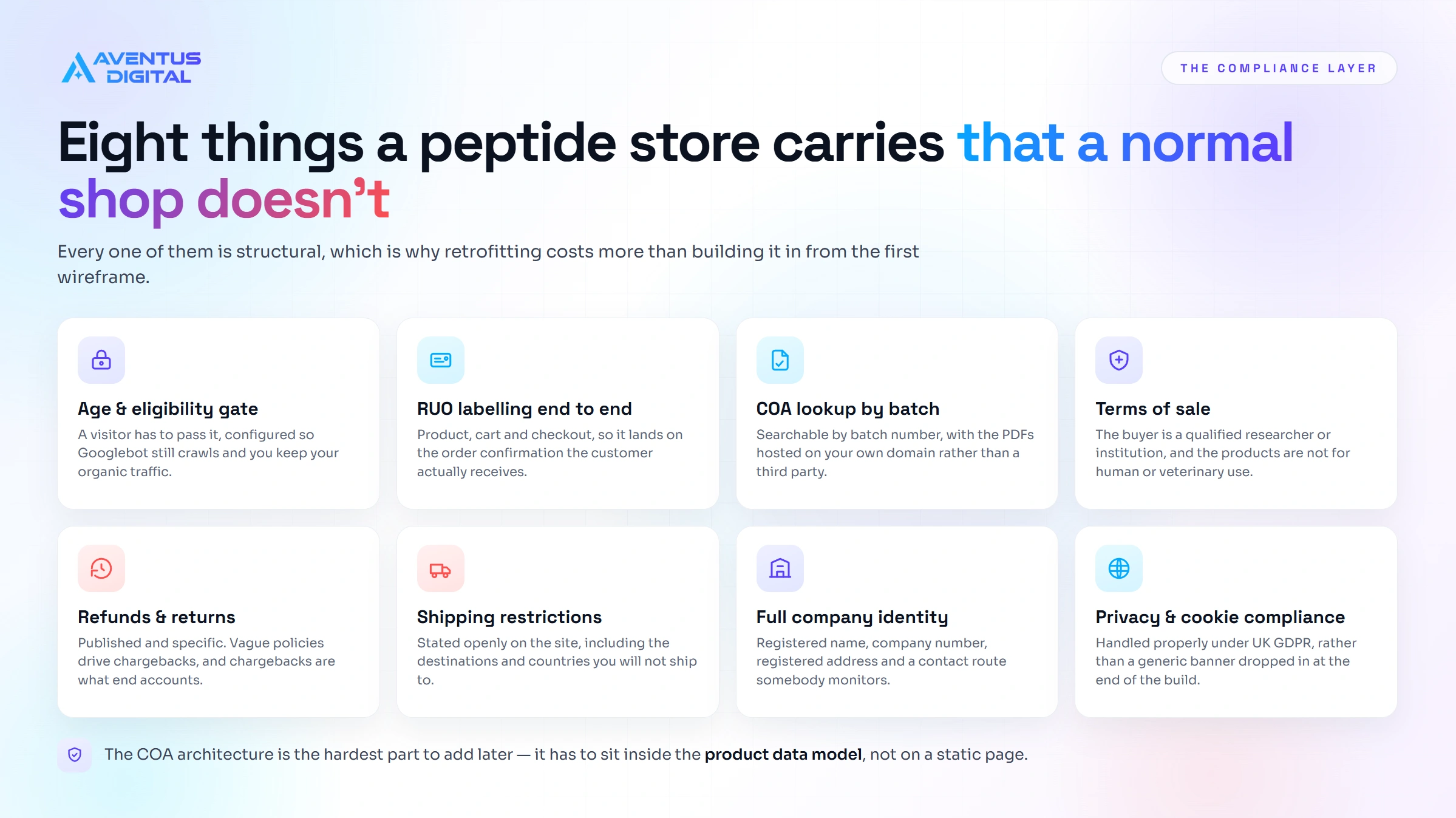
A compliant peptide store carries roughly eight things a normal shop does not. Every one of them is structural, which is why retrofitting is slower and more expensive than building it properly the first time.
- An age and eligibility gate a visitor must pass, configured so it does not block Googlebot and cost you your organic traffic
- Research use only labelling at product, cart and checkout level, so it appears on the order confirmation the customer receives
- A certificate of analysis lookup, searchable by batch number, with the PDFs hosted on your own domain
- Terms of sale stating the buyer is a qualified researcher or institution and that products are not for human or veterinary use
- A published refund, returns and damaged goods policy, because vague policies drive chargebacks and chargebacks end accounts
- Shipping and destination restrictions stated openly, including the countries you will not ship to
- Full company identity: registered name, company number, registered address and a monitored contact route
- Privacy and cookie compliance under UK GDPR
The certificate of analysis architecture matters more than most owners expect. It is the strongest trust signal on the site for an underwriter and for a real buyer, and it is the hardest part to add later, because it has to sit inside the product data model rather than on a static page.
Where we come in: our ecommerce websites are built on WooCommerce with COA batch lookup wired into the product data from day one, and the compliance blocks rendered from fields rather than pasted in by hand. That means a new product physically cannot go live without its research use only statement, its purity, its storage conditions and its batch document. Ecommerce builds start at £399, with full custom stores from £1,999. Keeping COAs current as stock rotates is handled by our website maintenance plans from £49 a month, because a COA page that has not been touched in eight months does more harm than no COA page at all.
Which platform can actually host a peptide store?
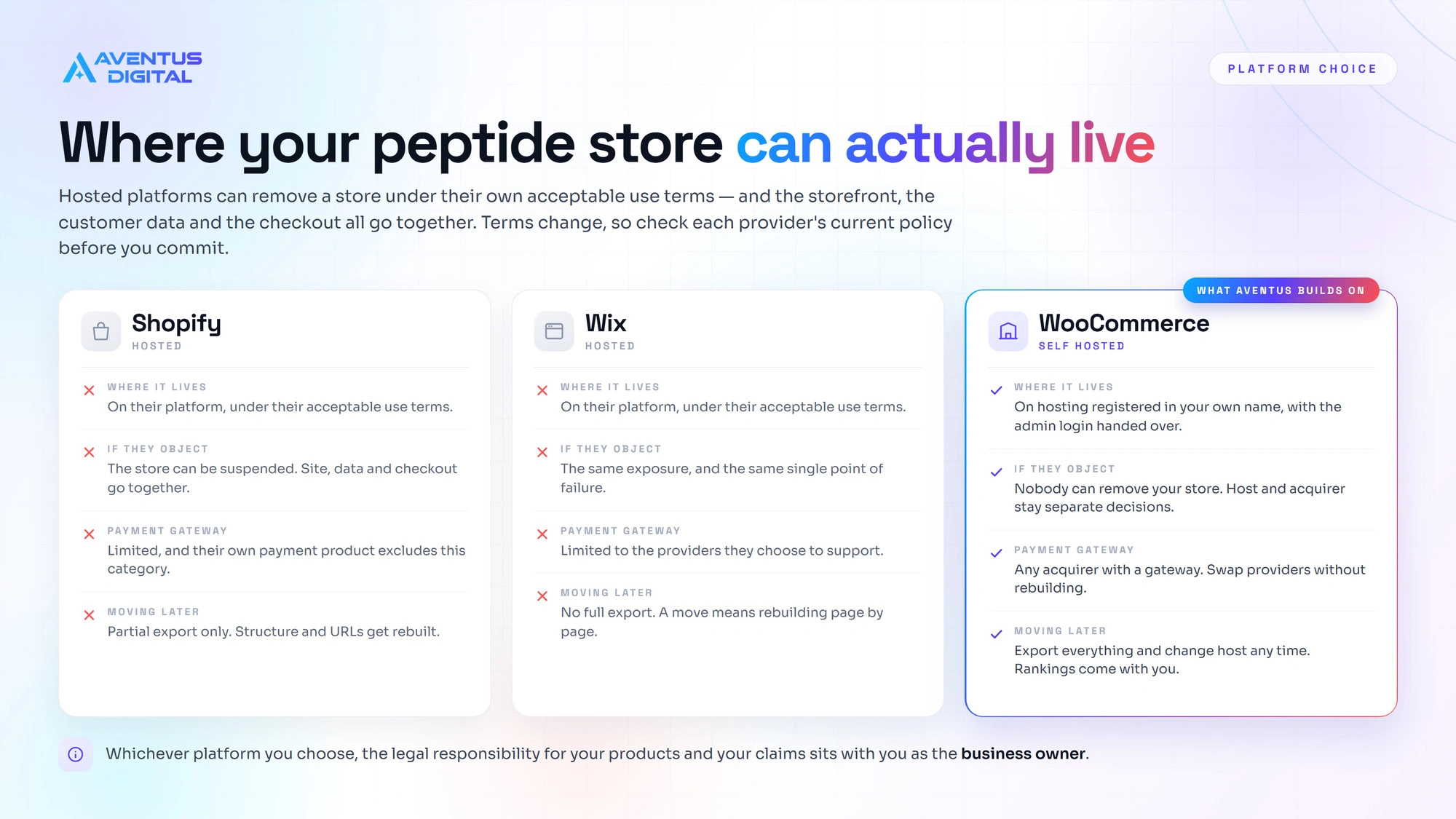
This is the decision that quietly determines whether the business survives a bad month. Hosted platforms reserve the right to remove a store under their own acceptable use terms, and when that happens you lose the storefront, the customer data and the payment flow in one afternoon, with no appeal worth having.
Swipe to compare
| Requirement | ShopifyHosted | WixHosted | WooCommerceWhat Aventus builds on |
|---|---|---|---|
| Where the store lives | On their platform, under their acceptable use terms | On their platform, under their acceptable use terms | On hosting registered in your own name |
| If the platform objects to your catalogue | Store can be suspended. Site, data and checkout go together | Same exposure, same single point of failure | Nobody can remove your store. Only your host and your acquirer are separate decisions |
| Payment gateway choice | Limited, and their own payment product excludes this category | Limited to supported providers | Any acquirer with a gateway. Swap providers without rebuilding |
| Age and eligibility gate | App based, and most block crawlers by default | Basic, with little control over how it behaves | Built to verify humans while staying open to Googlebot, so you keep your organic traffic |
| COA batch lookup | Third party app, files hosted elsewhere | Manual pages, no batch level structure | Searchable by batch, tied to the product record, hosted on your own domain |
| Compliance blocks on every product | Typed into each description by hand | Typed into each description by hand | Rendered from fields, so product forty cannot go live missing them |
| Moving later | Partial export. Structure and URLs rebuilt | No full export. A move means rebuilding page by page | Export everything and change host any time. Rankings come with you |
| Platform terms change, so check each provider’s current acceptable use policy before you commit. Whichever platform you choose, the legal responsibility for your products and your claims sits with you as the business owner. | |||
Where we come in: every peptide store we build runs on self hosted WooCommerce, on hosting registered in your name, with the admin login handed over at launch. If one acquirer exits the sector you swap the gateway rather than rebuild the business. You can see the full specification on our peptide websites page. If you are already on a hosted platform and quietly worried about being stuck there, a website redesign carries your content across and maps every existing URL to its new equivalent with a 301 redirect, so the traffic you have already earned survives the move.
Fix the claims problem before you apply
The fastest route to a decline is a product page that reads like a medicine. This is not only a payments issue. Many peptides are treated as medicinal products by the Medicines and Healthcare products Regulatory Agency, and selling, supplying or advertising a medicinal product to the public without a marketing authorisation is an offence in the UK. Marketing claims are separately policed by the Advertising Standards Authority.
One point that gets skipped, and it is the important one: the research use only position has to be real. Using RUO wording as a fig leaf while the rest of the site markets the product for human use is exactly what gets stores closed, funds frozen and directors personally exposed. If the business is genuinely selling to consumers for personal use, no website build fixes that, and it is not work we take on.
Where we come in: when we rebuild a peptide catalogue we rewrite the product template so the compliance language comes from structured fields rather than free text. Purity, storage, batch, RUO status and the not for human consumption statement all render automatically. Then we run the full catalogue against a claims checklist before launch. It is the same discipline behind every website design we deliver, applied to a category where a single sentence in a description can cost you your merchant account.
Never misrepresent the business to your processor
There is a well travelled set of shortcuts in this sector: miscoding the merchant category so the account looks like generic supplements, running a clean shopfront for the underwriter while the real catalogue sits behind a login, splitting transactions across shell sites, or routing through somebody else’s approved account.
All of it is misrepresentation to a financial institution. The realistic outcomes are held settlements, a terminated account, placement on the MATCH list which makes card processing considerably harder to obtain for five years, and personal liability for the director who signed the application.
Where we come in: we will not build any of it, and there is a practical reason beyond the legal one. A genuinely compliant site with a complete document pack usually gets approved faster than a disguised one gets through review. Every hour spent on the shortcut is an hour not spent on the thing that actually works.
Prepare the underwriting pack before you apply
Approval is usually decided on completeness. Have this ready in advance rather than assembling it while an application sits open:
- Companies House registration details and director identification
- Three to six months of business bank statements
- Supplier invoices and proof of your supply chain
- Certificates of analysis for current stock
- Any prior processing history and chargeback figures
- Direct URLs to your terms, refund policy, shipping policy, privacy policy and RUO statement
- A short written description of the business model and who your customers actually are
On the payments side, the realistic route is a dedicated high risk merchant account through an acquirer or broker that underwrites this sector knowingly. Expect the terms that come with it: a rolling reserve, higher processing rates, and a chargeback ratio you have to keep under control. Terms vary widely, so get more than one quote and read the reserve clause carefully.
Where we come in: we hand over a compliance URL sheet at the end of every peptide build, so the policy links on that list take five minutes to supply rather than a week. It goes out alongside hosting access, the admin login and a short training session, because the site is yours from launch day.
How to build a compliant peptide website: the order to do it in
Do it in this sequence and you avoid almost every expensive rework we get called in to fix:
- Take legal advice on your product list and confirm your position before a single page is written
- Choose self hosted WooCommerce so the store cannot be removed from under you
- Build the compliance layer into the product template, not into individual descriptions
- Publish COAs by batch on your own domain, and keep them current
- Write every product page as though an underwriter and a regulator will both read it, because both might
- Assemble the underwriting pack, then approach acquirers that knowingly serve the sector
Get a quote for a compliant RUO peptide website
Everything above is what we do on a live project, not a checklist we wrote for a blog. Peptide and research supply ecommerce is a niche we build in repeatedly, which is the only reason the compliance structure, the age gate, the COA batch system and the payment readiness are standard on our builds rather than paid extras.
A build with us includes the following as a matter of course:
- Self hosted WooCommerce on hosting registered in your name, with the admin login handed over at launch
- Research use only labelling rendered from product fields at product, cart, checkout and order confirmation
- Age and eligibility gate that verifies human visitors while staying fully crawlable
- Certificate of analysis lookup searchable by batch, with PDFs hosted on your own domain
- Terms, refund, shipping and privacy pages drafted for the sector and linked one click from every page
- A full claims read across the catalogue, categories, blog and image library before launch
- A compliance URL sheet at handover, ready to paste into your merchant account application
- SEO, GEO and AEO configured during the build rather than sold as an upsell later
Builds start at £399, with full custom stores from £1,999, all fixed price and quoted before work begins. Most go live in two to three weeks, and the bottleneck is usually waiting on lab documents rather than the build itself.
Peptide and research supply ecommerce
Get a quote for a compliant RUO peptide website
See the builds, the full specification and what is included, then request a fixed price quote. If you already have a site, send us the URL and we will tell you what is triggering the declines before you spend anything.
At Aventus Digital we are a team of top rated specialists with over seven years of experience, 650 plus five star reviews and 600 plus websites delivered across 40 plus countries. If your site has already been declined, the reason is usually visible on three product pages. Send us the URL for a free SEO and GEO audit, or if you are starting from scratch we will build you a free mockup of your homepage within 72 hours with no obligation to go any further. Everything we build in this sector is on our peptide websites page.
You Might Also Like
- Peptide websites the builds, the compliance structure, and what is included.
- Peptide website compliance: how to get approved for payment processing
- Ecommerce websites how we build WooCommerce stores that are ready for underwriting.
- How much does a website cost in the UK in 2026? every figure, with nothing hidden.
- What is GEO? The UK business owner’s guide the plain English primer on getting cited by AI.

Author
Zubayed Feroz
Founder of Aventus Digital
General website guidance, not legal or financial advice. Requirements vary by product and jurisdiction and they change, so take advice from a qualified solicitor on your own catalogue. Underwriting criteria are set by individual acquirers: we do not arrange or guarantee payment processing. Named services are referenced for comparison only, correct to the best of our knowledge on the date below.
Published 1 September 2026. Last reviewed 1 September 2026.
Frequently Asked Questions
Why do Stripe and PayPal decline peptide websites?
Both treat unlicensed pharmaceutical and nutraceutical products as restricted, and both onboard first then review later. The decline usually arrives after an automated risk review reads your live product pages and finds dosing language or outcome claims. Because they are aggregators rather than dedicated acquirers, settlements are often held before you are given a reason.
Can you get a UK merchant account for a peptide store?
Yes, through acquirers and brokers that knowingly underwrite this sector, provided the business is genuinely research use only and the website supports that position. Expect a rolling reserve, higher rates and a real underwriting process with documents. Approval is decided far more by the site and the paperwork than by the product list itself.
Does research use only wording protect a peptide seller?
Only when the position is real. If the rest of the site markets products for human use, an RUO line in the footer offers no protection with the MHRA, the ASA, or your acquirer. The wording has to match the actual business model, the customer base and every product page. Take your own legal advice on your specific catalogue.
Do peptide websites need an age gate?
An age and eligibility gate is standard on research supply stores and underwriters look for it. It has to be configured so it verifies human visitors without blocking search engine crawlers, otherwise you lose your organic traffic while fixing a compliance issue. It is one of the most common technical mistakes we correct on peptide sites.
Is Shopify or WooCommerce better for a peptide store?
WooCommerce, in almost every case. Hosted platforms can suspend your store under their own acceptable use terms and you lose the site, the data and the payment flow at once. Self hosting keeps everything under your control, so changing acquirer is a gateway swap rather than a rebuild.
What is a certificate of analysis and does my site need one?
A COA is the third party lab document showing the identity and purity of a specific batch. Publishing them, searchable by batch number and hosted on your own domain, is the strongest trust signal on the site for buyers and underwriters alike. It has to be built into the product data rather than added as a static page, and it has to be kept current as stock rotates.
How long does it take to build a compliant peptide website?
Most of our ecommerce builds go live in around two to three weeks, depending on catalogue size and how ready your COA documents and policy pages are. The build itself is rarely the bottleneck. Waiting on lab documents and legal sign off usually is, which is why we ask for both at the start rather than the end.
What does a compliant peptide website cost?
Our ecommerce builds start at £399, with full custom stores from £1,999, all fixed price. Ongoing website maintenance starts at £49 a month and covers updates, backups, security and keeping COA documents published as batches change. You can request a quote on our peptide websites page.
Can you fix a peptide site that has already been declined?
Usually, yes. We start with a compliance and technical audit to find what triggered it, which is normally product page language or missing policy pages. From there it is either a targeted fix or a website redesign that carries your rankings across. Send us the URL and the audit comes back within 48 hours.
Do you handle the legal side as well?
No. We are the website partner, not your legal adviser. We build the structure that supports a compliant position and we flag language that will cause you problems, but the legal responsibility for your products, your claims and your regulatory position sits with you. Take proper advice on your specific catalogue before you launch.
Related Blogs
Which Hosting Is Best for Peptide Websites?
Short answer: Hostinger is what we put research peptide stores on, and our link takes [...]
Oct
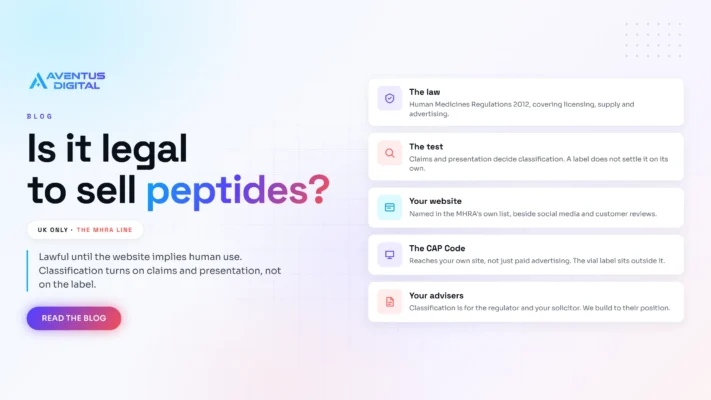
Is It Legal to Sell Research Peptides in the UK? The MHRA Line, Explained for Store Owners
Short answer: selling research peptides in the UK is lawful in itself, and it stops [...]
Oct

How to Start a Peptide Business in 2026: Costs and Steps
Short answer: to start a peptide business you register the company, open the bank account, [...]
Oct
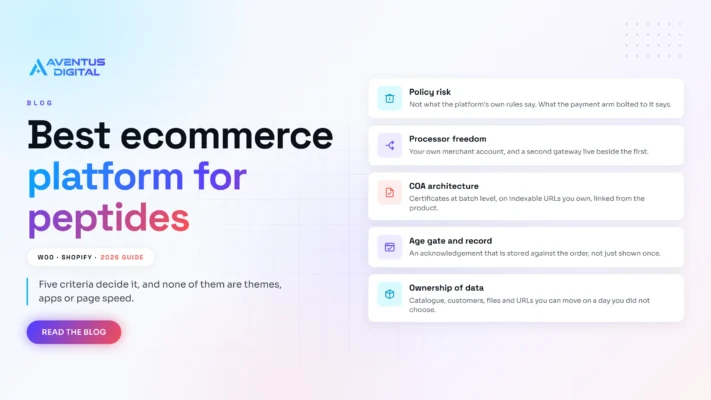
Best Ecommerce Platform for a Peptide Store (2026)
Short answer: the best ecommerce platform for peptides is a self-hosted WooCommerce store. Hosted platforms [...]
Oct
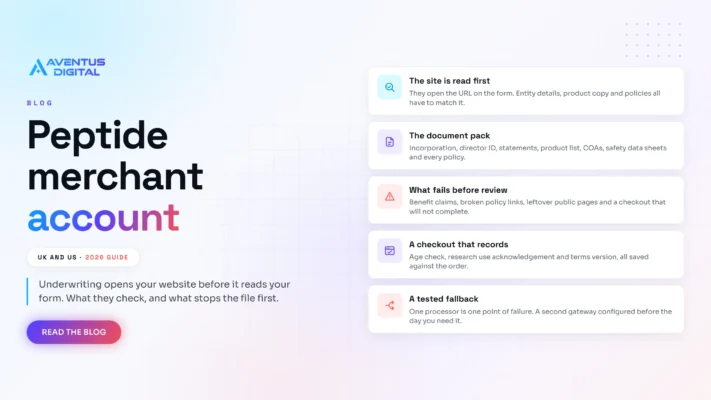
The peptide merchant account application pack that gets approved first time
Short answer: a peptide merchant account is won on evidence, not on wording. Underwriting opens [...]
Sep
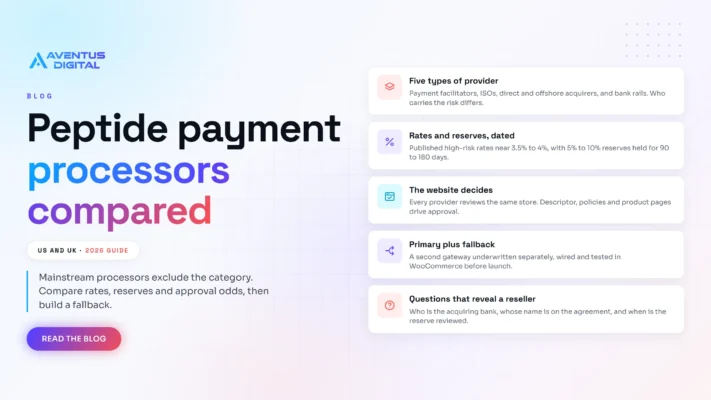
Peptide Payment Processors Compared: US and UK 2026
Short answer: mainstream processors such as Stripe, PayPal and WooPayments exclude the category, so a [...]
Sep
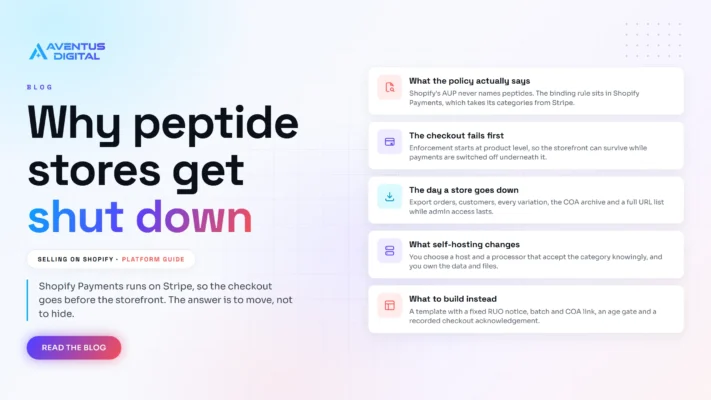
Selling Peptides on Shopify: Why Stores Get Shut Down
Short answer: not for long. You can open a store and sell peptides on Shopify, [...]
Sep

Peptide website compliance and how to get approved for payments
Short answer: peptide website compliance is decided on four things. A research use only position [...]
Sep