
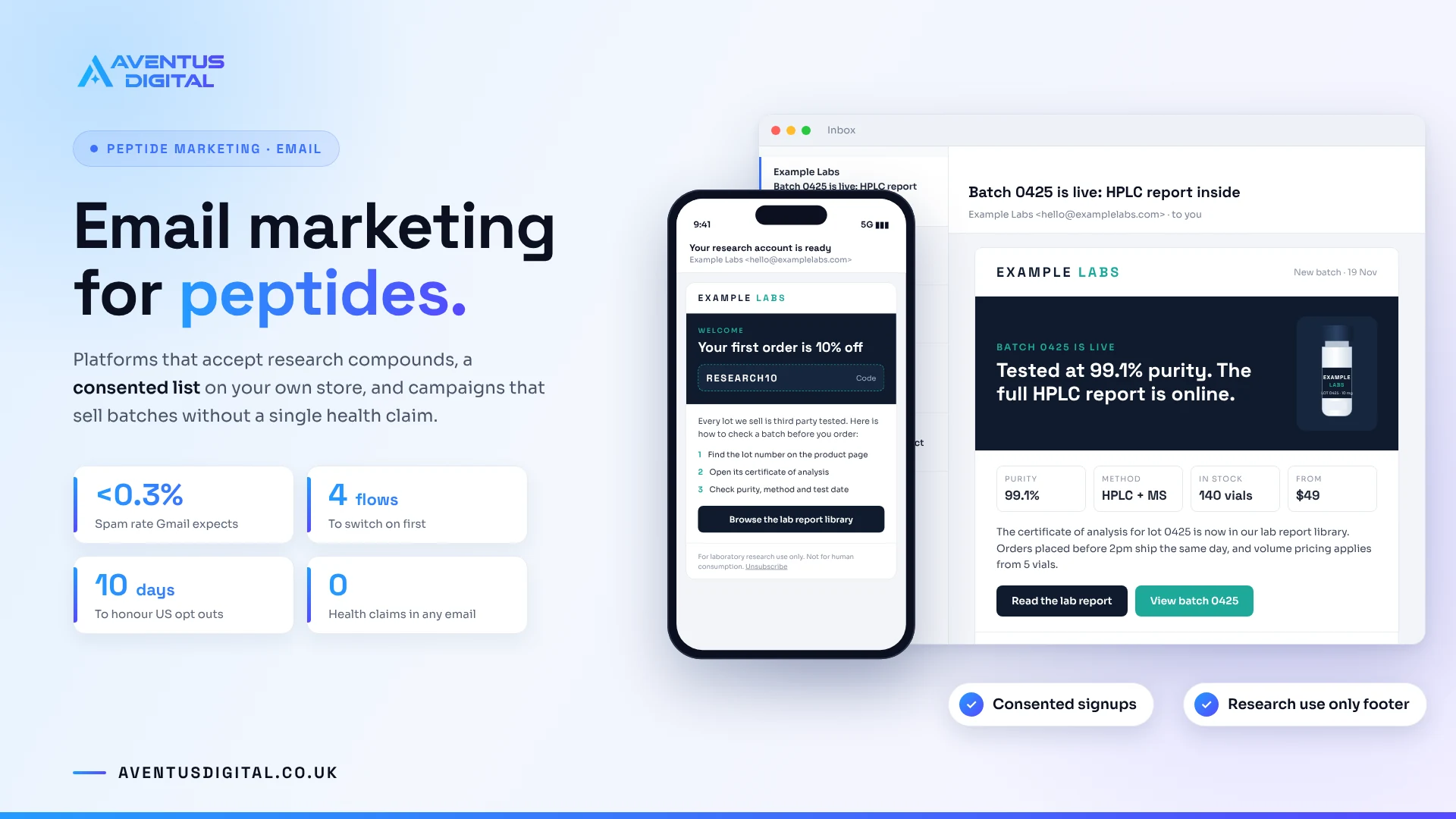
Email marketing for peptides: how research stores build a list that lasts
Email marketing for peptides works when three things line up: a sending platform whose acceptable use policy allows research compounds, a list built from consent on your own website, and emails that sell batches, stock and pricing without a single health claim. Get one of those wrong and the account, or your domain’s sender reputation, is the first thing you lose.
We set up the email side of the Zyvara Life build as part of a 14 day launch. The list grows from one offer: create a research account and get 10% off the first order. Because every subscriber starts as an account on the store, the list lives on a site the brand controls, and that is the first thing a sending platform asks about when it reviews how a list was built.
Email marketing for peptides at a glance
- Read the acceptable use policy of any email platform before you import a single address. Several mainstream tools exclude pharmaceutical products or research drugs in writing.
- Build the list on your own WooCommerce site with a clear opt in, and keep a copy you can export at any time.
- Authenticate your sending domain with SPF, DKIM and DMARC, and keep spam complaints well under 0.3%.
- Sell what the lab report proves: batch numbers, purity results, stock and price. Leave out benefits, dosing and results.
- Run four core flows first: welcome, abandoned cart, new batch or back in stock, and win back.
Aventus Digital has built WordPress and WooCommerce stores for more than 7 years, including 50+ research peptide stores across the UK, the US and the EU. Our team has delivered 700+ websites in 40+ countries and holds Fiverr Top Rated status with 650+ five star reviews, so the advice below comes from stores we have launched and still look after.
Is email marketing for peptides allowed on Mailchimp, Klaviyo or Omnisend?
This is the question to answer before you design a single template. Most email platforms publish an acceptable use policy, and the big names are cautious about anything that looks like medicine. Mailchimp lists pharmaceutical products under prohibited content. Omnisend’s policy, last updated on 30 April 2026, bans prescription medications including drugs for research purposes. Klaviyo’s community team has confirmed that pharmaceutical products are on its disallowed list.
None of this means a peptide store can never send email. It means the platform decides, the decision can come months after you have built your flows, and a closure usually takes your sending history with it.
| Platform | What the policy says | What we tell peptide clients |
|---|---|---|
| Mailchimp | Pharmaceutical products are listed as prohibited content, and accounts are reviewed by automated and human checks. | Treat it as unsuitable unless Mailchimp’s compliance team approves your catalogue in writing. |
| Omnisend | Prescription medications are prohibited, including drugs for research purposes (policy dated 30 April 2026). | Ask for written confirmation of what you sell before you build flows, and keep a full export of the list. |
| Klaviyo | The community team says pharmaceutical products are not allowed, and some categories need written approval. | Same approach: describe the catalogue accurately and get the answer in writing first. |
| Self hosted plugin with an SMTP relay | The plugin is yours, but the relay service that sends the mail has its own policy. | Check the relay’s policy too. Owning the software does not remove the sending provider’s rules. |
| Policies change. Read the current version on each provider’s site before you sign up, and describe your products as they are. Hiding the catalogue only moves the closure to a worse moment. | ||
Whatever you choose, keep the master list in WooCommerce rather than inside the email tool. If an account closes, you still own the addresses, the consent records and the order history, and you can move to another provider without starting from zero. A scheduled export, which we can run as part of website maintenance, keeps that copy current.
Building a peptide email list with consent
In the UK, the Privacy and Electronic Communications Regulations decide who you can email. The ICO’s guidance is clear: you need specific consent to send marketing emails to individuals, with a limited exception for your own previous customers known as the soft opt in. That exception never covers a bought or shared list, and every email needs a working unsubscribe.
If you sell into the US, the CAN-SPAM Act adds its own rules. The FTC’s compliance guide for business asks for a valid physical postal address in every message, honest subject lines, and opt outs processed within 10 business days. It applies to business to business email as well, which matters if you sell to labs.
The cleanest way to collect consent on a peptide store is at the moment someone creates a research account. On Zyvara the hook is the 10% first order offer. Whatever your hook, the signup form should carry an unticked marketing checkbox, the researcher declaration and a link to your research use only disclaimer, so the account and the consent are stored together, with a timestamp, on the site you control.
Avoid putting the email capture inside the age or researcher gate itself. People click through gates quickly, and a consent box buried there is easy to challenge later. Ask once the visitor has chosen to stay.
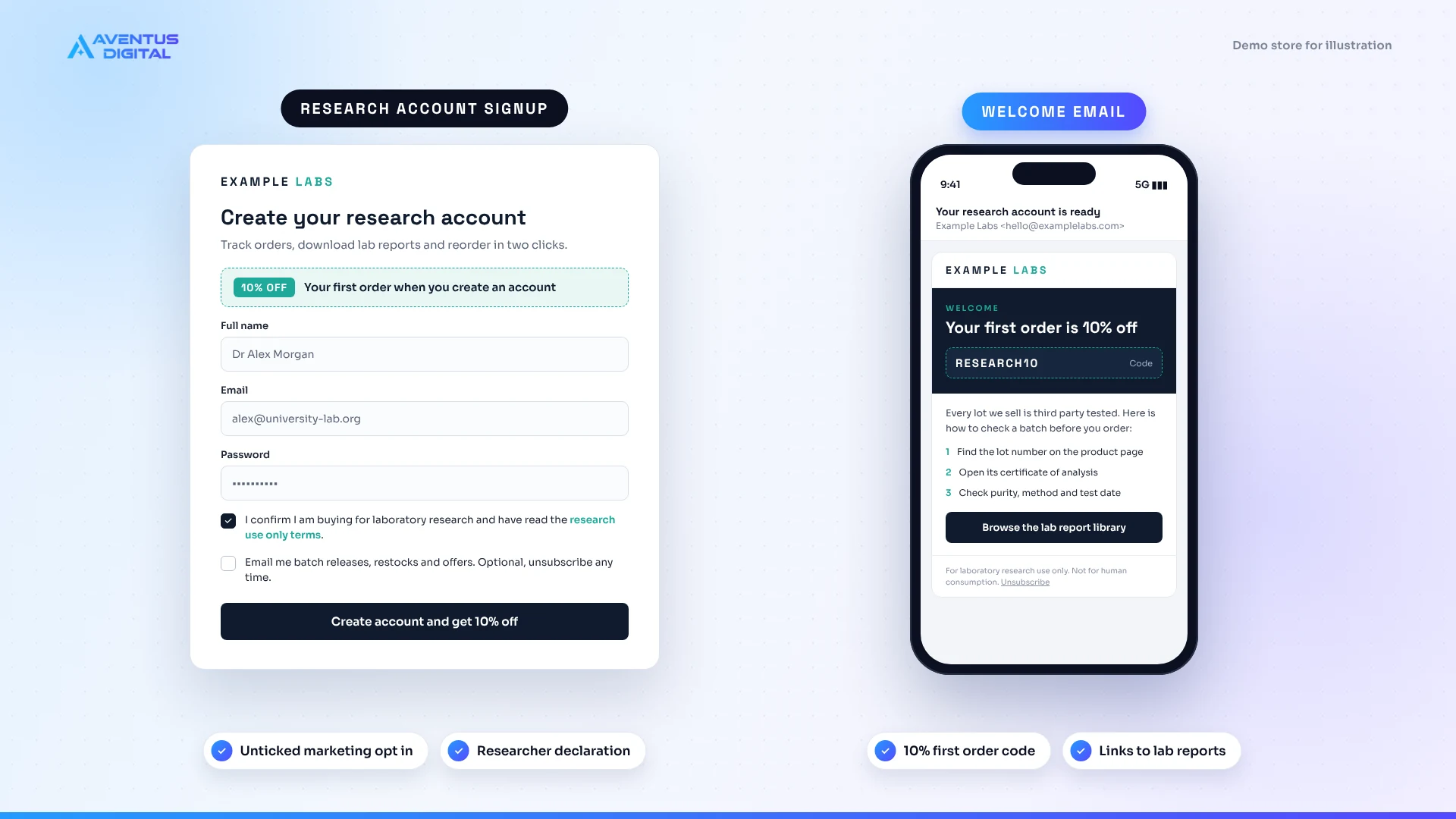
Example: a research account signup that pairs the first order offer with a clear marketing opt in.
Deliverability: getting peptide emails into the inbox
Gmail and Yahoo tightened their rules for bulk senders in 2024, and both keep enforcing them. Google treats anyone sending around 5,000 or more messages a day to Gmail addresses as a bulk sender. Google’s email sender guidelines expect SPF, DKIM and DMARC on your domain, one click unsubscribe on marketing mail, and a reported spam rate below 0.3%. Aim for 0.1% or lower, because peptide stores start with less goodwill from filters than a clothing brand.
- Send from your own domain, never from a free mailbox. A subdomain such as mail.yourstore.com keeps marketing reputation apart from order emails.
- Warm up a new domain slowly. Start with your most engaged buyers and grow volume over several weeks.
- Remove addresses that have not opened or clicked in six months. They drag down engagement and raise complaint rates.
- Keep order confirmations, dispatch notices and password resets as transactional mail, separate from campaigns.
We set these records up as part of our peptide website builds, so the first campaign does not land in spam because a DNS record was missing.
Flows every peptide store should run
Automated flows earn more than one off campaigns, because they reach people at the moment they act. These are the four we switch on first.
- Welcome. Deliver the first order code, explain how your batch testing works and link to your lab report library. Three emails over a week is enough.
- Abandoned cart. One reminder after a few hours and one the next day. Mention stock levels and shipping cut off times, not urgency tricks.
- New batch or back in stock. Researchers who order regularly want to know when a new lot lands and where to read its certificate of analysis.
- Win back. A plain note to buyers who have not ordered in a few months, with your current volume pricing. Zyvara’s tiers reach up to 25% off, which gives this email a real reason to exist.
Leave out anything that reads like a dosing schedule. A reminder timed to when someone would “run out” implies use, and that is the kind of detail regulators look for.
Email marketing for peptides: what to write and what to leave out
An email is advertising matter in the eyes of every regulator that matters to a peptide store. In the US, the FDA judges what a product is for by the seller’s objective intent, which can be shown by labeling claims, advertising matter, or written statements. A campaign that promises recovery or fat loss can turn a research compound into an unapproved drug on paper. In the UK, the ASA applies the CAP Code to marketing emails, and the MHRA treats medicinal claims as a sign that a product is a medicine.
| Topic | Avoid | Write this instead |
|---|---|---|
| Subject line | “The peptide that changed my recovery” | “Batch 0425 is live: HPLC report inside” |
| Product copy | Benefits, results, dosing, before and after | Purity figure, batch number, storage conditions, a link to the certificate |
| Social proof | Customer quotes about how a product made them feel | Reviews about dispatch speed, packaging and support |
| Imagery | People, bodies, syringes in use | Vials, packaging, lab report screenshots |
| Footer | No disclaimer or a hidden one | A short research use only line and your postal address |
| Responsibility sits with the business owner. Take advice from a solicitor who knows the medicines and advertising rules in each country you sell to. | ||
A useful test: if a sentence would still make sense on a lab supplier’s catalogue page, it is probably fine in your email. If it would only make sense in a fitness forum, cut it. Our free peptide compliance checker runs the same test on your product pages.
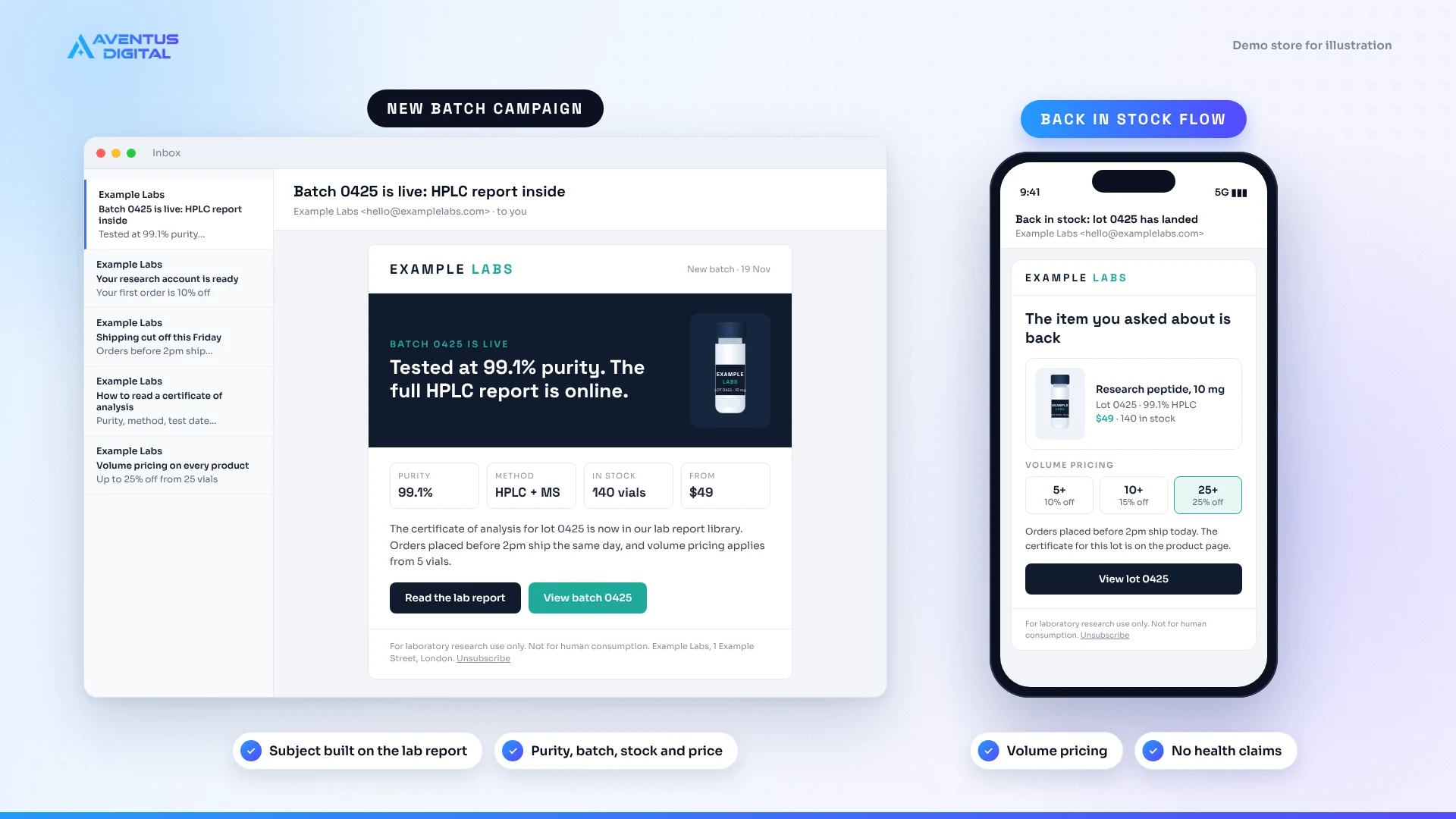
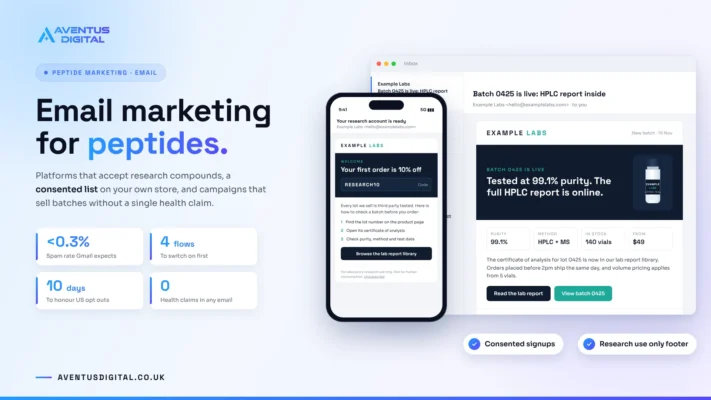
Example: a new batch announcement built around the lab report, stock and price.
Mistakes we see in peptide email campaigns
- Importing a list from an old store or a partner without consent records.
- Building months of flows on a platform that never confirmed it accepts research compounds.
- Copying a supplement brand’s welcome series, testimonials and all.
- Linking to product pages that still carry health claims, so a compliant email lands on a page that is not.
- Sending everything from the main domain with no DMARC record, then wondering why order emails go to spam too.
- Discount codes leaking onto coupon sites because they never expire.
What an Aventus peptide email setup includes
- A research account signup with an unticked marketing opt in and a stored consent record.
- SPF, DKIM and DMARC set up on your sending domain before launch.
- Welcome, abandoned cart and back in stock flows, written without health claims.
- Branded templates that match your store and link back to the lab report library.
- A list that lives in WooCommerce, exportable whenever you need it.
If your store already sends email and you are not sure the setup would survive a review, our team can check it as part of a free website audit, or you can see the wider plan on our peptide marketing page.
Want an email setup that survives a platform review?
We build peptide stores with consented signups, authenticated sending and flows written for research customers. You see a free homepage mockup before you pay anything.
Zyvara Life, a 30 product research peptide store, went live in 14 days.
Email marketing for peptides is one of the few channels a research brand fully controls, as long as the platform, the consent and the copy all hold up. Start with an honest conversation with your email provider, keep the list on your own site, and write every email so it could sit next to the lab report it links to.
You might also like
- Social media rules for peptide brands: what Meta and TikTok allow, and what to post instead of ads.
- Peptide affiliate program: how to pay partners without losing control of your wording.
- Is your peptide website compliant?: the checks we run before any launch.
- Zyvara Life case study: a full peptide store built in 14 days.

Author
Zubayed Feroz
Founder of Aventus Digital. 7 plus years building WordPress and WooCommerce stores, including more than 50 for research peptide brands in the UK, the US and the EU.
General information, not legal advice. This article explains how email platforms, UK PECR and US CAN-SPAM rules commonly apply to research peptide stores. It is not legal advice. Responsibility for compliance sits with the business owner, so take advice from a solicitor for your products and markets.
Published 19 November 2026. Last reviewed 19 November 2026.
Frequently asked questions
Is email marketing for peptides legal in the UK?
Yes, if you follow PECR and UK GDPR. You need specific consent to email individuals, or the soft opt in for your own past customers, plus an unsubscribe in every message. The content also has to avoid medicinal claims under the CAP Code. Read our guide on selling peptides in the UK for the wider picture.
Which email platform should a peptide store use?
Use one that has confirmed in writing that it accepts your catalogue. Mailchimp, Omnisend and Klaviyo all have policy wording that excludes pharmaceutical products or research drugs, so ask before you build anything, and keep a full export of your list.
Can I mention benefits or results in peptide emails?
No. Benefits, results and dosing can be read as evidence that a product is intended for human use, which is how the FDA and MHRA decide whether something is an unapproved medicine. Write about batches, purity, stock, price and shipping instead.
What is the soft opt in for a peptide store?
It lets you email people who bought from you or started a purchase, about similar products, as long as you gave them a clear chance to opt out when you collected their details and in every email since. It does not cover bought lists or contacts from another business.
Why do my peptide emails go to spam?
The usual causes are a missing SPF, DKIM or DMARC record, sending from a new domain at full volume, emailing old unengaged addresses and complaint rates near 0.3%. Health claims and aggressive subject lines make filtering worse.
Can Aventus set up email for my existing peptide store?
Yes. We add consented signups, authenticate your sending domain and write the core flows as part of our peptide marketing work, whether we built the site or not.
Related blogs
Peptide social media marketing: what each platform allows in 2026
Peptide social media marketing in 2026: what Meta and TikTok allow, what to post without [...]
Nov
Email marketing for peptides: how research stores build a list that lasts
Email marketing for peptides: which platforms allow research compounds, how to build a consented list, [...]
Nov
Peptide affiliate program: how to set one up without losing control
How to run a peptide affiliate program on WooCommerce: software, commission and cookie settings, wording [...]
Nov
Research use only disclaimer: wording examples for peptide stores
A research use only disclaimer tells buyers a product is sold for laboratory research and [...]
Nov
Selling research peptides internationally: rules by country
Research peptide rules are set country by country, and in 2026 regulators in the US, [...]
Nov
Best peptide websites in 2026
The best peptide websites in 2026 make purity something a researcher can check rather than [...]
Nov
Gym website guide: what yours needs, from a real 2026 build
What a gym website needs in 2026, from prices and class booking to coaches and [...]
Nov
Is your peptide website compliant?
Peptide compliance means every part of a research peptide store, from product titles and vial [...]
Nov