
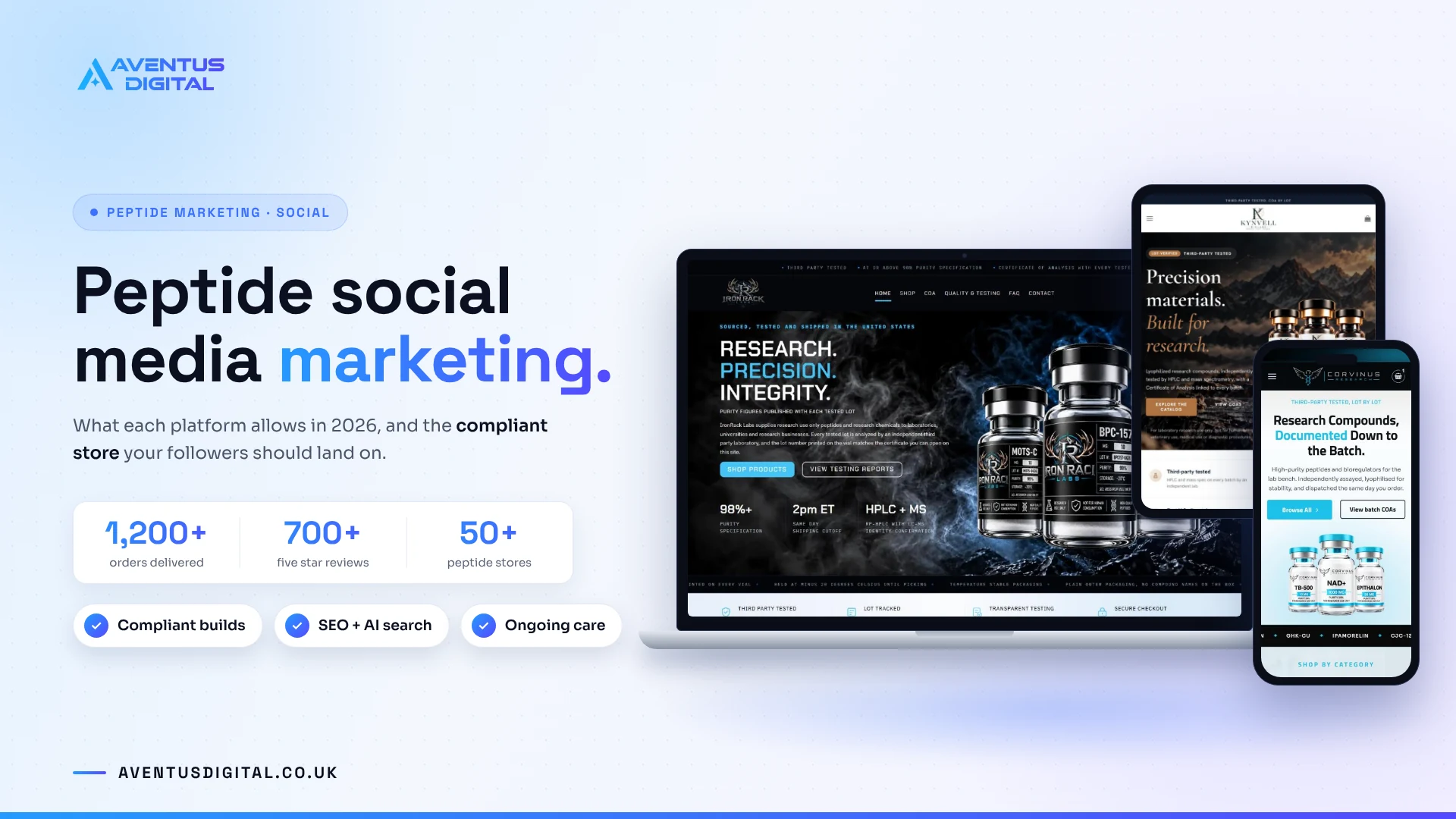
Peptide social media marketing: what each platform allows in 2026
Peptide social media marketing is possible, but not in the way most ecommerce brands run it. Meta and TikTok do not allow ads or posts that try to sell drugs or unsafe substances, so research peptide brands grow through organic education, lab and batch content, creators who follow the rules and owned channels, with every post pointing back to a compliant website.
When we planned the Zyvara Life launch, social growth was built around the channels that allow peptides rather than around an ad budget that would be rejected in review. The store went live in 14 days with 30 products, and the plan points followers to the website, the research account signup and the monthly articles rather than to a checkout inside Instagram.
Peptide social media marketing at a glance
- Paid ads for research peptides on Facebook, Instagram and TikTok are a dead end under current policies. Do not build a launch around them.
- Organic posts still carry risk if they try to sell. Price led “buy now” posts are the ones that get removed.
- Lab reports, batch releases, packaging, dispatch and plain research news are the content that lasts.
- Creators and affiliates must label paid posts and follow your wording rules, because the brand shares responsibility.
- Treat social as the top of the funnel. The goal is a follow, a newsletter signup or a visit to your lab report library.
Aventus Digital has spent 7+ years building WordPress and WooCommerce stores, including 50+ for research peptide brands in the UK, the US and the EU. With 700+ websites delivered in 40+ countries and 650+ five star reviews as a Fiverr Top Rated team, we plan social for these stores knowing which approaches keep accounts alive and which ones end them.
Can peptide brands advertise on Facebook and Instagram?
In practice, no. Meta’s advertising standards say advertisers can’t promote the sale or use of unsafe substances, and Meta decides what counts as unsafe. Research peptides sit close enough to prescription drugs and unsafe supplements that ads are rejected, and repeated rejections can restrict the whole Business account, including the Page and the ad account.
The organic side has its own rule. Meta’s Community Standards on restricted goods prohibit attempts by retailers to buy, sell or trade pharmaceutical and non medical drugs. A post with a price, a product photo and “link in bio to order” is the pattern that rule is written for. The same standard allows discussion, which is why education survives where selling does not.
You will see peptide brands running ads anyway. Meta’s own Oversight Board has noted that enforcement of these rules can be inconsistent, but an account that slips through today can be closed tomorrow with no appeal that brings the followers back.
TikTok and other platforms for peptide brands
TikTok is stricter still. Its branded content policy lists drug related products, prescription drugs and pharmaceutical products among the things creators cannot promote in paid partnerships, and its ad policies require healthcare advertising to follow local law and target adults only. For a research peptide brand, TikTok works only as a place for plain education, if at all.
YouTube, LinkedIn, X and Reddit each have their own rules on unapproved pharmaceuticals and on selling inside posts, and they change often. The safe position is the same everywhere: do not sell in the feed, do not make claims, and send people to a website where your research use only terms, age checks and lab reports do the work.
| Content | Risk | Safer version |
|---|---|---|
| Before and after, results, testimonials about effects | High. Reads as a health claim and breaks most platform rules. | Do not post it, on any platform. |
| Dosing, protocols, stacks | High. Implies human use, which undermines research use only positioning. | Link to published papers without adding instructions. |
| Product photo with price and “order now” | High on Meta. Matches the rule against retailers selling drugs. | Show the vial and the batch number, and point to the website for details. |
| Batch release with a lab report screenshot | Low to medium, if there is no price and no claim. | “Batch 0425 tested at 99.1% purity. Full report on our site.” |
| Packaging, dispatch, warehouse, team | Low. Builds trust without touching the product’s use. | Weekly behind the scenes posts and short reels. |
| Research news and paper summaries | Low to medium. Fine while it stays factual. | Summarise the study design and findings, and link the source. |
| Platforms decide, not you. These ratings are our reading of the published rules, not guidance from any platform. Policies change, so read each one’s current rules before you post. | ||
What to post: peptide social media marketing without health claims
The brands that keep their accounts post like a lab supplier with a personality. They show the work behind the product and leave the use of the product out of it. A simple weekly rhythm covers most of what you need.
- Lab and quality. A new certificate of analysis, a short video of a sample being packed for testing, an explanation of what HPLC and mass spectrometry check.
- Batch and stock updates. New lots, restocks and shipping cut off times, with the detail on the website rather than in the caption.
- Behind the scenes. Packaging, cold chain storage, dispatch days, the team.
- Research reading. Plain summaries of published studies, with the paper linked and no suggestion of what a reader should do with it.
- Compliance education. What research use only means, why you ask visitors to confirm who they are, how to read a lab report.
Keep the profile itself clean too: a short research use only line in the bio, a link to your website and no prices. Our guide to the research use only disclaimer has wording you can adapt.
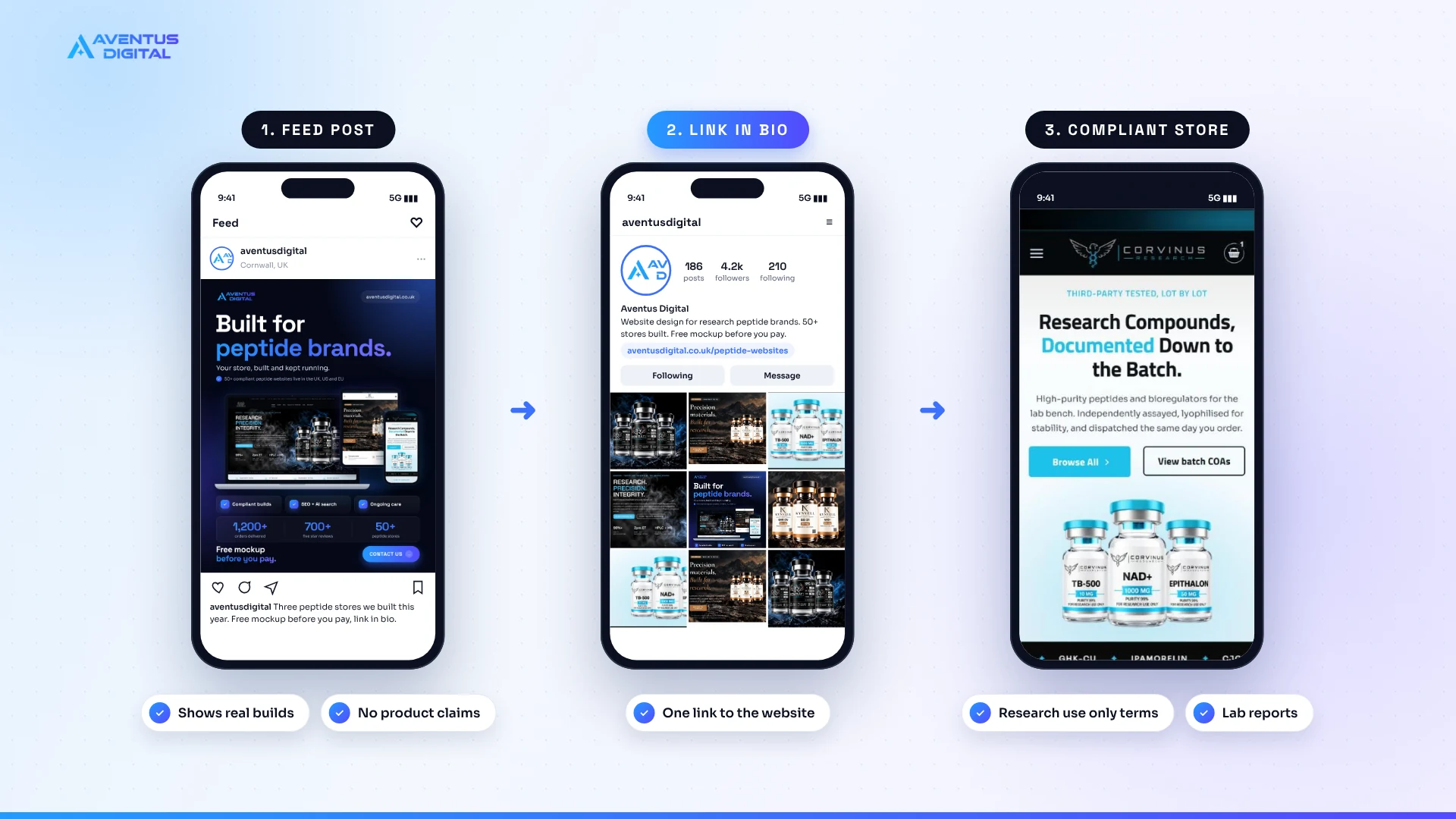
Example: a batch release post that shows the lab report and leaves out price and claims.
Turn followers into an audience you own
Every social account a peptide brand runs can disappear without warning, so the job of social is to move people somewhere it cannot. Each post should give a reason to join the newsletter, read a guide or browse the lab report library.
That is why the website carries so much of the weight. A follower who lands on a page full of health claims undoes all the care taken in the post. Before you push traffic to a store, run its product pages through our peptide compliance checker and read our guide to email marketing for peptide stores, which covers how to collect consent once a visitor arrives.
Search also matters more for peptide brands than for most, because it is one of the few channels without a content ban on the category. Content written for Google and for AI answers, which we explain in our guide to GEO, keeps bringing in researchers long after a post has scrolled away.
Creators, influencers and peptide social media marketing
Creators reach audiences a brand account cannot, and they are also where most of the compliance trouble starts. In the UK, the ASA and CMA influencer guidance expects paid content to carry a clear label such as “Ad” upfront, and the ASA has held that brands and affiliates both answer for affiliate content under the CAP Code. In the US, the FTC’s Endorsement Guides require any paid relationship to be disclosed clearly and conspicuously.
The bigger risk is what creators say. A fitness creator talking about how a compound “helped my recovery” is making a health claim on your behalf. Give every creator written rules on wording, review content before it goes out for the first few months, and end the relationship if the rules are ignored. We cover the setup in detail in our guide to running a peptide affiliate program.
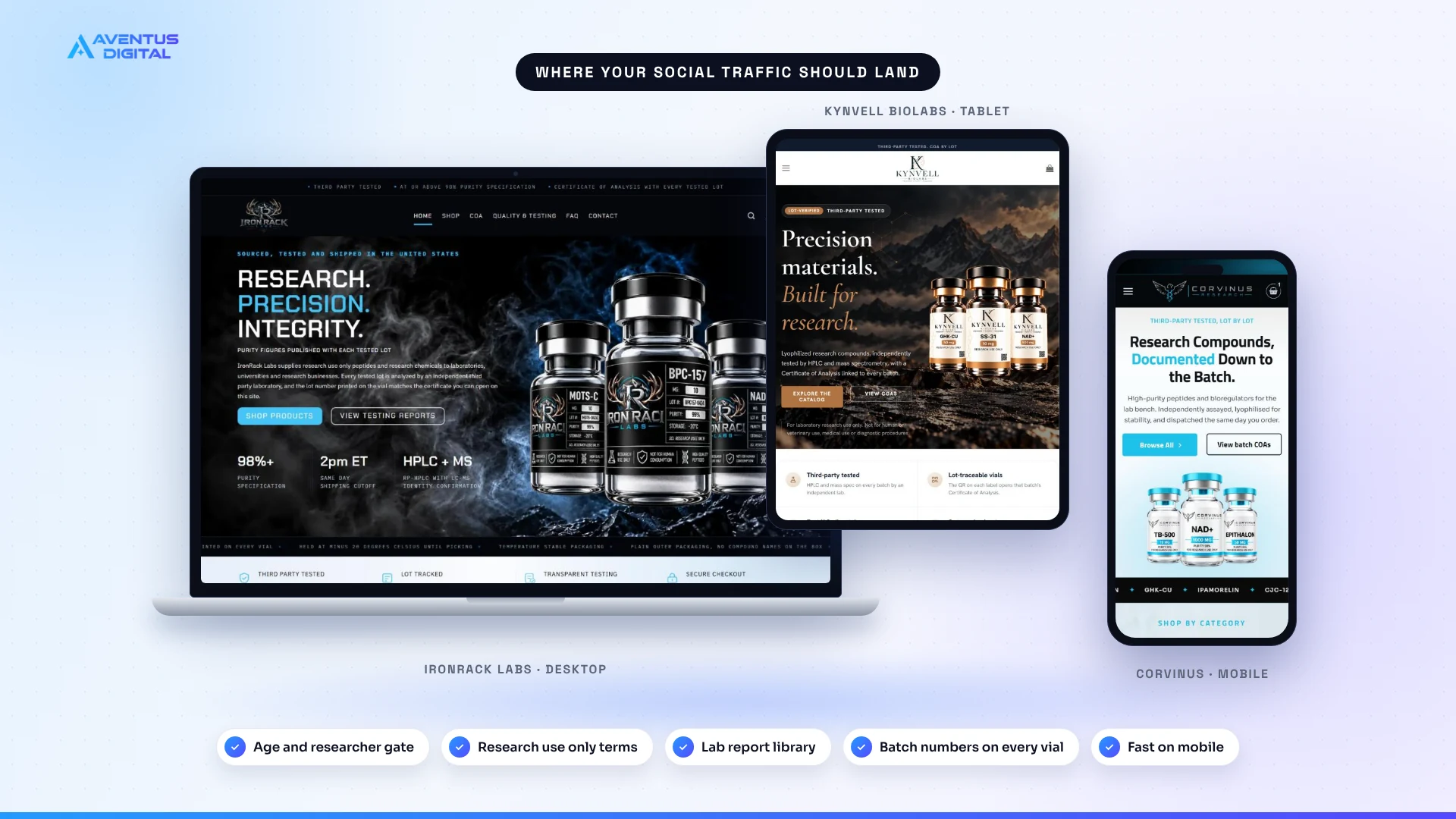
Example: packaging and dispatch posts that build trust without mentioning how the product is used.
Communities: Reddit, Discord and Telegram
Research communities are where serious buyers ask questions, and they punish obvious promotion. Read each subreddit’s rules before posting, answer questions about testing and storage without linking your products, and let your profile do the introducing. Some brands run their own Discord or Telegram channel for batch alerts. If you do, treat it like any other marketing channel: no claims, no dosing talk from staff, and moderators who remove it when members post it.
Mistakes we see in peptide social media marketing
- Spending a launch budget on Meta ads that never pass review.
- Product posts with prices, discount codes and “DM to order”.
- Reposting customer stories about effects.
- Creators posting without an Ad label or with their own dosing advice.
- A bio link pointing to a product page that still carries health claims.
- No backup channel, so one closed account wipes out the whole audience.
What an Aventus peptide social setup includes
- A channel plan built around platforms that allow peptide content, agreed before launch.
- Content pillars and post templates in your brand style, with compliant caption examples.
- A clean bio, link page and landing pages that carry your research use only terms.
- Open Graph tags so shared links show the right image and title.
- Signup forms that turn social visitors into consented email subscribers.
See how this fits with SEO and email on our peptide marketing page, or ask for a free website audit of the store your social traffic lands on.
Need a store your social traffic can safely land on?
We build peptide websites with research use only terms, age checks, lab report libraries and signup forms ready for the traffic social brings. You see a free homepage mockup before you pay anything.
Zyvara Life, a 30 product research peptide store, went live in 14 days.
Peptide social media marketing rewards patience over spend. Post the lab work, the batches and the research, keep selling off the feed, hold creators to your wording rules and move every follower towards a website and an email list you own.
You might also like
- Email marketing for peptide stores: platforms, consent and flows that sell without claims.
- Peptide affiliate program: paying partners while keeping control of what they say.
- Research use only disclaimer: the wording and where it belongs on your site.
- Zyvara Life case study: a full peptide store built in 14 days.

Author
Zubayed Feroz
Founder of Aventus Digital. 7 plus years building WordPress and WooCommerce stores, including more than 50 for research peptide brands in the UK, the US and the EU.
General information, not legal advice. This article describes how social platform policies and UK and US advertising rules commonly affect research peptide brands. Platform policies change often and are applied at each platform’s discretion. It is not legal advice. Responsibility for compliance sits with the business owner, so take advice from a solicitor for your products and markets.
Published 19 November 2026. Last reviewed 19 November 2026.
Frequently asked questions
Can you run Facebook or Instagram ads for peptides?
Not reliably. Meta’s advertising standards do not allow ads that promote the sale or use of unsafe substances, and research peptide ads are usually rejected. Repeated rejections can restrict the Business account, so build growth on organic content and owned channels instead.
What should a peptide brand post on social media?
Lab reports and batch releases, packaging and dispatch, behind the scenes content, plain summaries of published research and explanations of research use only. Leave out prices, discount codes, results, dosing and customer stories about effects.
Does peptide social media marketing work without ads?
Yes, when social feeds owned channels. Organic posts build trust and send people to your newsletter, blog and lab report library, which keep working even if an account is closed. SEO and email carry the conversions.
Can I use influencers to promote research peptides?
Only with clear rules. Paid posts need an upfront Ad label in the UK and a clear disclosure in the US, and the brand shares responsibility for what creators say. Our guide to running a peptide affiliate program covers the wording rules we use.
Is TikTok safe for peptide brands?
It is the riskiest of the large platforms. TikTok’s branded content policy excludes drug related and pharmaceutical products from paid partnerships, so use it only for plain education, or leave it out of the plan.
Can Aventus help with peptide social media?
Yes. We plan channels, create post templates and build the website and signup forms that social traffic lands on, as part of our peptide marketing service.
Related blogs
Peptide social media marketing: what each platform allows in 2026
Peptide social media marketing in 2026: what Meta and TikTok allow, what to post without [...]
Nov
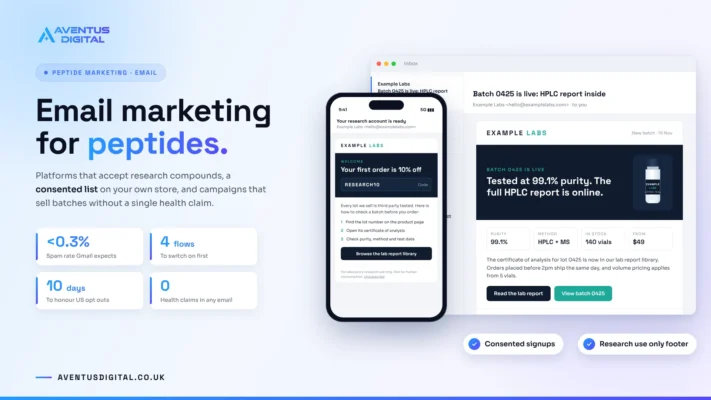
Email marketing for peptides: how research stores build a list that lasts
Email marketing for peptides: which platforms allow research compounds, how to build a consented list, [...]
Nov
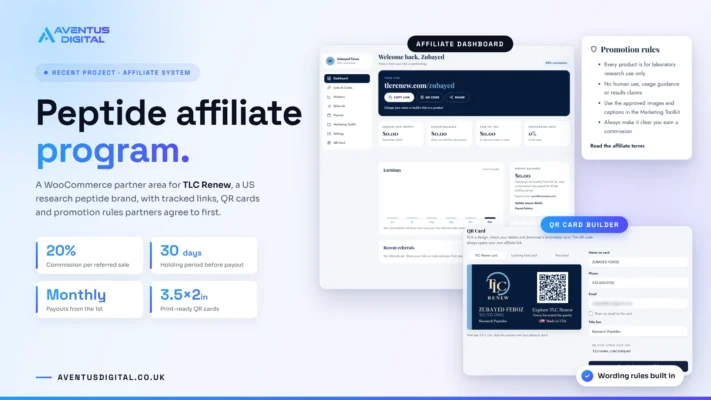
Peptide affiliate program: how to set one up without losing control
How to run a peptide affiliate program on WooCommerce: software, commission and cookie settings, wording [...]
Nov
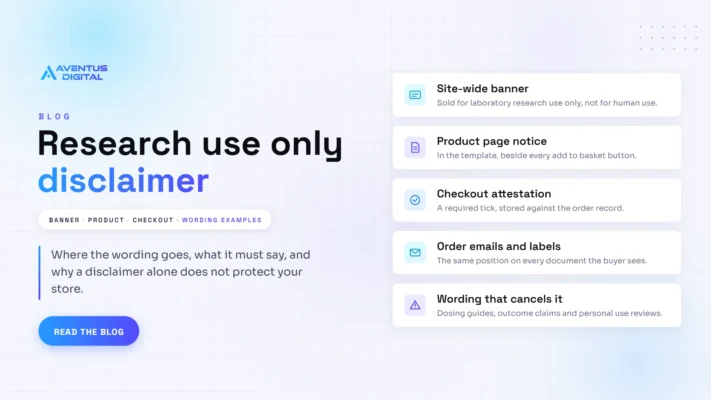
Research use only disclaimer: wording examples for peptide stores
A research use only disclaimer tells buyers a product is sold for laboratory research and [...]
Nov
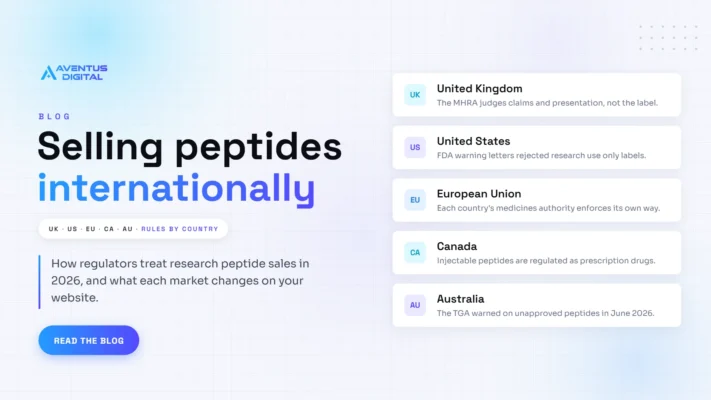
Selling research peptides internationally: rules by country
Research peptide rules are set country by country, and in 2026 regulators in the US, [...]
Nov
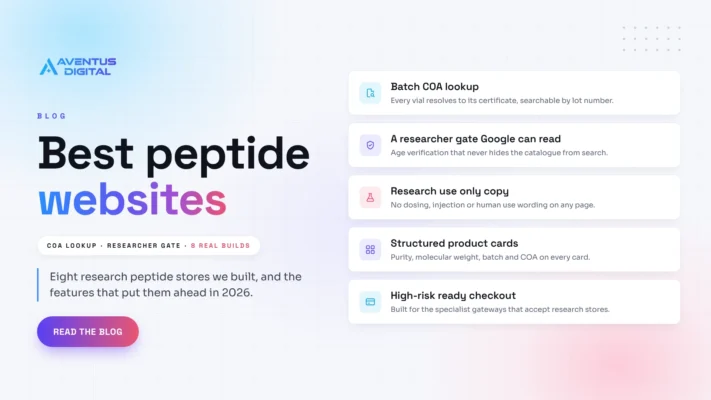
Best peptide websites in 2026
The best peptide websites in 2026 make purity something a researcher can check rather than [...]
Nov
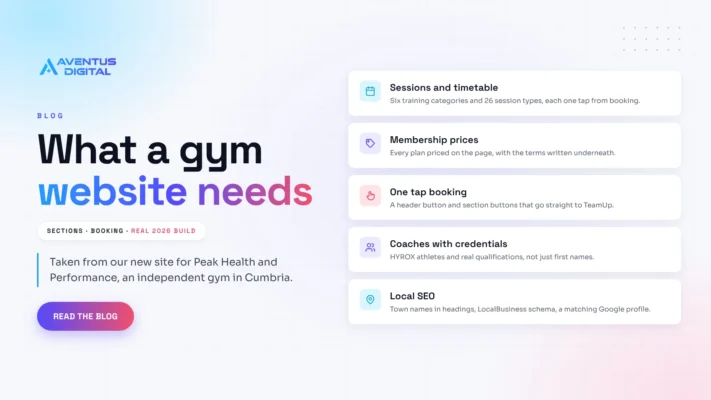
Gym website guide: what yours needs, from a real 2026 build
What a gym website needs in 2026, from prices and class booking to coaches and [...]
Nov
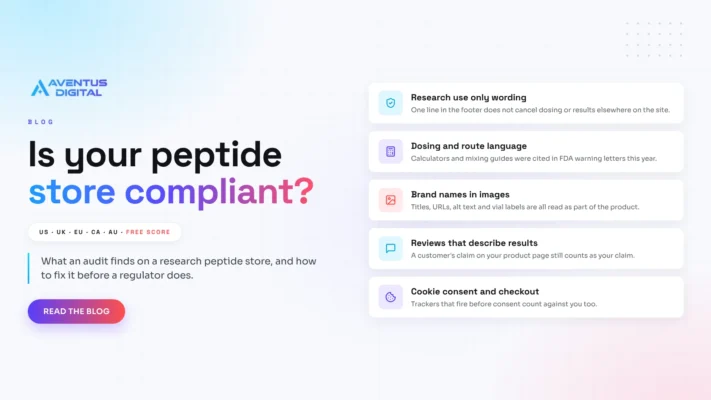
Is your peptide website compliant?
Peptide compliance means every part of a research peptide store, from product titles and vial [...]
Nov