
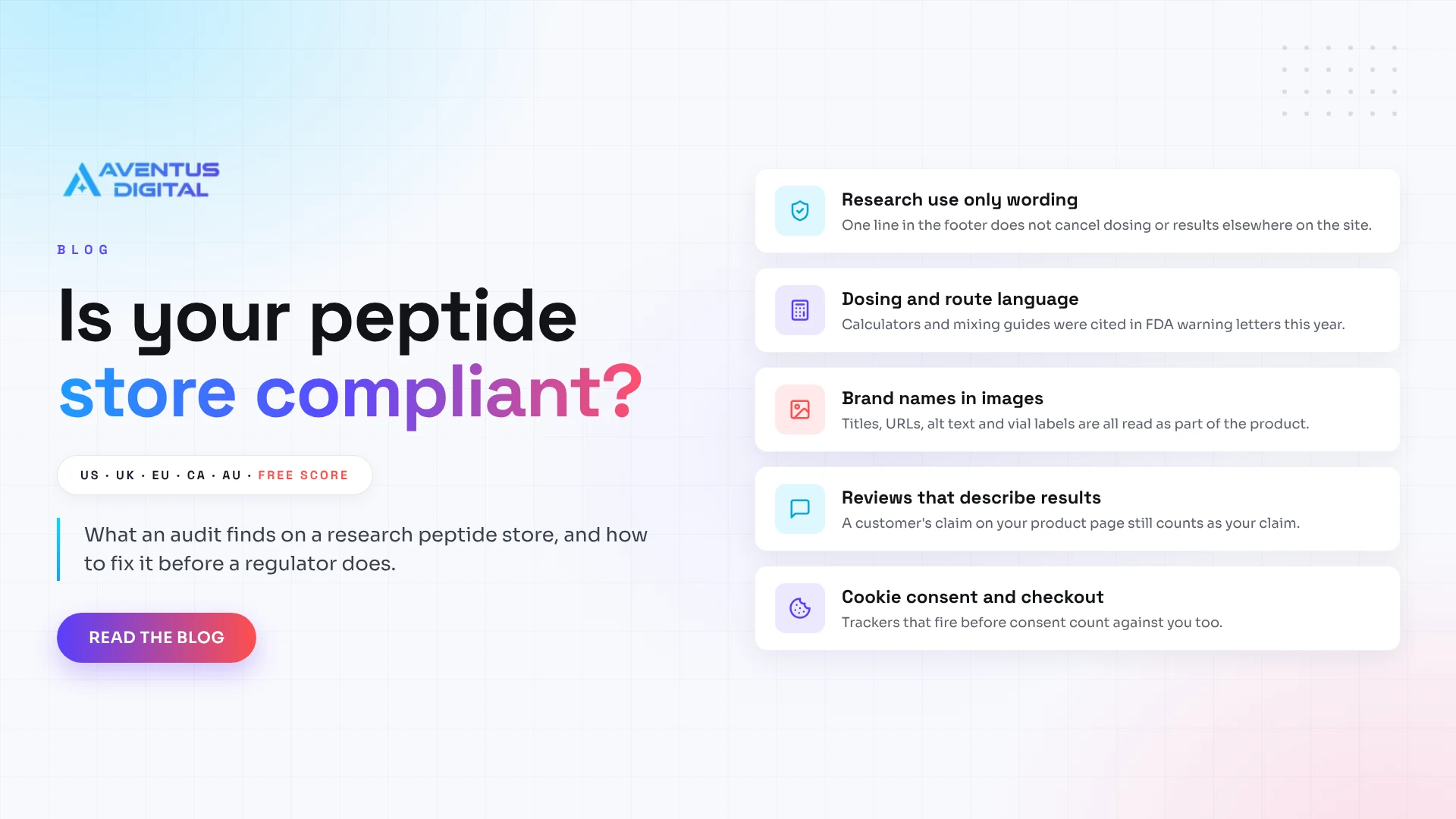
Peptide compliance in 2026: what an audit finds on your store
Peptide compliance means every part of a research peptide store, from product titles and vial photos to reviews and the cookie banner, holds up against the medicines, advertising and consumer rules of each market you ship to. A research use only line in the footer is not enough on its own, and in 2026 regulators said so in writing.
Most store owners we speak to are not trying to cut corners. They added the disclaimer, wrote careful product copy and launched. Then a processor holds their payouts, or a competitor gets a warning letter, and they realise nobody has ever read their site the way a regulator would. We build research supply stores, including Crew Labs and Zyvara Life, and our peptide compliance checker turns that read into a score you can act on.
Why peptide compliance got stricter in 2026
- USA: FDA warning letters to online RUO sellers, dated 31 March and 24 August, rejected research use only labels. The August letters named bacteriostatic water sold for mixing and dosing calculators as evidence of human use
- The headline that misleads people: the FDA’s April changes to its Category 2 list concern pharmacy compounding under prescription. They did not make online RUO sales lawful
- Canada: Health Canada won a permanent injunction against an online peptide seller in June, covering its websites and social media
- Australia: the TGA made unapproved peptides a compliance priority for 2026 to 2027
- UK: the MHRA judges a product by how it is presented, which we cover in our guide to whether it is legal to sell peptides in the UK
The pattern is the same everywhere. The disclaimer is one line, and the rest of the website is the evidence.
Is there such a thing as an FDA compliant peptide website?
No. The FDA does not certify websites, and no developer can make a research peptide store “FDA compliant”. What the FDA does is decide what a product is for by looking at everything around it, including the website. In 2026 its drugs centre sent warning letters to online peptide sellers dated 31 March, and five more dated 24 August. Every seller in the August group used “research use only” or “not for human consumption” labels, and the FDA said the websites as a whole still showed the products were meant for people.
On 30 October 2026 HHS published an interim enforcement discretion policy for six peptides. It covers state licensed pharmacies and physicians compounding under section 503A, on prescription. It does not make research use only stores lawful, and the warning letters remain the clearest guide to what the FDA looks for online.
What the FDA pointed to on those websites
- Claims about effects in people, including weight loss and performance
- Dosing or reconstitution calculators, peptide guides and mixing instructions
- Bacteriostatic water and injection supplies sold alongside the peptides
What to check on your own store
- Remove dosing calculators, reconstitution guides and “how to use” content
- Do not bundle bacteriostatic water, syringes or pens with research compounds
- Rename categories and products that describe a human outcome
- Remove reviews and testimonials that describe personal use
- Keep research use only wording consistent on every product, category and policy page
- Run a researcher gate with an attestation, while keeping the catalogue crawlable
The compliance layer every peptide store needs
Passing a check is far easier when compliance is part of how the store is built rather than a set of notices added later. These are the structural pieces we build into every research peptide store:
- An age and eligibility gate that visitors pass before the catalogue opens, built as an overlay so Google can still crawl every page
- Research use only labelling at product, cart and checkout level, repeated on the order confirmation
- A certificate of analysis lookup, searchable by batch number, with the PDFs hosted on your own domain
- Terms of sale stating the buyer is a qualified researcher or institution and that products are not for human or veterinary use
- A refund, returns and damaged goods policy, because vague policies drive chargebacks
- Shipping and destination restrictions stated openly, including the countries you do not ship to
- Full company identity: registered name, company number, registered address and a monitored contact route
- Privacy and cookie consent that meets UK GDPR and the rules of each market you sell to
The order to build it in
- Take legal advice on your product list before a single page is written
- Choose self hosted WooCommerce, so the store cannot be removed from under you
- Build the compliance blocks into the product template, not into individual descriptions
- Publish COAs by batch on your own domain, and keep them current
- Write every product page as though an underwriter and a regulator will both read it
- Assemble the underwriting pack, then approach acquirers that knowingly serve the sector
The full build sequence is in our guide on how to build a peptide website, and the payment side is in the peptide merchant account application pack. A store that is genuinely compliant never needs a hidden catalogue, a miscoded merchant category or someone else’s approved account, and we do not build any of them.
Outside the UK and US
Canada and Australia both took a firm line in 2026. Health Canada treats injectable peptides as prescription drugs, and in June a Quebec court granted it a permanent injunction against an online peptide seller. In Australia, the TGA and the Chief Medical Officer issued a joint warning on unapproved peptides in June, and Australian guidance is clear that a research use only label does not make selling or importing an unapproved peptide lawful. In the EU, each country’s medicines authority decides whether a product is presented or works as a medicine.
If you sell beyond the UK and US, take advice for each market before you open it at checkout, and block checkout for any country you have not cleared. Our guide to selling peptides internationally sets out the rules market by market, and the checker below applies the rule set for each market you tell it about.
What a peptide compliance audit actually finds
This is the free Snapshot from our sample report. The store is fictional, but the issues in it are typical of what we find on live stores.
northvalelabs.example
Sample Snapshot for a fictional website
Overall risk score
19 findings. Capped at 49 while a Critical finding is open.
Scores by layer
Top 3 issues
Pharma brand name on product
found on a product page
Bacteriostatic multi-dose diluent listing
found on a product page and its label
Trackers fire before cookie consent
found site-wide
Three things are worth noticing in that report.
- One layer sank the score. Five of the six layers score 76 or higher. Legal scores 15, and any open Critical finding caps the total at 49, however polished the rest of the store is
- The Critical issues are ordinary product data. A pharma brand name in a title and a bacteriostatic diluent listing are two lines in a catalogue, not a rogue blog post. The second is exactly what the FDA cited in August
- Not every risk is about peptides. Trackers firing before cookie consent is a privacy finding that runs across the whole site, and underwriters notice it
The rules we check, market by market
You tell us where you sell, and the checker applies the rule set for each of those markets to every page, product and post on the store. There is no sampling, and the rules are reviewed every week.
| Market | Rules the checker applies | Why it matters in 2026 |
|---|---|---|
| USA | FDA and FTC claims rules, fake reviews, California privacy, email and SMS consent | FDA warning letters to RUO sellers in March and August |
| UK | MHRA medicines rules, CAP Code, cookie consent, UK GDPR, consumer contracts, DMCC Act | Presentation decides whether a peptide is treated as a medicine |
| EU | Medicinal and health claims, consumer rights, sale prices, ePrivacy, GDPR, accessibility | Enforced country by country, so each market you ship to counts |
| Canada | Food and Drugs Act, natural health products, Competition Act pricing, PIPEDA, CASL | Injectable peptides are regulated as prescription drugs |
| Australia | TGA advertising rules, Australian Consumer Law, Privacy Act, Spam Act | Unapproved peptides are a TGA priority for 2026 to 2027 |
| Findings feed six scored layers: Legal 35%, Processor readiness 20%, Privacy 15%, Consumer protection 15%, Best practice 10%, Accessibility 5%. A risk assessment, not legal advice. | ||
Legal and processor readiness carry more than half the weight, because those are the findings that cost you a payment account or bring a regulator’s letter. The checker is built for research peptide stores, and it also covers supplements, CBD, skincare and general ecommerce.
Free Snapshot or Full Review?
The Snapshot tells you whether you have a problem. The Full Review tells your developer exactly what to change, where it sits (product title, tab, vial label, footer) and what to replace it with.
| What you get | Free Snapshot | Full Review |
|---|---|---|
| Overall risk score and grade | Free SnapshotIncluded | Full ReviewIncluded |
| Severity counts | Free SnapshotIncluded | Full ReviewIncluded |
| Scores for six layers | Free SnapshotIncluded | Full ReviewWith finding counts |
| Top 3 issues | Free SnapshotTitle and page type | Full ReviewExact location |
| Every finding with the exact wording found | Free SnapshotLocked | Full ReviewIncluded |
| Replacement wording | Free SnapshotLocked | Full ReviewIncluded |
| Legal reference for each finding | Free SnapshotLocked | Full ReviewIncluded |
| Priority fix list | Free SnapshotLocked | Full ReviewIncluded |
| Market notes for each country | Free SnapshotLocked | Full ReviewIncluded |
| Free rescan within 30 days | Free SnapshotNot included | Full ReviewIncluded |
| See a sample report | Free SnapshotView sample | Full ReviewView sample |
| Price | Free SnapshotFree | Full Review£49one-off |
Need the fixes made too? Ask for a fixed-price quote.
Want to see one first? Open the sample Snapshot and the sample Full Review, both built from the same fictional store. The Full Review also includes analyst notes on risks that no rule covers yet, and it is delivered the same day it is paid.
How to get your peptide compliance score
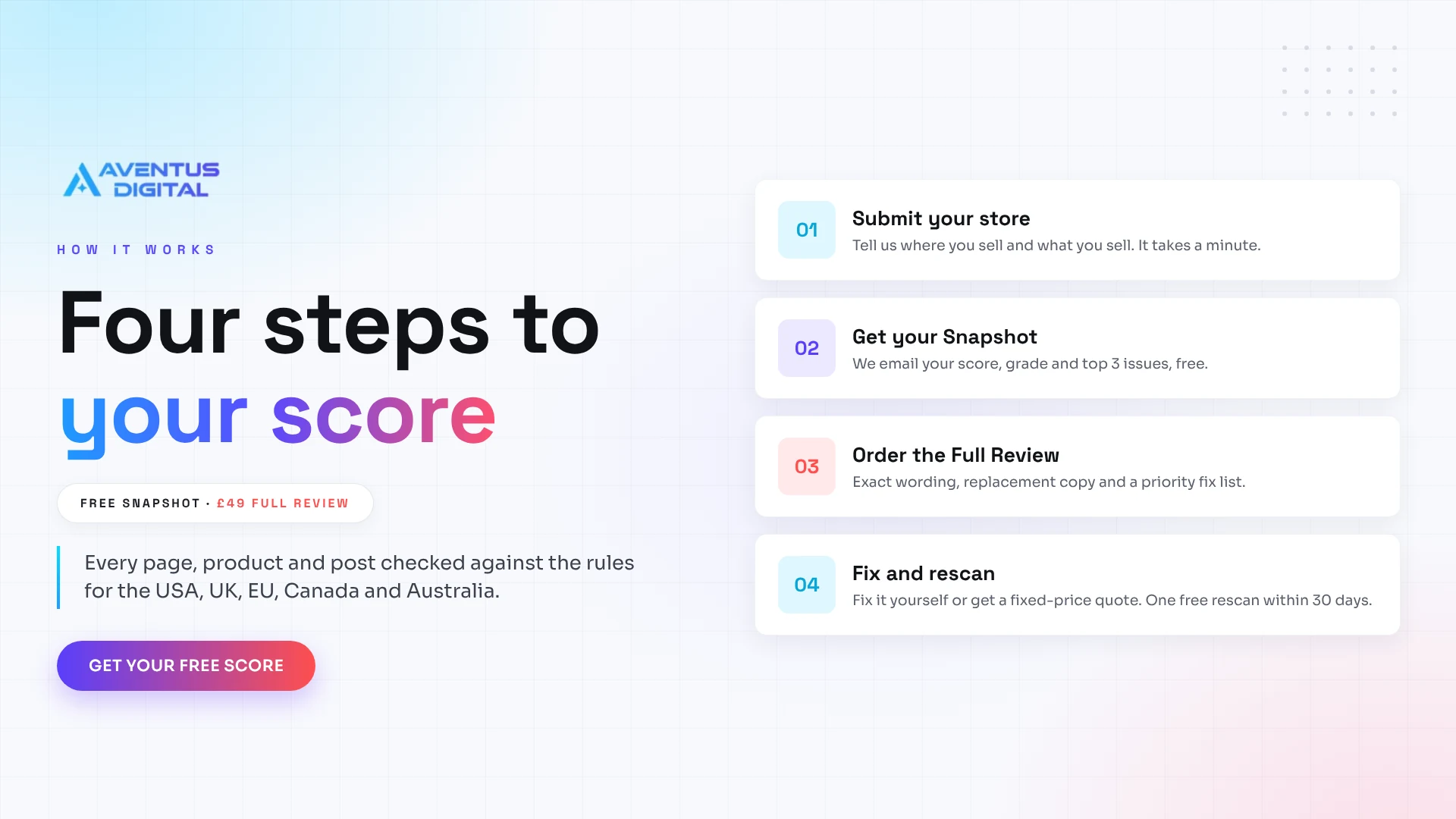
- Submit your store. Tell us where you sell and what you sell. It takes a minute, and we only need your public URL
- Get your Snapshot. The checker reviews every page and we email your score and top three issues, free
- Order the Full Review if you want the detail. We send an invoice and deliver the report the same day it is paid
- Fix and rescan. Make the changes yourself or ask us for a fixed-price quote, then use your free rescan within 30 days
This is what you fill in:
The checker is a risk assessment, not legal advice. It does not certify that a store is compliant, and it cannot promise what a processor or regulator will decide. What it gives you is the view they will get, before they get it. If you would rather not make the fixes yourself, we quote a fixed price on WordPress and WooCommerce stores and rescan once they are live.
Peptide compliance checker
See what a regulator or underwriter sees on your store
Every page, product and post checked against the rules for the USA, UK, EU, Canada and Australia. Your score, grade and top three issues, free by email.
Free Snapshot. Full Review £49 with one free rescan within 30 days. Not legal advice, and no guarantee of processor approval.
Peptide compliance is not a launch task you finish once. New products, new reviews and plugin updates change what your site says every month, which is why our website maintenance plans include compliance checks. Get your score before your processor or a regulator reads the site for you, and run it again after every big change.
You Might Also Like
- Peptide compliance checker every page, every market, scored out of 100.
- Is it legal to sell research peptides in the UK? the MHRA line, explained for store owners.
- Peptide merchant account application pack
- Peptide payment processors compared: US and UK 2026
- Peptide websites the builds, the compliance structure and what is included.
- Best peptide websites in 2026

Author
Zubayed Feroz
Founder of Aventus Digital. 7 plus years building WordPress and WooCommerce stores, 700 plus websites across 40 plus countries, including research supply stores for UK and US clients.
General website guidance, not legal advice. Medicines, advertising, privacy and consumer rules differ between markets and change over time, so take advice from a lawyer qualified in each market you sell to. The peptide compliance checker is a risk assessment: it does not certify compliance and cannot guarantee regulator or payment processor decisions. The sample report shown is for a fictional website.
Published 5 November 2026. Last updated 17 November 2026.
Frequently Asked Questions
What is peptide compliance?
Peptide compliance is how well a research peptide store holds up against the medicines, advertising, privacy and consumer rules in each market it sells to. It covers product titles, images, vial labels, reviews, blog posts, policies, pricing and checkout, not just the disclaimer. Regulators and payment processors judge the whole site.
What does a peptide compliance audit check?
Our checker reads every page, product and post, with no sampling. It looks for dosing and injection language, treatment claims, pharma brand names and restricted molecule names in titles, URLs, images and vial labels, reviews that describe results, and gaps in RUO wording, policies, cookie consent, pricing and checkout. Each finding is scored across six weighted risk layers into one score out of 100.
Is a research use only disclaimer enough?
No. In 2026 FDA warning letters rejected RUO disclaimers when the rest of the website pointed to human use, such as dosing calculators or bacteriostatic water sold for mixing. Regulators in the UK, Canada and Australia also look at overall presentation. The disclaimer has to match everything else on the site.
How much does a peptide compliance review cost?
The Snapshot is free and shows your score, grade, severity counts, layer scores and top three issues. The Full Review is £49 one-off and adds every finding with the exact wording found, replacement wording, legal references, a priority fix list, market notes and one free rescan within 30 days.
How quickly will I get my results?
The Snapshot is emailed to you after the checker has reviewed your store. If you order the Full Review, we send an invoice and deliver the PDF the same day it is paid.
Is the checker legal advice, and will it get me approved by a processor?
No to both. It is a risk assessment that shows what a regulator or underwriter is likely to see on your site, and it does not certify compliance. Processors set their own criteria, so take legal advice on your catalogue and use the report to fix what it finds before you apply.
Is there such a thing as an FDA compliant peptide website?
No. The FDA does not certify websites. It judges what a product is intended for by looking at the whole website, so what you can do is remove the things its 2026 warning letters pointed to: claims about effects in people, dosing calculators and injection supplies sold alongside research compounds.
Do the rules change outside the UK and US?
Yes. Canada treats injectable peptides as prescription drugs, Australia’s TGA has made unapproved peptides an enforcement focus, and EU countries enforce medicines law one by one. Take advice for each market and block checkout for any country you have not cleared.
Related Blogs
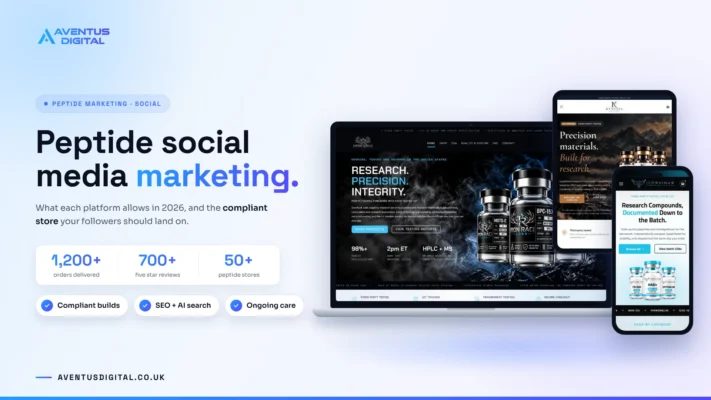
Peptide social media marketing: what each platform allows in 2026
Peptide social media marketing in 2026: what Meta and TikTok allow, what to post without [...]
Nov
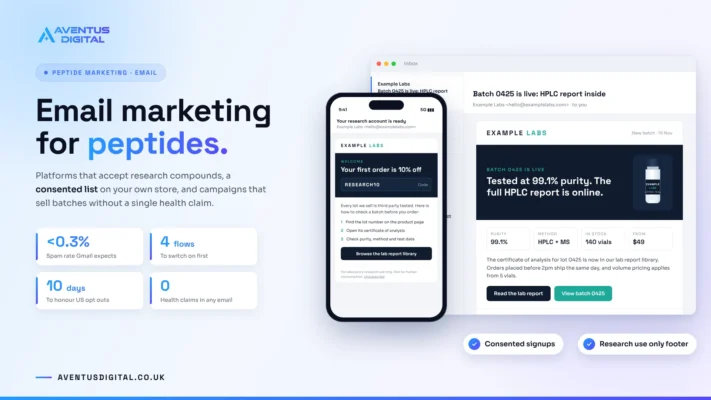
Email marketing for peptides: how research stores build a list that lasts
Email marketing for peptides: which platforms allow research compounds, how to build a consented list, [...]
Nov
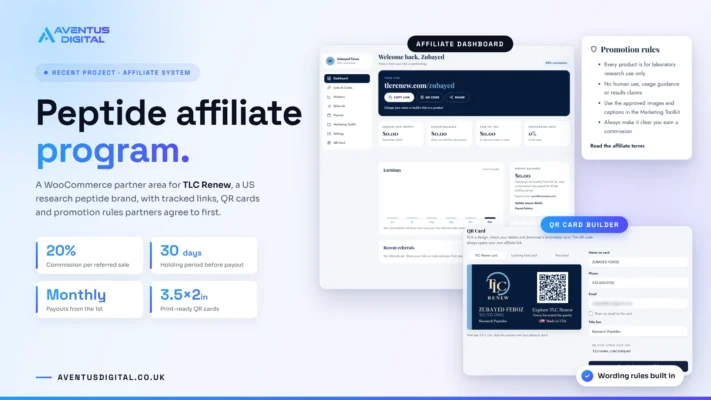
Peptide affiliate program: how to set one up without losing control
How to run a peptide affiliate program on WooCommerce: software, commission and cookie settings, wording [...]
Nov
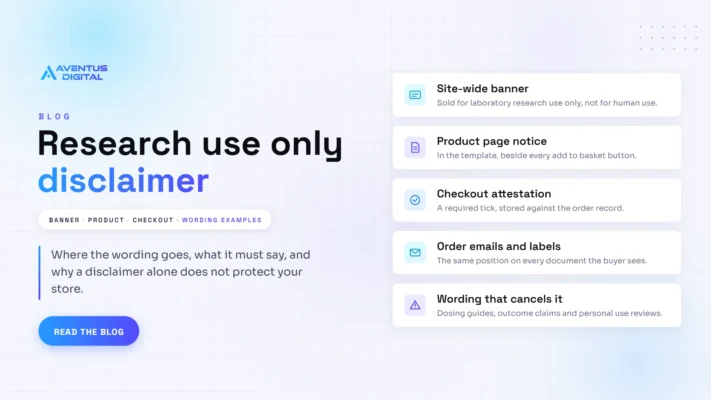
Research use only disclaimer: wording examples for peptide stores
A research use only disclaimer tells buyers a product is sold for laboratory research and [...]
Nov
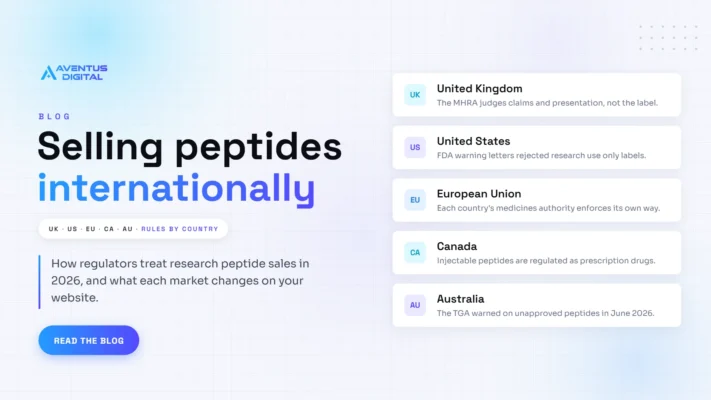
Selling research peptides internationally: rules by country
Research peptide rules are set country by country, and in 2026 regulators in the US, [...]
Nov
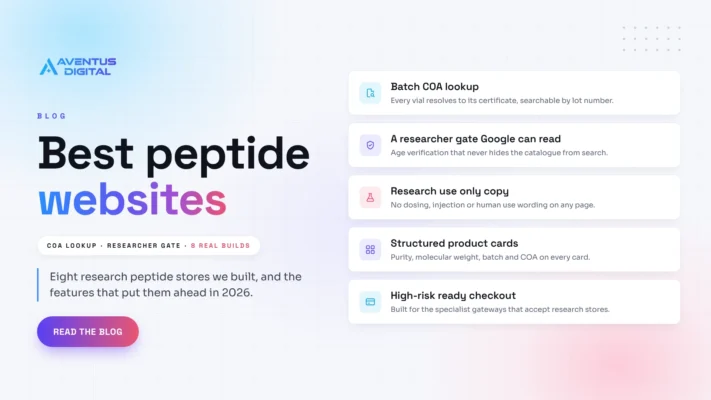
Best peptide websites in 2026
The best peptide websites in 2026 make purity something a researcher can check rather than [...]
Nov
Gym website guide: what yours needs, from a real 2026 build
What a gym website needs in 2026, from prices and class booking to coaches and [...]
Nov
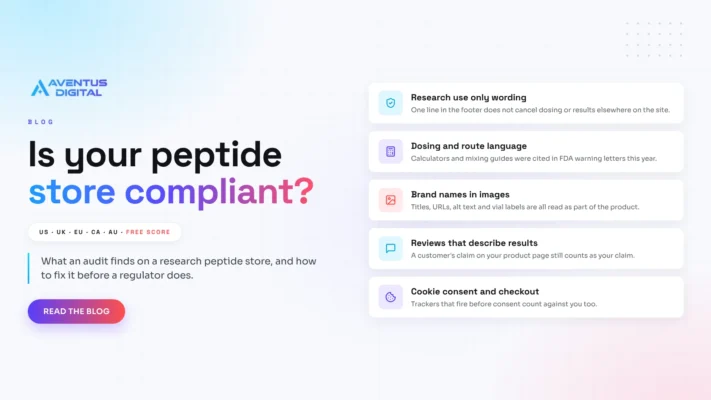
Is your peptide website compliant?
Peptide compliance means every part of a research peptide store, from product titles and vial [...]
Nov