
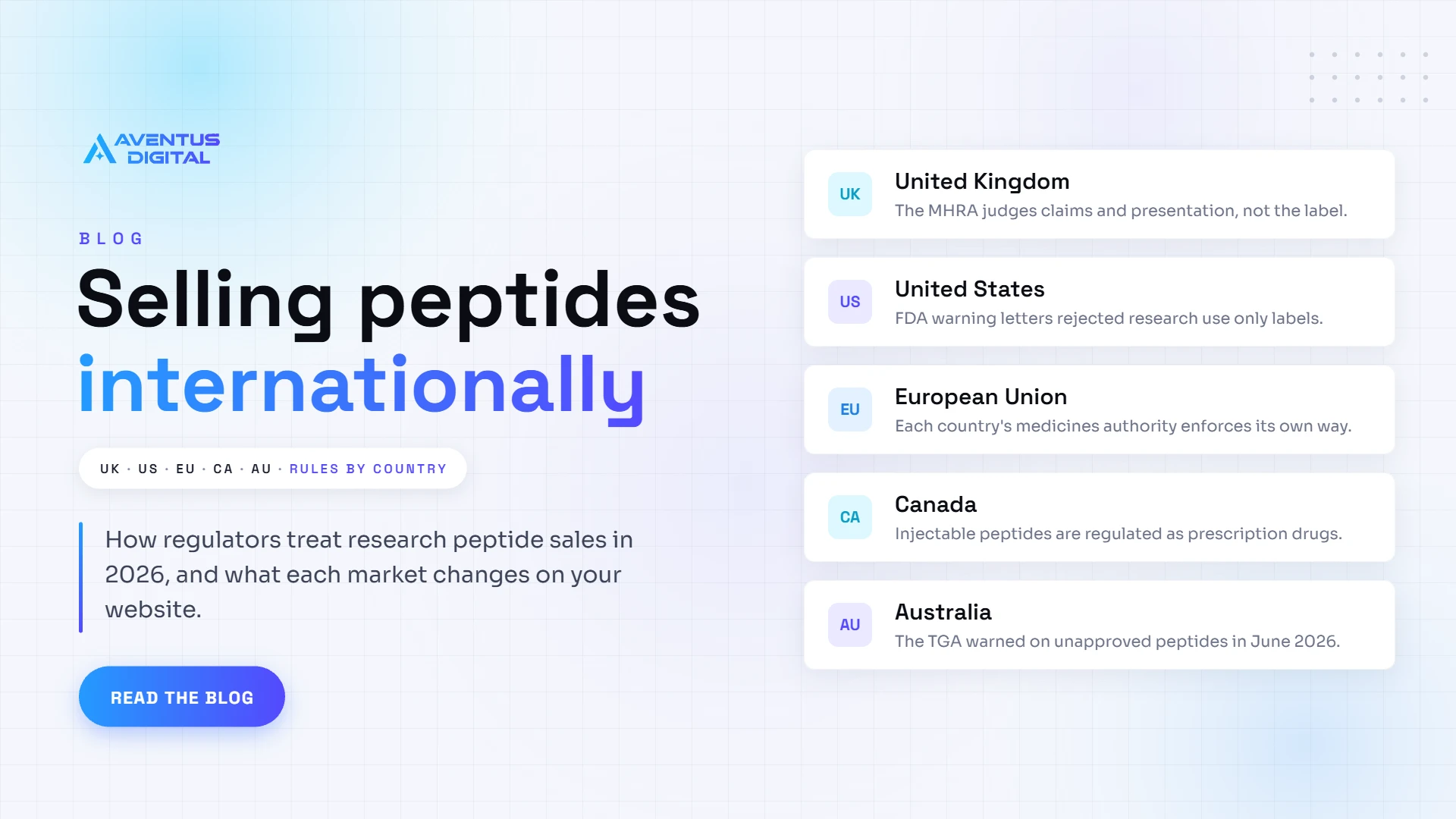
Selling research peptides internationally: rules by country
Research peptide rules are set country by country, and in 2026 regulators in the US, Canada and Australia said much the same thing: a research use only label does not make a sale lawful if the business points to human use. This guide compares the main markets and what each one means for your website.
Most of the 50+ peptide stores we have built sell to the UK, the US or both, and more of them now ship into Europe and further afield. Once a store starts trading, the question we hear most is not about design. It is which countries a founder can open at checkout, and what has to change on the site when they do.
We are Aventus Digital, and over 7+ years we have delivered 700+ websites for clients in 40+ countries. This guide is general information about how regulators describe their own position and what that means for a website. It is not legal advice. Every country section links to the regulator’s own words, and we review the page every quarter.
Peptide regulations by country at a glance
The table below is the short version. The sections after it explain each market, then what changes on the website, in shipping and in payments.
| Market | Regulator | 2026 positionAs at 17 November 2026 | On your websiteWhat we set up |
|---|---|---|---|
| United Kingdom | MHRA, with the ASA and the CAP Code on advertising | Classification turns on claims and presentation. The MHRA lists websites, social media and customer reviews among the things it reads. | No medicinal claims anywhere, one research use position in the product template, moderated reviews. |
| United States | FDA, with the FTC on advertising | Warning letters to online sellers dated 31 March and 24 August rejected research use only labels. The October HHS policy covers six peptides for pharmacy compounding only. | No claims about effects in people, no dosing calculators, no injection supplies sold alongside. |
| European Union | Each country’s medicines authority, with the European Medicines Agency | EU law treats a product as a medicine by how it is presented or by how it works, and each country enforces it. | A legal check per country before checkout opens, translated policies and GDPR consent. |
| Canada | Health Canada | Injectable peptides are regulated as prescription drugs. A Quebec court granted a permanent injunction against an online seller in June. | Checkout stays closed to Canada until a Canadian lawyer has reviewed your catalogue. |
| Australia | Therapeutic Goods Administration (TGA) | Joint warning with the Chief Medical Officer on unapproved peptides in June. Research use only wording does not make them lawful to supply. | Checkout stays closed to Australia until an Australian lawyer has reviewed your catalogue. |
| Other markets | The local medicines regulator | Varies by country, and often changes without much notice. | Read the regulator’s own guidance, then decide. Checkout blocked until you have. |
| Summarised from each regulator’s published statements and reviewed on 17 November 2026. Positions change, so check the source on the day you rely on it. This is general information, not legal advice. Responsibility for your products, claims and regulatory position sits with you as the business owner. | |||
One pattern runs through every row. Regulators read the whole business, not the label. The same store can be treated as a laboratory supplier or as an unlicensed medicines seller depending on what its pages, reviews, images and social posts say.
The United Kingdom: presentation decides
In the UK, the Human Medicines Regulations 2012 decide whether something is a medicinal product, and the MHRA’s borderline products guidance explains how it reaches a view. It weighs the claims made for a product and how it is presented to the public, and it names websites, social media and customer reviews in that list. Advertising on your own website also falls under the CAP Code, which the ASA enforces.
A UK store stays on the right side of that line by presenting products only as research materials, on every page and in every review it publishes. We cover the UK position in detail in is it legal to sell peptides.
The United States: intended use decides
The FDA decides what a product is by its intended use, and it reads intended use from the labelling, the marketing and the website as a whole. A research use only label does not settle it. On 31 March 2026 its drugs centre issued warning letters to online peptide sellers after reviewing their websites, and on 24 August it sent five more. Every seller in the August group used research use only or not for human use wording, and the FDA pointed to the websites themselves, including bacteriostatic water sold alongside the peptides and dosing calculators.
On 30 October 2026 HHS published an interim enforcement discretion policy for six peptides. It covers compounding by state licensed pharmacies and physicians under section 503A, on prescription. It does not make research use only stores lawful, and the warning letters remain the clearest guide to what the FDA looks for online.
Is it legal to sell research peptides in Canada?
Health Canada regulates injectable peptides as prescription drugs, which must be authorised before they can be sold. On 11 June 2026 the Superior Court of Quebec granted Health Canada a permanent injunction against an online peptide retailer, which the regulator announced on 29 July. Earlier in the year it warned the public about unauthorised injectable peptides bought online and seized products from sellers. Calling a product a research peptide does not, on its own, take it outside Health Canada’s reach.
For most research stores, that makes Canada a market to keep closed at checkout until a Canadian lawyer has reviewed the catalogue and the way the site presents it.
Is it legal to sell research peptides in Australia?
In Australia, peptides that are not on the Australian Register of Therapeutic Goods are unapproved, and many are prescription only substances. In June 2026 the Chief Medical Officer and the TGA issued a joint warning about the growing supply and advertising of unapproved peptides, and Australian health guidance makes clear that a research use only or not for human consumption label does not make them lawful. Advertising prescription only or unapproved therapeutic goods to the public is generally prohibited.
As with Canada, the safe default is to keep Australia closed at checkout until an Australian lawyer has reviewed your catalogue.
Selling research peptides in Europe
EU law, under Directive 2001/83/EC, treats a product as a medicinal product in two ways: by presentation, if it is presented as treating or preventing disease in people, or by function, if it is used to change how the body works. Each member state’s medicines authority applies that test, so the same product can be treated differently in different countries, and enforcement varies from one market to the next.
Europe also brings its own consumer and privacy rules. The EU GDPR and ePrivacy rules set how cookie consent and customer data must work, and consumers buying at a distance usually have a 14 day right to withdraw, which your returns policy has to deal with if you sell to individuals. Treat each EU country as its own market, not the EU as one.
What changes on your website for each market
Once your advisers have cleared a market, the website has to be set up for it. These are the parts that change.
- Currency and tax: GBP with VAT for the UK, USD with state sales tax for the US, EUR and local currencies with EU VAT for Europe, and local currency elsewhere.
- Language: translated product data and policies, with the translations read for compliance just as closely as the English.
- Cookie consent: UK GDPR and PECR in the UK, GDPR and ePrivacy in the EU, and state privacy laws such as California’s in the US.
- Shipping zones: one zone per market, with its own rates, couriers and delivery times.
- Checkout country blocking: WooCommerce can limit checkout to the countries you choose, so a market you have not cleared cannot place an order.
- Policies per market: terms, returns and privacy wording that reflect each country’s consumer rules, published as real pages.
Where we come in: every store we build is set up for the countries it actually sells to, not copied from a template made for another market. We plan currencies, tax, shipping zones, policies and checkout blocking at the start of the project, as part of our peptide website design work, so adding a market later is a settings change rather than a rebuild.
Shipping research peptides across borders
Shipping is where international selling most often goes wrong, and it is the part founders tend to think about last.
- Customs paperwork: describe every parcel accurately, with the right commodity code and value. Mis-describing contents to get through customs is a serious legal risk and the fastest way to lose a courier account.
- Temperature and packaging: plan packaging and delivery times around how your products need to be stored, because cross-border parcels spend longer in transit.
- Couriers: some couriers refuse research compounds outright. Check each courier’s prohibited items list before you promise delivery to a country.
- The destination’s rules: customs in the buyer’s country can seize parcels it considers unauthorised medicines, whatever the rules are where you ship from.
Your shipping policy should name the countries you ship to, the countries you do not, and who carries the risk if a parcel is held at the border.
Payments when you sell in several countries
Acquirers underwrite against the countries on your application, so every market you open has to be declared. EU cards need Strong Customer Authentication, cross-border cards cost more than domestic ones, and local bank rails differ by country. We compare the options, including those beyond the UK and US, in peptide payment processors compared, and the documents an acquirer asks for are in our peptide merchant account application pack.
How to decide which countries to open
Use this checklist before you switch on any new market at checkout.
- Legal advice: a lawyer qualified in that market has reviewed your catalogue and how your site presents it.
- The regulator’s own position: you have read the regulator’s published guidance and noted the date you read it.
- Payments: your acquirer covers the country and it is declared on your application.
- Shipping: a courier will carry your products there, and you can complete the customs paperwork accurately.
- The store: currency, tax, language, consent and policies are set up for that market.
- Review: you have a date in the diary to check the regulator’s position again, at least every quarter.
Open the country only when all six are true. Until then, keep checkout blocked for it. Not sure what your current store says about itself? Run our free peptide website compliance checker, which applies the rules for the UK, the US, the EU, Canada and Australia.
Peptide websites for brands worldwide
Selling in more than one country?
Get a free homepage mockup set up for your markets, with currencies, shipping zones, policies and checkout blocking planned before we build. Tell us your budget range and the countries you sell to.
Website work only. We are not lawyers, so confirm your legal position in each market before launch.
Selling internationally is a sequence, not a switch: advice for each market, the regulator’s own position, payments, shipping, then the store settings. Get those in order and adding a country becomes routine.
You might also like
- Is it legal to sell peptides?: UK and US rules, side by side.
- Peptide website compliance checklist: what the 2026 FDA letters mean for your store.
- Peptide payment processors compared: UK, US and international options.
- Peptide merchant account application pack: the documents underwriting asks for.
- How to build a peptide website: the 7 step process behind 50+ stores.

Author
Zubayed Feroz
Founder of Aventus Digital. 7 plus years building WordPress and WooCommerce stores, including more than 50 for research peptide brands in the UK, the US and the EU.
General information, not legal advice. Peptide rules differ by country and change often, so take advice from a lawyer qualified in each market you sell to. We summarise each regulator’s published position and link to the source, so check it on the day you rely on it. Responsibility for your products, claims and regulatory position sits with you as the business owner.
Published 17 November 2026. Last reviewed 17 November 2026. Next review February 2027.
Frequently asked questions
Is it legal to sell research peptides outside the UK and US?
It depends on the country and on how the store presents its products. In 2026 Health Canada and Australian health authorities both made clear that a research use only label does not make a sale lawful on its own, so take legal advice for each market before you sell there.
Can one website sell research peptides to several countries?
Yes, technically. WooCommerce handles multiple currencies, languages and shipping zones, and you can block checkout for any country you have not cleared. Each country’s rules still apply to the orders you accept from it.
Which countries are hardest for peptide stores in 2026?
Australia and Canada, where regulators warned the public about unapproved peptides, seized products and, in Canada, obtained a permanent court injunction against an online seller.
Does a research use only disclaimer protect me abroad?
No. Regulators look at the whole business, including product pages, reviews, images and social posts. The disclaimer only holds up when everything else on the site agrees with it.
Do I need a company in each country I sell to?
Not always, but a local entity can help with payment processors and tax registration. Ask an accountant in that market before you open it.
Related blogs
Peptide social media marketing: what each platform allows in 2026
Peptide social media marketing in 2026: what Meta and TikTok allow, what to post without [...]
Nov
Email marketing for peptides: how research stores build a list that lasts
Email marketing for peptides: which platforms allow research compounds, how to build a consented list, [...]
Nov
Peptide affiliate program: how to set one up without losing control
How to run a peptide affiliate program on WooCommerce: software, commission and cookie settings, wording [...]
Nov
Research use only disclaimer: wording examples for peptide stores
A research use only disclaimer tells buyers a product is sold for laboratory research and [...]
Nov
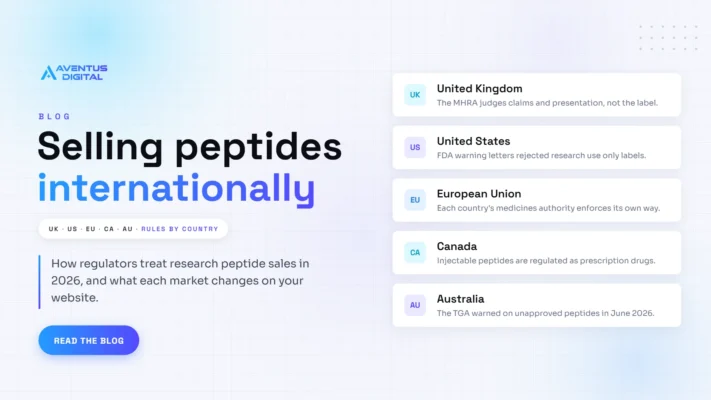
Selling research peptides internationally: rules by country
Research peptide rules are set country by country, and in 2026 regulators in the US, [...]
Nov
Best peptide websites in 2026
The best peptide websites in 2026 make purity something a researcher can check rather than [...]
Nov
Gym website guide: what yours needs, from a real 2026 build
What a gym website needs in 2026, from prices and class booking to coaches and [...]
Nov
Is your peptide website compliant?
Peptide compliance means every part of a research peptide store, from product titles and vial [...]
Nov