
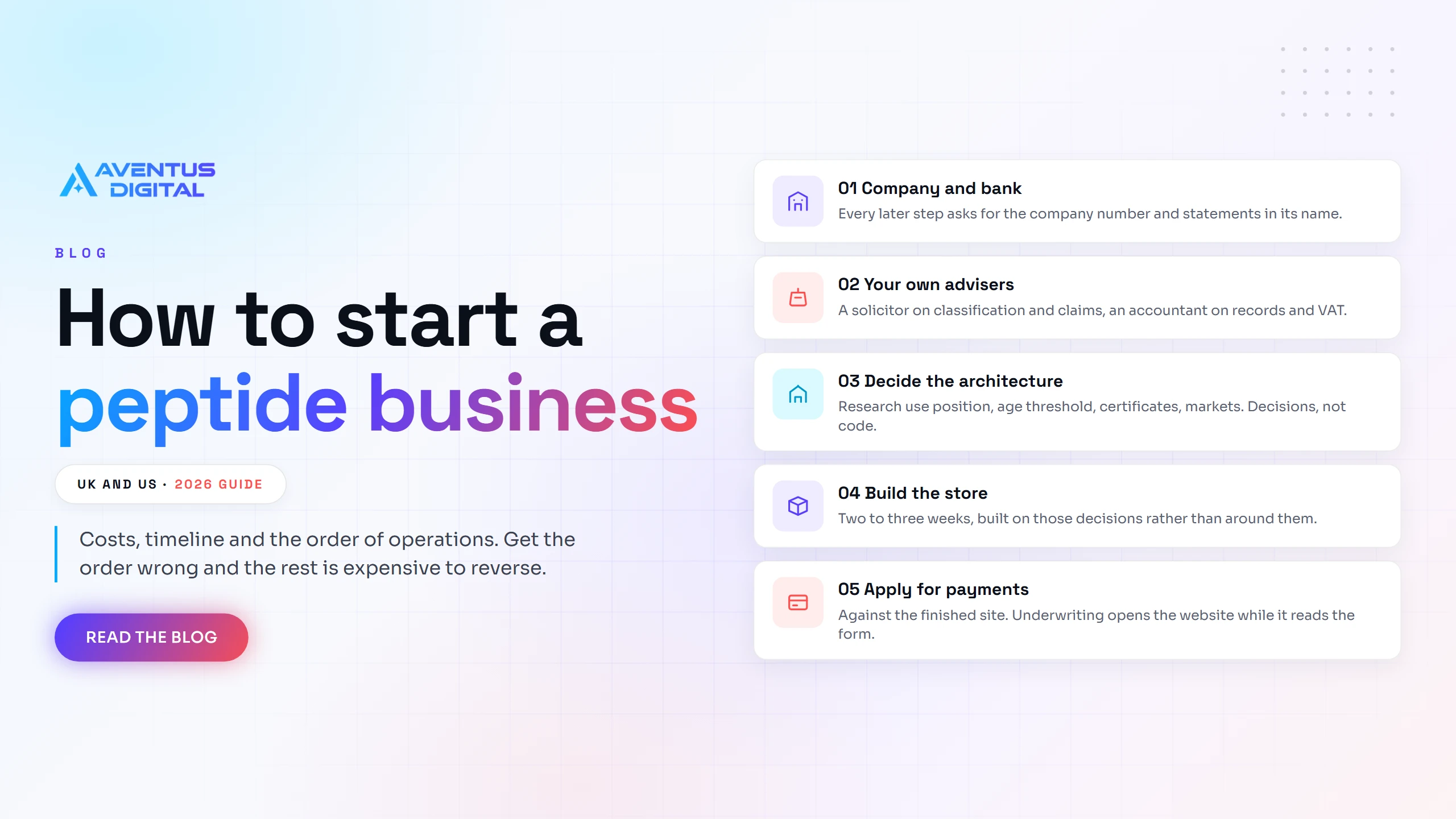
How to start a research peptide business in 2026: realistic costs, timeline and order of operations
Short answer: to start a peptide business you register the company, open the bank account, decide the compliance architecture, then build the store, then apply for payments. Budget from about £399 for the website plus a few hundred pounds of statutory costs, and expect six to ten weeks from decision to first order if nothing stalls.
Founders usually overestimate the size of the website and underestimate the order it has to be done in. On 5 October 2026 we counted the published pages on the five research supply stores we build or maintain: 13, 15, 15, 20 and 21. Between 5 and 8 product categories each, and the newest store launched with 14 products. A store that trades is roughly fifteen pages, not fifty, and the fifteen have to be the right ones.
We are Aventus Digital, and we build and maintain WooCommerce stores for research peptide brands in the UK, the US and the EU, including Crew Labs, Zyvara Life and Solix Labs. Across 7 plus years we have delivered 600 plus websites in 40 plus countries, with 700 plus five star reviews behind us. This post covers the website and the business setup around it. It does not cover sourcing, importing or what you may supply: that is for the regulator and for your own solicitor and accountant, and responsibility for your products, your claims and your regulatory position sits with you as the business owner.
The order of operations, which is where most founders go wrong
Almost every founder who comes to us late has done the same thing: bought stock, built a quick store, taken the first orders through a mainstream checkout, and then lost payments in month two. Nothing about that order is reckless. It is just backwards, and it is expensive to reverse.
- One. Register the company and open a business bank account. Every later step asks for the company number and statements in the company’s name.
- Two. Take your own advice. A solicitor on classification and claims, an accountant on VAT and records. This is the step people skip, and it is the only one that decides whether the rest is worth doing.
- Three. Decide the compliance architecture. Research use only position, age threshold, what the product template says, how certificates are published, which markets you ship to. Decisions, not code.
- Four. Build the store on those decisions. Two to three weeks on our builds.
- Five. Apply for payments against the finished site. Underwriting opens the website while it reads the form, so the site has to exist first.
- Six. Open to traffic. SEO, content and outreach after the checkout works, not before.
Swap steps four and five and you are asking an acquirer to underwrite a site that is not finished. Swap two and three and you are building someone else’s assumptions. For what the underwriter actually opens, see our post on the merchant account application pack.
Where we come in: we take the architecture decisions with you in one session before anything is designed, then build to them. If you already have a store from the wrong order, our free website audit comes back within 48 hours with what has to change first.
Why compliance architecture is decided before the build, not after
Retrofitting is the single most expensive habit in this sector, because the things that need changing are structural rather than cosmetic.
- The product template. If the research use position and the batch reference are not fields in the template, every product carries a different version of the same sentence, and you are editing fifty descriptions later instead of one file.
- The certificate structure. A folder of PDFs is quick. A batch registry on indexable URLs, linked from the product and repeated in the order email, is what a processor and a customer both want, and it is near impossible to retrofit once documents are already published on ad hoc links.
- The checkout record. An age check and an acknowledgement that is stored against the order is a build decision. Adding one later means a plugin layer on top of a live checkout, which is where update problems come from.
- The policy set and the URLs. Terms, privacy, shipping, refunds and a research use only policy, each on a clean URL you can paste into an application. Moving them later costs you redirects and search visibility.
Regulators judge presentation as a whole, not a label. In the UK, classification under the Human Medicines Regulations 2012 turns on intent and presentation, and the MHRA takes the same view of website copy. In the US, the FDA publishes warning letters to online sellers where research use only labelling sits beside marketing that indicates human use. Neither position is solved by wording bolted on at the end. Take your own legal advice on where your catalogue sits, then build the site to match it.
Where we come in: every structural decision above is standard on our peptide store builds, which is why the architecture conversation happens before the design one.
| Stage | What it costsUK figures, October 2026 | When it landsFrom a standing start | What we do hereOn every peptide store |
|---|---|---|---|
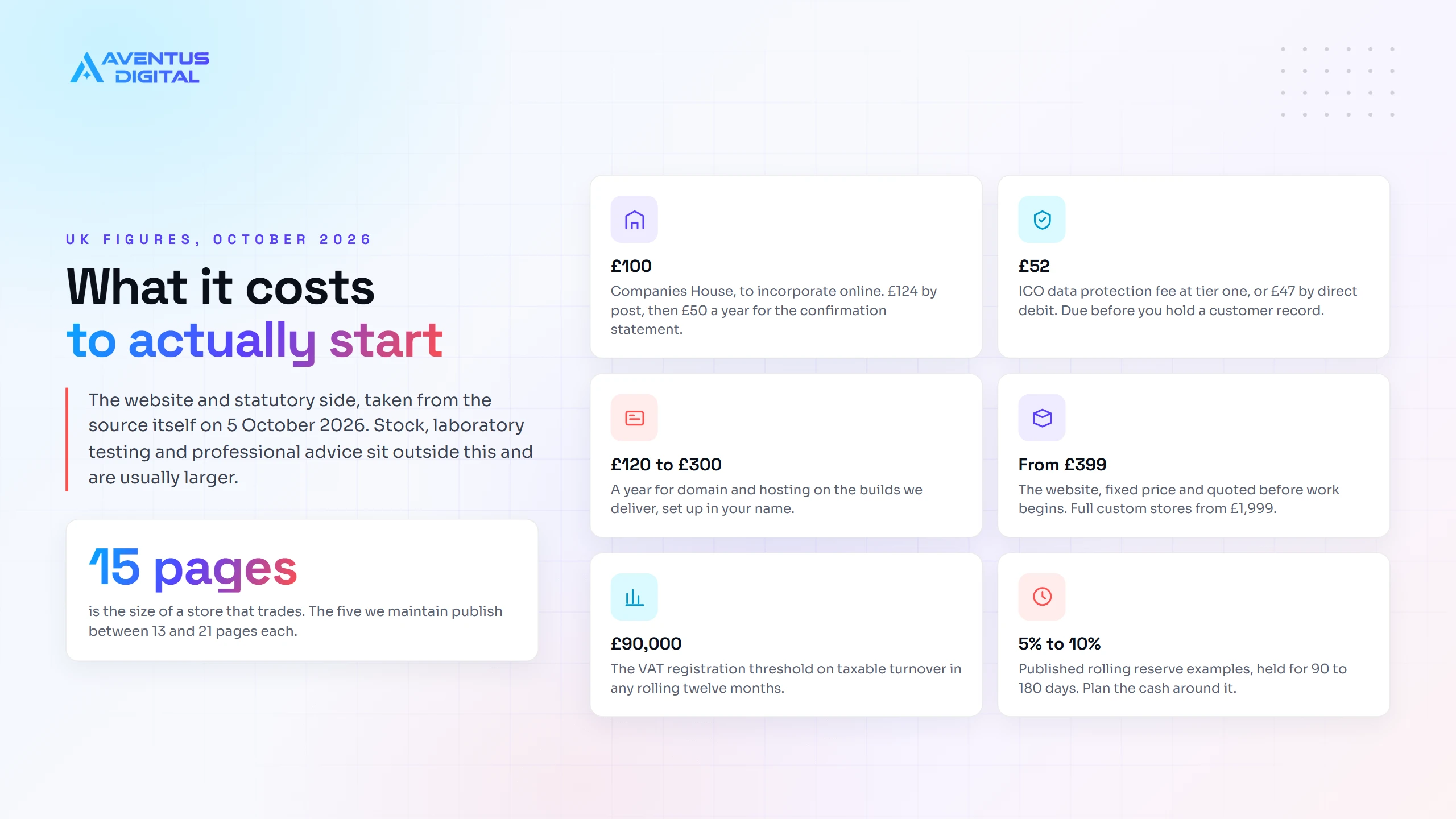
| Company and bank account | £100 to incorporate online with Companies House, £124 by post, then £50 a year for the confirmation statement. Business banking varies by bank. | Week one. Incorporation is same day online, the bank account is the slow part. | Nothing yet, and we will not start a build without it. The registered name, number and address go in the footer, the terms and the order emails. |
| Your own advisers | Quoted by your solicitor and accountant. Get the quote before you commit to a catalogue. | Week one to two, and the only step with no shortcut. | We build to the position they give you. We are the website partner, not your legal adviser. |
| Data protection registration | £52 a year to the ICO at tier one, or £47 by direct debit. Tier one covers up to ten staff or £632,000 turnover. | Week one to two, before you hold a single customer record. | Privacy policy, cookie handling and the data you actually collect at checkout, written to match what you registered. |
| Domain and hosting | Budget £120 to £300 a year on the builds we deliver, depending on traffic and backup requirements. | Week two, before the build starts. | We specify it, set it up in your name, and configure backups. Hosting in your name is the point of self-hosting. |
| The website | From £399, full custom stores from £1,999, fixed price and quoted before work begins. Maintenance from £49 a month. | Weeks two to five. Most stores go live in two to three weeks. | The whole build: product template, COA archive, age gate, checkout record, policy set, SEO, GEO and AEO from day one. |
| Payment processing | No fee to apply. Expect higher rates and a rolling reserve, with published examples around 5% to 10% held for 90 to 180 days. | Week five onwards, after the site is finished, never before. | We prepare the links and evidence the application asks for, and wire a tested fallback gateway beside the first. |
| VAT | Registration is required once taxable turnover passes £90,000 in any rolling twelve months. You can register voluntarily sooner. | When you cross it, which for most new stores is not year one. | Tax settings, price display and invoices configured in WooCommerce when you register. |
| Statutory figures checked against Companies House, the ICO and GOV.UK on 5 October 2026 and they change, so confirm before you budget. Costs outside the website, including stock, laboratory testing and insurance, sit with you and your advisers. This is website guidance, not legal advice. Responsibility for your products, claims and regulatory position sits with you as the business owner. | |||
What it really costs to start a peptide business
The table above is the website and the statutory side, which is the part we can give you honest numbers for. Every figure in it comes from the source itself, checked on 5 October 2026: Companies House fees for incorporation and the confirmation statement, the ICO data protection fee for registration, and GOV.UK on when to register for VAT. Three things sit outside the table and they are usually larger.
- Stock and laboratory testing. Your suppliers and your chosen laboratory quote this, and it is the biggest variable in the plan. We do not advise on sourcing or testing. What we need from it is the certificate file for each batch, named so it can be published.
- Professional advice. A solicitor on classification and claims, an accountant on records and VAT. Treat it as a cost of entry rather than an optional extra.
- Working capital for reserves. High-risk acquirers commonly hold a percentage of settlements for a set period, so a share of your early revenue is not available when you expect it. The published figures and dates are in our comparison of peptide payment processors.
Against those, the website is the predictable line. A store that trades is about fifteen pages, as the five we maintain show, and it is a fixed price quoted before anyone starts. What moves the number is scope: more categories, a bigger catalogue, custom content for several markets.
Where we come in: we quote the build fixed, before work begins, and the free 72 hour homepage mockup means you see the direction before you commit a pound to it.
A realistic timeline to first order and to steady trading
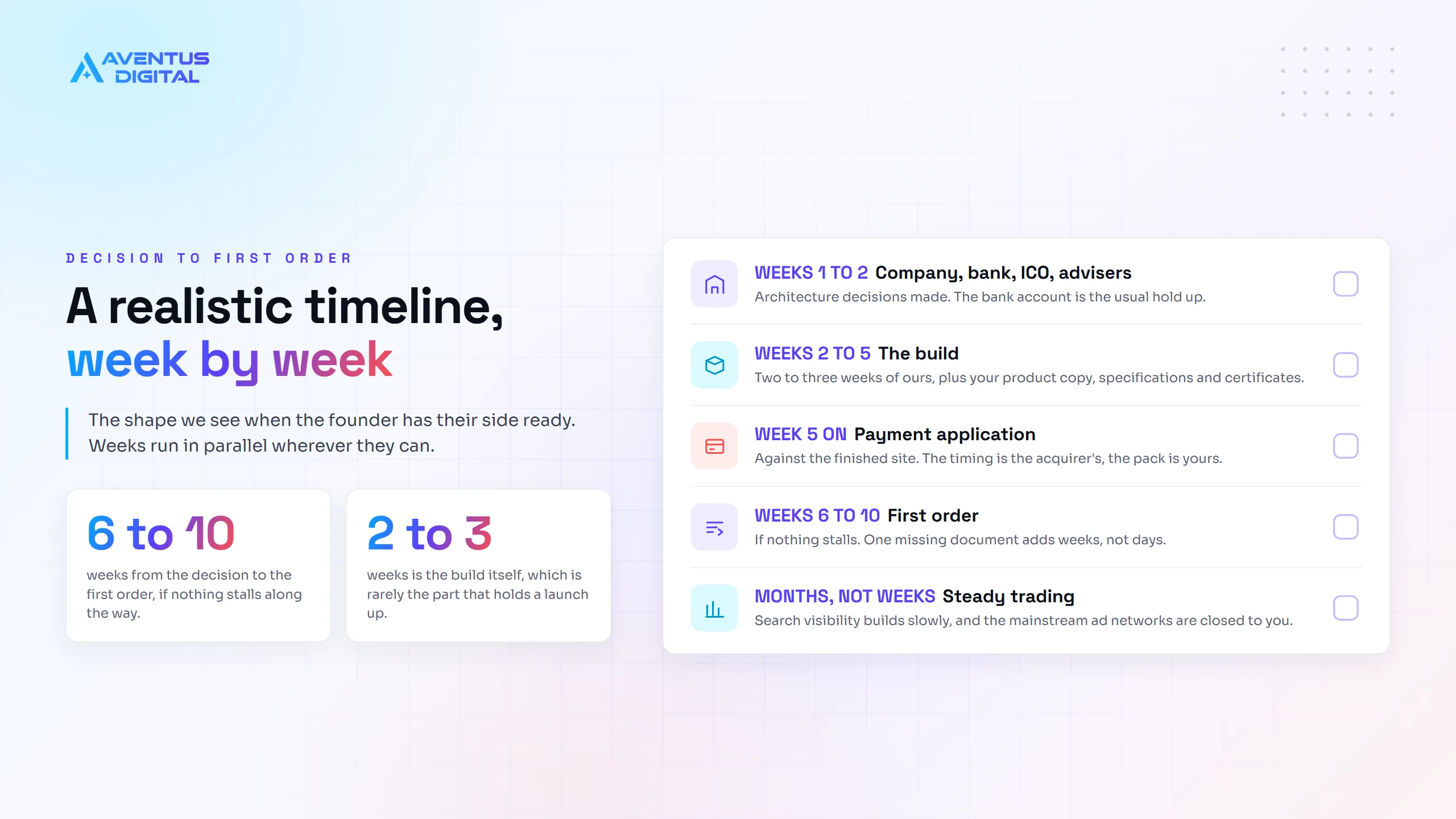
This is the shape we see on builds where the founder has their side ready. Weeks run in parallel wherever they can.
- Weeks one and two. Company registered, bank account opened, ICO registration done, advisers briefed, architecture decisions made. The bank account is the usual hold up.
- Weeks two to five. The build. Two to three weeks of work for us, plus your time on product copy, specifications and certificate files, which is the part founders underestimate.
- Week five onwards. Payment application against the finished site. Timing is the acquirer’s, not yours, and a complete pack is the only part you control.
- Six to ten weeks from the decision to the first order, if nothing stalls. One missing document or one bank delay adds weeks, not days.
- Steady trading is a different horizon. Search visibility builds over months rather than weeks, and in this sector paid acquisition on the mainstream networks is largely closed to you, so the content and the structure are the channel.
Do not plan on launch day traffic. Plan on a store that is findable, with a checkout that works and content that answers the questions buyers actually search, which is why SEO, GEO and AEO are built into the pages rather than added in month six.
Where we come in: our ecommerce website builds ship with the structure search engines and AI answers can read, and website maintenance from £49 a month keeps it that way while you concentrate on the business.
The mistakes that cost the most to undo
These are the five we are called in to fix, in rough order of how expensive they are once they have happened.
- Launching on a platform whose payment arm excludes the category. The storefront survives, the checkout does not, and the fix is a migration under time pressure. The platform comparison is in our post on the best ecommerce platform for peptides, and the Shopify case specifically in selling peptides on Shopify.
- Product copy written like consumer marketing. Inherited from a template or a supplier feed, it is the most common single reason an application is declined, and every page has to be rewritten.
- Certificates published as loose PDFs. Quick at the time, and it means rebuilding the archive and redirecting every link once you need batch records.
- Trading before the company and the policies exist. The website then says one thing and the application says another, which is the contradiction underwriting looks for.
- One payment method and no fallback. An afternoon of work while the store is healthy, close to impossible in the week an account closes.
One thing we will not help with, and nor should anyone else: reapplying under a different name or entity to get past screening. That is misrepresentation, and a termination recorded on the card scheme terminated merchant file lasts five years and follows the directors. Fix the site and the pack, then go again.
Where we come in: all five are structural, which is why a website redesign for an inherited store starts with the page list, the policy set, the product copy and the certificates before a single visual decision.
What every Aventus peptide store includes
Starting from nothing, this is what you get handed over, built to be read by an underwriter as well as a customer:
- Company details, the full policy set and a research use only policy, published as real pages with clean URLs.
- A product template carrying a fixed research use position, the batch reference and a link to that batch’s certificate.
- A COA archive organised by batch that stays organised as batches are added.
- Age confirmation and a required checkout acknowledgement, both stored against the order.
- Primary and fallback gateways configured and tested, plus a non card method.
- SEO, GEO and AEO built in from day one, and a handover pack with the links your payment application asks for.
Builds start at £399 and full custom stores from £1,999, fixed price and quoted before work begins, with maintenance from £49 a month. Most stores go live in two to three weeks.
Peptide and research supply ecommerce
Get a quote for a compliant RUO peptide website
See the builds, the full specification and what is included, then request a fixed price quote. If you already have a site, send us the URL and we will tell you what is triggering the declines before you spend anything.
Fixed price from £399. Website work only: we do not arrange or guarantee payment processing.
Starting out and want to know what the build actually involves? Ask for the free 72 hour homepage mockup and you will see the direction before you spend anything. If you already have a store built in the wrong order, the free website audit comes back within 48 hours, and our website redesign route picks up from there.
You Might Also Like
- Peptide websites: how we build and maintain research peptide stores, with pricing.
- Best ecommerce platform for peptides: the five criteria that decide the platform, scored.
- The merchant account application pack: what underwriting reads before it reads your form.
- Peptide payment processors compared: published rates, reserves and approval odds, dated.
- Building a compliant peptide website: the full build guide for 2026.

Author
Zubayed Feroz
Founder of Aventus Digital
General website guidance, not legal or financial advice. Requirements vary by product and jurisdiction and they change, so take advice from a qualified solicitor on your own catalogue. Underwriting criteria are set by individual acquirers: we do not arrange or guarantee payment processing. Named services are referenced for comparison only, correct to the best of our knowledge on the date below.
Published 5 October 2026. Last reviewed 5 October 2026.
Frequently Asked Questions
How do I start a peptide business?
In this order: register the company and open the bank account, take advice from a solicitor and an accountant on your catalogue, decide the compliance architecture, build the store on those decisions, apply for payments against the finished site, then open to traffic. The order matters more than the speed, because steps taken out of sequence are the ones that cost money to reverse. We cover the website and the setup around it, not sourcing or supply.
What does it cost to start?
On the website and statutory side, checked on 5 October 2026: £100 to incorporate online with Companies House, £52 a year to the ICO at tier one or £47 by direct debit, roughly £120 to £300 a year for domain and hosting, and the build from £399, or from £1,999 for a full custom store, with maintenance from £49 a month. Stock, laboratory testing, insurance and professional advice sit outside that and are usually larger.
How long before it is profitable?
Nobody can give you an honest number for that, and anyone who does is guessing at your margins and your market. What we can tell you is the shape: six to ten weeks from the decision to the first order if nothing stalls, and search visibility that builds over months rather than weeks. Plan the cash around a rolling reserve holding part of your early revenue, and around no paid acquisition on the mainstream networks.
What do I need in place before building a website?
The registered company and its details, a business bank account, your ICO registration, the advice you have taken on classification and claims, and the architecture decisions that follow from it: age threshold, research use position, how certificates will be published and which markets you ship to. Product specifications and certificate files are the part founders underestimate, because those are yours to supply and the build waits on them.
Do I need a limited company?
For practical purposes in this category, yes, and your accountant should confirm it for your situation. High-risk acquirers underwrite an entity, not a person, and ask for the certificate of incorporation, director identification and business bank statements. The company details then have to appear on the website and match the application exactly, which is the first thing underwriting checks.
Can I start with a small catalogue?
Yes, and most do. The newest of the five stores we maintain launched with 14 products across 5 categories, and the stores overall run between 13 and 21 published pages. A tight catalogue is easier to document, easier to keep certificates current for, and easier to present consistently, which is what underwriting is reading for.
Can I take orders while the payment application is in progress?
You can trade with a non card method such as bank transfer, with clear instructions and order status updates, and that is worth having anyway as a fallback. What you should not do is route the category through a mainstream checkout that excludes it while you wait. That is the decision that ends in frozen funds, and we set out what happens next in our comparison of peptide payment processors.
Do I need to register for VAT straight away?
Not unless your taxable turnover passes £90,000 in any rolling twelve months, though you can register voluntarily sooner and your accountant may suggest it. Either way it is a configuration job on the store rather than a rebuild: tax settings, price display and invoices. Ask your accountant, not us, about which is right for you.
Related Blogs
Which Hosting Is Best for Peptide Websites?
Short answer: Hostinger is what we put research peptide stores on, and our link takes [...]
Oct
Is It Legal to Sell Research Peptides in the UK? The MHRA Line, Explained for Store Owners
Short answer: selling research peptides in the UK is lawful in itself, and it stops [...]
Oct
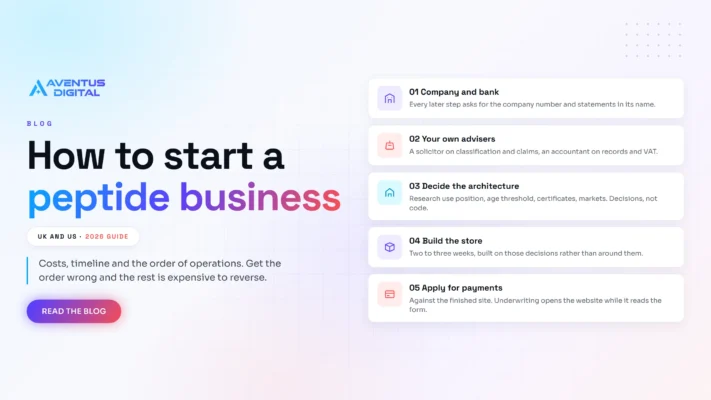
How to Start a Peptide Business in 2026: Costs and Steps
Short answer: to start a peptide business you register the company, open the bank account, [...]
Oct
Best Ecommerce Platform for a Peptide Store (2026)
Short answer: the best ecommerce platform for peptides is a self-hosted WooCommerce store. Hosted platforms [...]
Oct
The peptide merchant account application pack that gets approved first time
Short answer: a peptide merchant account is won on evidence, not on wording. Underwriting opens [...]
Sep
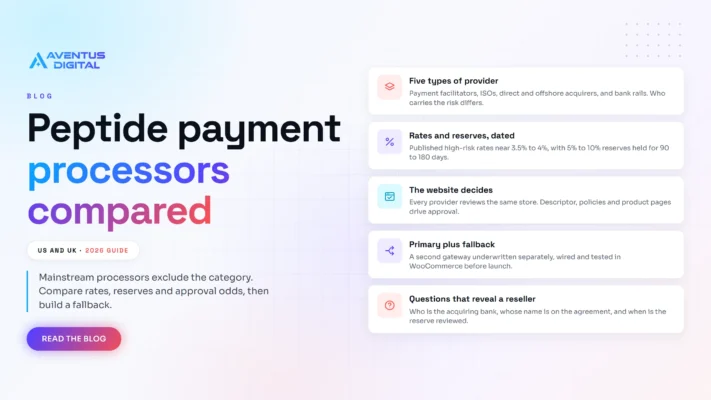
Peptide Payment Processors Compared: US and UK 2026
Short answer: mainstream processors such as Stripe, PayPal and WooPayments exclude the category, so a [...]
Sep
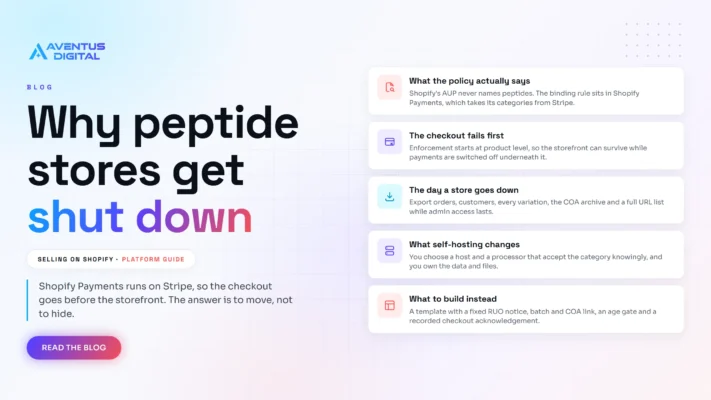
Selling Peptides on Shopify: Why Stores Get Shut Down
Short answer: not for long. You can open a store and sell peptides on Shopify, [...]
Sep
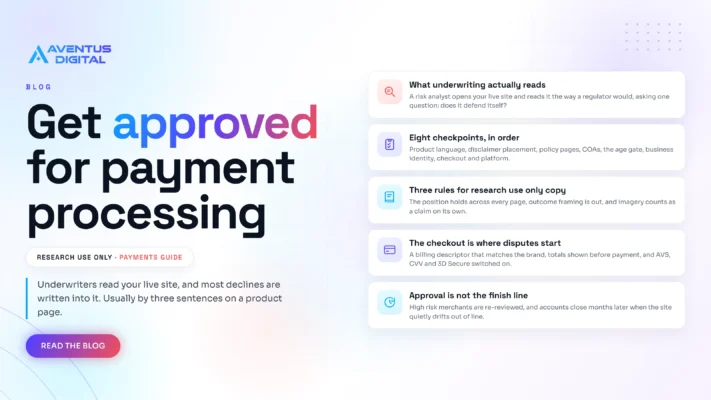
Peptide website compliance and how to get approved for payments
Short answer: peptide website compliance is decided on four things. A research use only position [...]
Sep