
Best ecommerce platform for a peptide store in 2026: WooCommerce vs Shopify vs BigCommerce vs Shift4Shop
Short answer: the best ecommerce platform for peptides is a self-hosted WooCommerce store. Hosted platforms are not blocked by their own rules, they are blocked by the payment arm attached to them, and they cannot give you the COA structure, the checkout record or the data ownership this category needs. The platform decision is really a payments and architecture decision.
On 2 October 2026 we pulled public data from the five research supply stores we build or maintain. Between them they list 113 products and serve 58 certificate PDFs from their own media libraries, from 38 on the largest down to none at all on the newest store. Every one of those PDFs sits on a URL the owner controls. That single detail is the part of the platform choice nobody thinks about until a processor asks to see a batch record.
We are Aventus Digital, and we build and maintain WooCommerce stores for research peptide brands in the UK, the US and the EU, including Crew Labs, Zyvara Life and Solix Labs. Across 7 plus years we have delivered 600 plus websites in 40 plus countries, with 700 plus five star reviews behind us. We are the website partner, not your legal adviser and not a payments broker. Responsibility for your products, your claims and your regulatory position sits with you as the business owner.
The five criteria that decide the best ecommerce platform for peptides
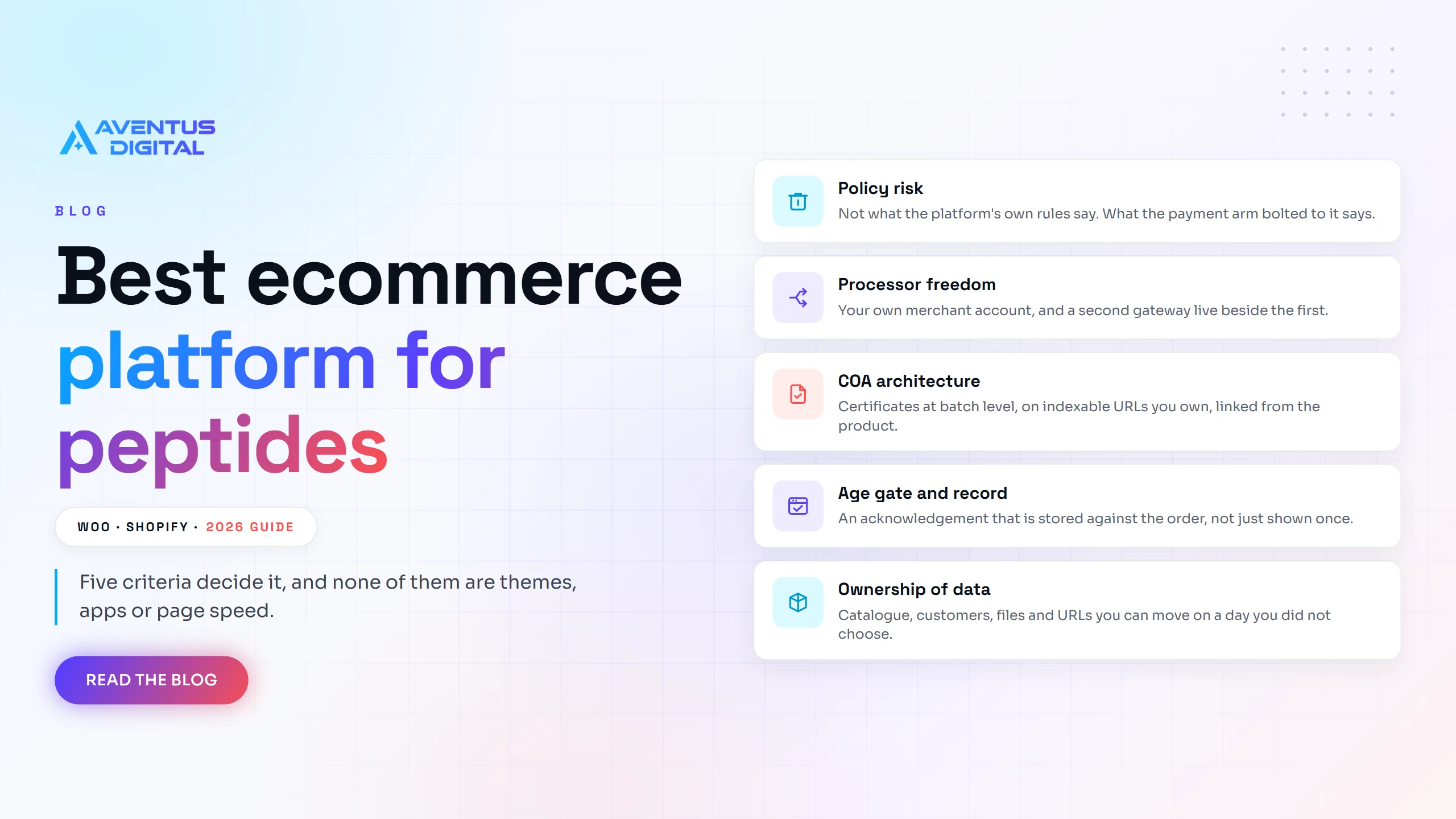
Most platform comparisons score themes, apps and page speed. None of that is what closes a research supply store. Five things decide it, and they are the five we work through with every owner before a build starts.
- Policy risk. Not what the platform’s own rules say, but what the payment arm bolted to it says. The two are rarely the same document.
- Processor freedom. Whether you can take your own merchant account, and whether you can run a second gateway beside the first without a penalty.
- COA architecture. Whether certificates can live at batch level, on indexable URLs you own, linked from the product that batch belongs to.
- Age gating and the checkout record. Whether you can add a required acknowledgement and store it against the order, rather than show a pop-up that nothing records.
- Ownership of content and data. Whether the catalogue, the customer list, the files and the URLs are yours to move on a day you did not choose.
Worth saying plainly: none of the four platforms in this post bans the category in its own acceptable use policy. Shopify’s acceptable use policy does not name pharmaceuticals or research chemicals at all. The policy that matters sits one level down, with the processor, which is why we treat the platform question and the payments question as one decision.
Where we come in: we run those five criteria against the store you already have before anyone talks about rebuilding it. That is the same pass as our free website audit, back within 48 hours, and it tells you whether your platform is the problem or your product pages are.
Where the policy risk actually sits, platform by platform
The pattern repeats across every hosted platform. The storefront rules are broad and silent on this category. The payment product attached to the storefront inherits a processor’s restricted list, and that list is where research supply gets caught.
- Shopify. Shopify Payments runs on Stripe, and Stripe’s restricted businesses list restricts card not present pharmaceuticals and prohibits incorrectly labelled research chemicals. The Shopify Payments terms take their prohibited categories from the processor, so the storefront can pass review while the checkout is switched off. We covered that sequence in detail in our post on selling peptides on Shopify.
- BigCommerce, now Commerce.com. As at 2 October 2026 bigcommerce.com redirects to commerce.com, and the master services agreement is issued by Commerce LLC with a revision date of 1 June 2026. Its acceptable use policy was last revised 31 July 2025, enumerates almost nothing, and handles regulated goods with a highly regulated products clause that puts compliance with applicable law back on the merchant. Permissive on paper, and it still leaves you dependent on whichever processor underwrites you.
- Shift4Shop. The one hosted platform that markets to high risk openly. Its high risk industries page names vapes and tobacco, adult, ammunition and accessories, nutraceuticals and supplements, and CBD. It does not name research chemicals or peptides anywhere on that page, so acceptance is a conversation with their underwriting team rather than something the page settles.
- WooCommerce. Software, not a merchant. There is no acceptable use policy to fall foul of, because nobody is hosting your store but you. The restriction lives entirely with the gateway you choose, and you can change it. For completeness, WooPayments has its own prohibited and restricted products list, which does name peptides and other research chemicals, so WooPayments is not the gateway for this catalogue even though WooCommerce is the right platform.
That last line is the distinction the whole post turns on. Choosing WooCommerce is not choosing a payment processor. It is choosing not to have the two decided for you by the same company.
Where we come in: we build the store so the gateway is a slot, not a foundation. Our ecommerce website builds wire a primary and a fallback gateway from the start, and the rates and reserve terms behind each one are set out, dated, in our comparison of peptide payment processors.
| Criterion | ShopifyHosted | Commerce.comFormerly BigCommerce | Shift4ShopHosted, high risk | WooCommerceSelf-hosted |
|---|---|---|---|---|
| Policy risk | AUP silent on the category, but Shopify Payments inherits the processor’s restricted list. Storefront can pass while the checkout stops. | AUP revised 31 July 2025 enumerates almost nothing and puts regulated goods back on the merchant. Risk moves to whoever underwrites you. | Markets to high risk and names five categories. Research supply is not one of them, so it is decided case by case. | No host, no acceptable use policy over your store. The only policy that applies is your gateway’s. |
| Processor freedom | Third party gateways carry an extra transaction fee on most plans, which taxes the fallback you need most. | Open to many gateways, which is a genuine advantage over Shopify for this category. | Built around its own processing. Attractive if underwriting says yes, limiting if it later says no. | Any gateway with a WooCommerce plugin, two live at once, switched over in minutes without a platform penalty. |
| COA architecture | Files sit in a general asset store. Batch level records need an app or metafields, and the URLs are not yours. | Custom fields help, but a batch registry is still bolted on rather than native. | File uploads supported. No structure for batch records linked to the order a buyer placed. | A batch registry on your own domain, indexable URLs, and a certificate linked from the product and repeated in the order email. |
| Age gating and the checkout record | App based gates are common. Storing the acknowledgement against the order for representment is the hard part. | Possible with scripts and custom fields, with the same question about what is saved and where you read it back. | Age verification is a supported feature, aimed at its existing age restricted categories. | Required acknowledgement and terms version written to the order meta and shown on the order screen, where you need it in a dispute. |
| Ownership of content and data | Catalogue, customers and files live inside the account. Export is possible, redirects and file URLs are not. | Same shape. You rent the storefront and the URLs that sit on it. | Same shape, with a smaller ecosystem to migrate into later. | Database, media library, URLs and backups on hosting in your name. A move is a migration, never a rebuild from nothing. |
| Scored against published platform documents checked on 2 October 2026 and against builds we have delivered. Platform terms change, so re-check the source before you commit. This is website guidance, not legal advice. Responsibility for your products, claims and regulatory position sits with you as the business owner. | ||||
Where each peptide ecommerce platform actually breaks
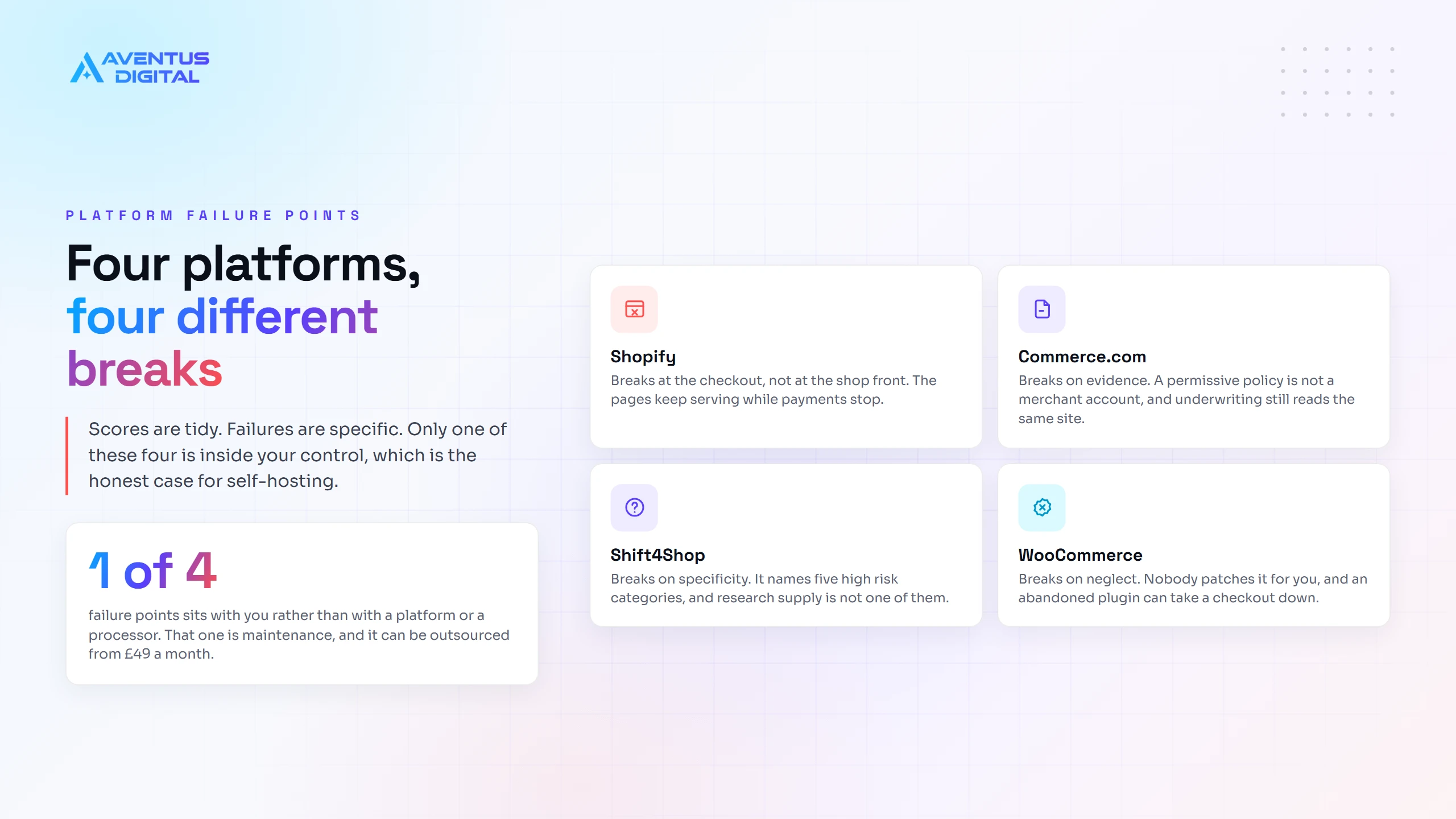
Scores are tidy. Failures are specific. This is what we see go wrong, in the order owners meet it.
- Shopify breaks at the checkout, not at the shop front. The store keeps serving pages, the payment method stops, and the owner spends the first day arguing about the storefront while the lost revenue is all in the gateway.
- Commerce.com breaks on evidence. A permissive policy is not a merchant account. You still face underwriting with the same website, and if the certificates are not published at batch level the file is thin in exactly the same way.
- Shift4Shop breaks on specificity. It is honest about serving high risk sellers, but the categories it names are not this one, and a platform that is strongest when its own processing is approved is weakest on the day that changes.
- WooCommerce breaks on neglect. Nobody patches it for you. An unmaintained WooCommerce store ages badly, and an abandoned plugin can take a checkout down as effectively as a declined application.
Only one of those four failures is inside your control. That is the honest case for self-hosting, and it is also the case for budgeting maintenance from day one rather than discovering it in month eight.
Where we come in: we inherit stores from all four platforms, and the rebuild always starts in the same place: the public page list, the policy set, the product copy and the certificate structure. That is the shape of our website redesign work on an existing research supply store.

The maintenance objection, answered honestly
The strongest argument for a hosted platform is real: somebody else runs the updates. Dismissing that is how agencies end up handing over a store the owner cannot keep alive. So here are the numbers from the five stores we look after, pulled on 2 October 2026.
- All five run WordPress 7.0.6 or newer, four of them on 7.1.2, the current release.
- All five run WooCommerce 11.1.0 or newer, with no store more than two patch releases behind.
- Between them they list 113 products, from 14 on the newest store to 32 on the largest.
- Between them they serve 58 certificate PDFs from their own media libraries. One store has 38. One has none yet, because it launched recently and its first batches are still with the lab.
That is what maintained looks like, and it is a monthly job rather than a heroic one: core and plugin updates on a staging copy, a test order through the live checkout, a link check across the policy pages, and a look at the public page list for anything that should not be there. It costs from £49 a month, which is less than the third party gateway surcharge on a modest month of Shopify orders.
Be clear about the trade. A hosted platform removes a job you can outsource and keeps a risk you cannot. Self-hosting adds a job you can outsource and removes the risk you cannot carry.
Where we come in: website maintenance from £49 a month covers the updates, the backups, the test order and the link pass, so the WooCommerce objection stops being yours to solve.
Who each platform genuinely suits, including when WooCommerce is wrong
No platform is correct for everyone, and we have talked owners out of a build more than once.
- Shopify suits a brand that is not in a restricted category at all, or a research supply owner who only needs a catalogue and enquiry route while a compliant store is built properly elsewhere.
- Commerce.com suits a larger operation already standardised on it for other product lines, with its own merchant account and a developer to build the batch structure the platform does not give you.
- Shift4Shop suits a seller in one of the high risk categories it names, who has had approval confirmed in writing by its underwriting team before building anything.
- WooCommerce suits almost every research supply store that intends to trade for years, hold its own merchant account, publish certificates at batch level and own its catalogue, customers and URLs.
- WooCommerce is the wrong answer when there is no budget for maintenance and nobody to own it, when the business is still deciding what it sells, or when the real need this quarter is a single page explaining the company rather than a shop at all. Validate first, build second.
Wix and Squarespace sit outside the four for a simple reason: both run their own payments on mainstream processors, neither gives you batch level certificate architecture, and neither lets you take your store elsewhere intact. We go through that comparison for general businesses in our WordPress versus Wix and Squarespace guide, and for this category the gap is wider still.
Where we come in: if the answer is not a store yet, we will say so. If it is, the build follows the specification on our peptide websites page.
What every Aventus peptide store includes
Whatever you are moving from, this is what we hand over, built on WooCommerce and ready to be read by an underwriter as well as a customer:
- A product template carrying a fixed research use position, the batch reference and a link to that batch’s certificate.
- A COA archive organised by batch, on indexable URLs you own, that stays organised as batches are added.
- Age confirmation and a required checkout acknowledgement, both stored against the order.
- Company details, the full policy set and a research use only policy, published as real pages with clean URLs.
- Primary and fallback gateways configured and tested, plus a non card method.
- SEO, GEO and AEO built in from day one, and a handover pack with the links an application asks for.
Builds start at £399 and full custom stores from £1,999, fixed price and quoted before work begins, with maintenance from £49 a month. Most stores go live in two to three weeks.
Peptide and research supply ecommerce
Get a quote for a compliant RUO peptide website
See the builds, the full specification and what is included, then request a fixed price quote. If you already have a site, send us the URL and we will tell you what is triggering the declines before you spend anything.
Fixed price from £399. Website work only: we do not arrange or guarantee payment processing.
Weighing platforms and not sure which problem you actually have? Take the free website audit and we will send the list back within 48 hours. If the store is sound and only the structure is wrong, our website redesign route starts from the certificate structure and the policy set. Starting from nothing, ask for the free 72 hour homepage mockup.
You Might Also Like
- Peptide websites: how we build and maintain research peptide stores, with pricing.
- Selling peptides on Shopify: why the checkout stops first, and what a migration looks like.
- Peptide payment processors compared: published rates, reserves and approval odds, dated.
- The merchant account application pack: what underwriting reads before it reads your form.
- Building a compliant peptide website: the full build guide for 2026.

Author
Zubayed Feroz
Founder of Aventus Digital
General website guidance, not legal or financial advice. Requirements vary by product and jurisdiction and they change, so take advice from a qualified solicitor on your own catalogue. Underwriting criteria are set by individual acquirers: we do not arrange or guarantee payment processing. Named services are referenced for comparison only, correct to the best of our knowledge on the date below.
Published 2 October 2026. Last reviewed 2 October 2026.
Frequently Asked Questions
What is the best ecommerce platform for a peptide store?
A self-hosted WooCommerce store, for almost every research supply business that intends to trade for years. It is the only option of the four that lets you hold your own merchant account, run a fallback gateway beside it, publish certificates at batch level on URLs you own, and store a checkout acknowledgement against the order. The trade is that you own the maintenance, which is a job you can outsource from £49 a month.
Can I use Shopify for peptides?
You can open a store, and the storefront may run for a while. Shopify’s acceptable use policy does not name the category, but Shopify Payments runs on Stripe, and Stripe’s restricted list restricts card not present pharmaceuticals and prohibits incorrectly labelled research chemicals. The usual outcome is that payments stop while the shop front keeps serving pages. Our post on selling peptides on Shopify sets out the sequence.
Does BigCommerce allow research chemicals?
BigCommerce now trades as Commerce.com, and as at 2 October 2026 its acceptable use policy, last revised 31 July 2025, does not enumerate research chemicals either way. It handles regulated goods by requiring the merchant to comply with applicable law. In practice that means the platform is not your obstacle, your acquirer is, and you will face the same underwriting with the same website whichever hosted platform you pick.
Is WooCommerce harder to maintain?
It needs maintaining, which a hosted platform does for you. It is not hard, it is routine: updates on a staging copy, a test order through the live checkout, a link check on the policy pages and a look at the public page list. On 2 October 2026 the five stores we maintain were all on WordPress 7.0.6 or newer and WooCommerce 11.1.0 or newer, none more than two patch releases behind. Budget for it from day one rather than finding it in month eight.
What about Wix or Squarespace?
Both run their own payments on mainstream processors, neither offers batch level certificate architecture, and neither lets you take the store elsewhere intact. For a general small business they are a reasonable choice, and we compare them properly in our WordPress versus Wix and Squarespace guide. For research supply the gap is wider, because every one of the five criteria in this post lands on the wrong side.
Can I move an existing store to WooCommerce without losing search traffic?
Yes, if the URL list is exported before anything is switched off and every old product, category and blog URL gets a 301 redirect to its match on the new store. Rankings move with the redirects. What does not survive a rushed migration is the URL list itself, which is why we export it on day one rather than on the day the platform is cancelled.
Do I need a merchant account before the store is built?
Not before, but not after either. Underwriting opens your website while it reads your form, so the sensible order is to build the site that supports the application, then apply, then connect the gateway. The merchant account application pack lists what is checked. Underwriting criteria are set by each acquirer, and we do not arrange or guarantee payment processing.
Related Blogs
Which Hosting Is Best for Peptide Websites?
Short answer: Hostinger is what we put research peptide stores on, and our link takes [...]
Oct

Is It Legal to Sell Research Peptides in the UK? The MHRA Line, Explained for Store Owners
Short answer: selling research peptides in the UK is lawful in itself, and it stops [...]
Oct

How to Start a Peptide Business in 2026: Costs and Steps
Short answer: to start a peptide business you register the company, open the bank account, [...]
Oct

Best Ecommerce Platform for a Peptide Store (2026)
Short answer: the best ecommerce platform for peptides is a self-hosted WooCommerce store. Hosted platforms [...]
Oct
The peptide merchant account application pack that gets approved first time
Short answer: a peptide merchant account is won on evidence, not on wording. Underwriting opens [...]
Sep

Peptide Payment Processors Compared: US and UK 2026
Short answer: mainstream processors such as Stripe, PayPal and WooPayments exclude the category, so a [...]
Sep
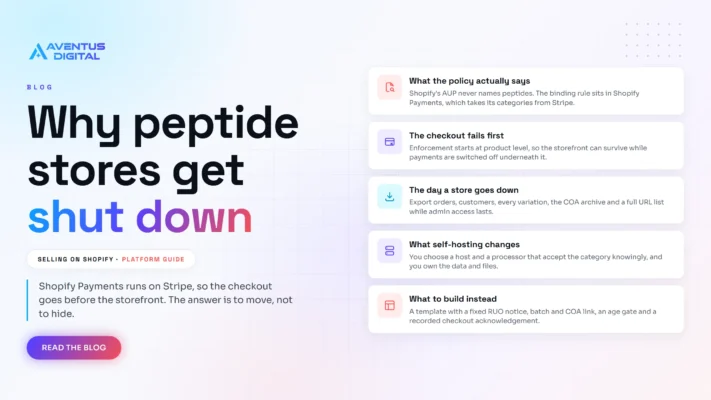
Selling Peptides on Shopify: Why Stores Get Shut Down
Short answer: not for long. You can open a store and sell peptides on Shopify, [...]
Sep

Peptide website compliance and how to get approved for payments
Short answer: peptide website compliance is decided on four things. A research use only position [...]
Sep