
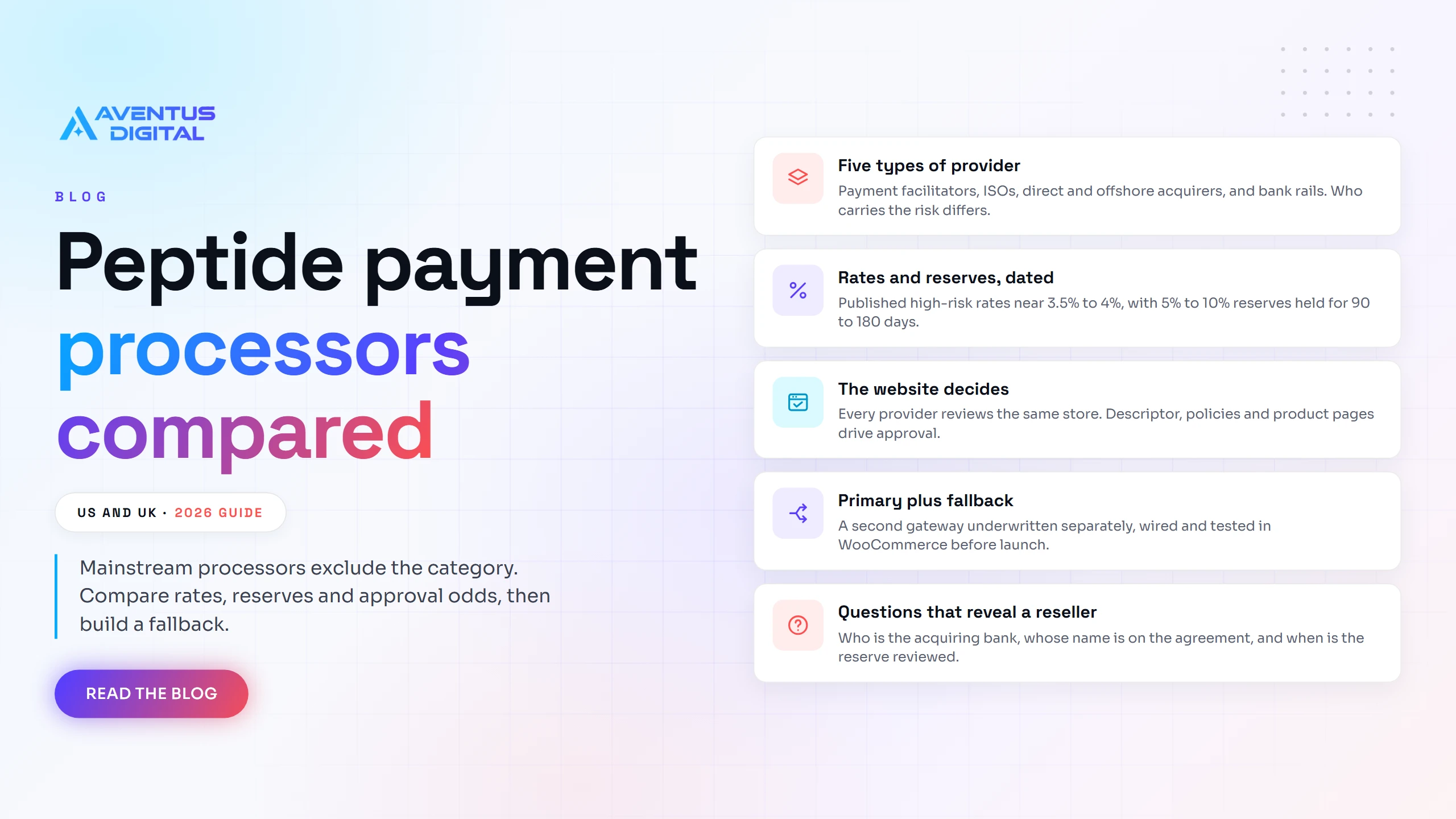
Peptide payment processors compared: US and UK options in 2026
Short answer: mainstream processors such as Stripe, PayPal and WooPayments exclude the category, so a peptide payment processor is almost always a high-risk acquirer, reached directly or through a reseller. Published high-risk rates sit around 3.5% to 4%, reserves of 5% to 10% are held for 90 to 180 days, and approval turns on your website.
On 22 September 2026 we checked the public checkout of the five peptide stores we build and maintain. No two run the same payment setup. Two offer a second payment method at checkout, one takes no card payments at all, and one sends cards through a gateway company that is separate from the bank that actually settles the money. That spread is the real market, and it is why comparing types of provider tells you more than comparing brand names.
Aventus Digital builds and maintains WooCommerce stores for research peptide brands across the UK, the US and the EU, including Vyon Bio Labs, Endura Research and Zyvara Life. We have delivered 600+ websites across 40+ countries in 7+ years. We are the website partner, not a legal or financial adviser, and we do not arrange or guarantee payment processing. Responsibility for your products, your claims and your regulatory position sits with you as the business owner.
Who processes payments for peptide stores? Five types of provider
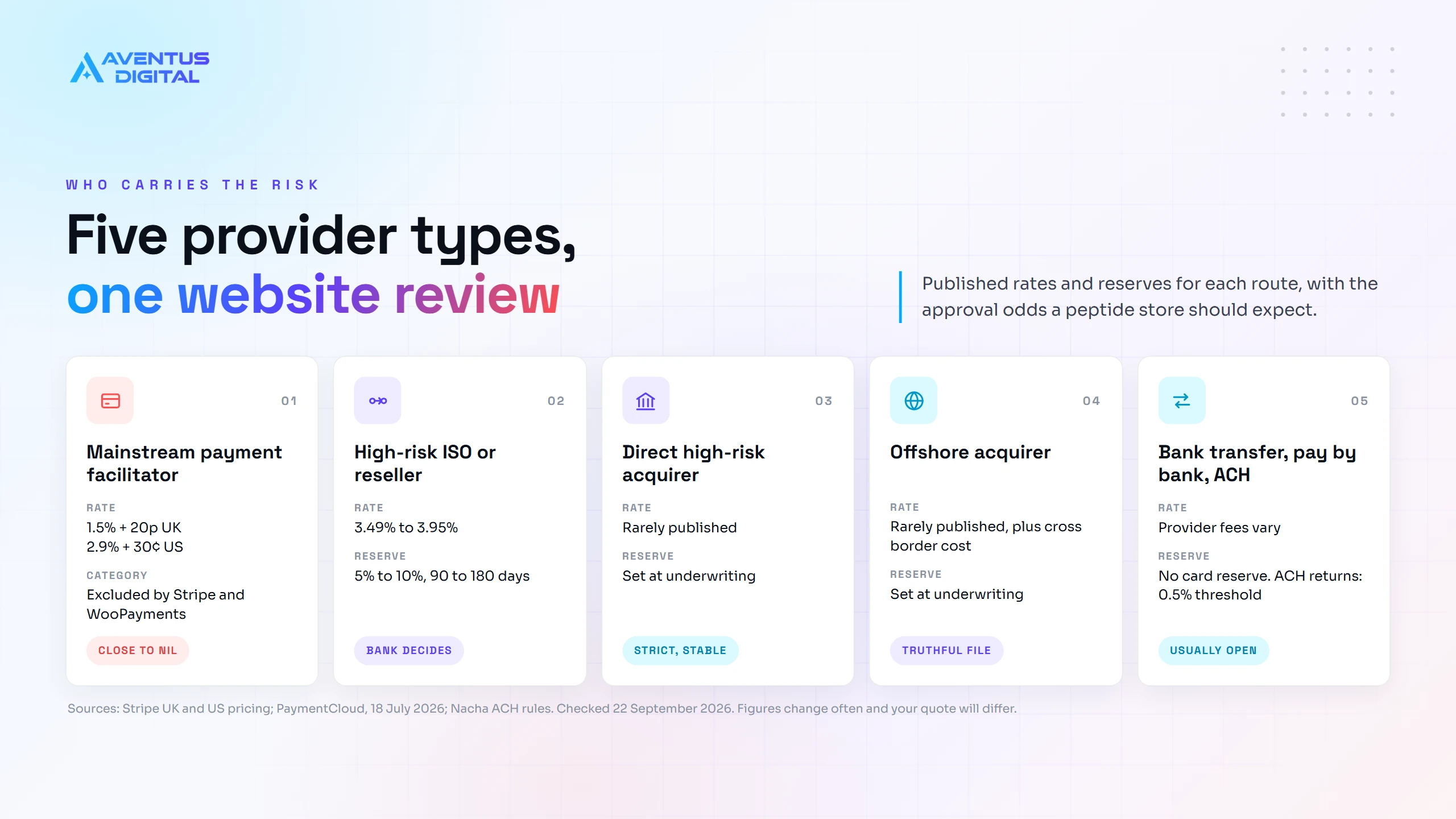
A peptide payment processor is not one kind of company. Five kinds of business can sit behind a checkout, and the difference that matters is who actually carries the risk of your account.
- Mainstream payment facilitators. Stripe, PayPal, Square and WooPayments sign you up in minutes as a sponsored merchant and review the business afterwards. The WooPayments prohibited list names peptides and other research chemicals outright (page updated 21 August 2026).
- High-risk ISOs and resellers. They find you a bank and handle the application. The UK Payment Systems Regulator’s card acquiring market review (November 2021) puts it plainly: ISOs refer merchants to acquirers and do not provide acquiring themselves.
- Direct high-risk acquirers. The licensed acquirer that underwrites you, issues your merchant ID and settles your funds.
- Offshore acquirers. Acquirers outside your home market that accept categories domestic banks decline, with cross border processing and pricing that is rarely published.
- Non-card rails. Bank transfer, UK pay by bank through open banking, and ACH in the US. No card scheme, but still rules: Nacha sets a 0.5% threshold for unauthorised ACH debit returns.
Where we come in: we do not choose or arrange your processor, but we build the store every one of these providers will review. On our research peptide store builds the underwriting pack is part of the project: policy pages, the billing descriptor, the product page template and a screenshot set of the checkout, ready to attach to whichever application you make.
Peptide payment processor rates, reserves and settlement compared
The figures below come from each provider’s own published pages and carry the date shown. Treat them as a starting point for questions, not a quote. Most high-risk pricing is never published at all: the same PSR review found that acquirers and ISOs do not typically publish their prices.
For reference, these are the standard rates the category cannot get. Stripe UK charges 1.5% + 20p for standard UK cards, and Stripe US charges 2.9% + 30¢. PayPal UK lists 2.9% plus a 30p fixed fee for commercial transactions (fee page updated 15 July 2026). All checked 22 September 2026.
| Provider type | Published rates and reservesSource and date | Approval oddsFor a peptide store | How Aventus builds itOn every peptide store |
|---|---|---|---|
| Mainstream payment facilitator | Stripe 1.5% + 20p (UK), 2.9% + 30¢ (US). Stripe schedules a first payout within 7 to 14 days. PayPal’s own reserve example is 10% held on a 90 day rolling basis. | Close to nil for a lasting account. Stripe prohibits incorrectly labelled research chemicals (list updated 13 May 2026) and WooPayments names peptides (21 August 2026). | We never set these up as a peptide store’s card processor, and we remove leftover plugins from inherited builds so nothing routes there by default. |
| High-risk ISO or reseller | PaymentCloud publishes an average of 3.49% to 3.95%, with reserves of 5% to 10% held for 90 to 180 days (18 July 2026). AllayPay, which describes itself as an ISO for RUO peptide merchants, states a 5% to 10% rolling or upfront reserve and a $100,000 monthly minimum (27 August 2026). | Depends on the acquirer behind them. The ISO submits the file, the bank makes the decision. | We build to the acquirer’s checklist, not the reseller’s sales page, and hand over the documents pack ready to submit. |
| Direct high-risk acquirer | Rarely published. Rate and reserve are set at underwriting and can be reviewed after a clean trading period. | The strictest review and the most stable account once approved. | Legal entity, address, descriptor, policies and catalogue match the application line by line. |
| Offshore acquirer | Rarely published. Home market cards are processed cross border, which adds cost the headline rate does not show. | Can be quicker to open, but the application must still describe the business truthfully. | Checkout currency, copy and order emails set so the buyer recognises the charge on their statement. |
| Bank transfer, pay by bank and ACH | No card scheme reserve. Nacha sets a 0.5% threshold for unauthorised ACH debit returns. UK pay by bank providers must be on the FCA register. | Usually available, at the cost of a slower checkout and manual reconciliation. | Built in as a second method, with clear instructions and automatic order status updates. |
| Figures are taken from each provider’s own page on the date shown and were checked on 22 September 2026. Pricing changes often, and your own quote will differ. This is website guidance, not legal advice. Responsibility for your products, claims and regulatory position sits with you as the business owner. | |||
Why the website decides the outcome more often than the provider does
Owners spend weeks comparing rates and minutes on the thing every underwriter actually opens: the store. Each type of provider in the table reviews the same website, and most of them look at the same few pages.
The card schemes make this sharper. Visa’s Acquirer Monitoring Program counts fraud reports plus disputes against settled transactions. Visa’s fact sheet sets the excessive threshold for a merchant in the US or the EU at 150 basis points (1.5%) from 1 April 2026, but it flags the acquirer at 70 basis points (0.7%) across its whole portfolio. Your acquirer has every reason to act long before you reach your own threshold.
Disputes are mostly a website problem. When we audit a store with a dispute issue, the cause is usually one of these:
- A billing descriptor the buyer does not recognise against the store name.
- Product pages that say something different from what the application described.
- Shipping, returns and cancellation terms that are hard to find before payment.
- Order emails with no clear contact route, so the buyer calls their bank instead of you.
Our guide to getting a peptide website approved for payments walks through the eight checkpoints an underwriter works through.
Where we come in: our SEO and GEO audit reads the store the way an underwriter does, from the descriptor to the order emails, and comes back within 48 hours. You get a list of every page that could raise a question, ranked by how likely it is to cost you an approval or a dispute.
Primary plus fallback: how it is wired in WooCommerce
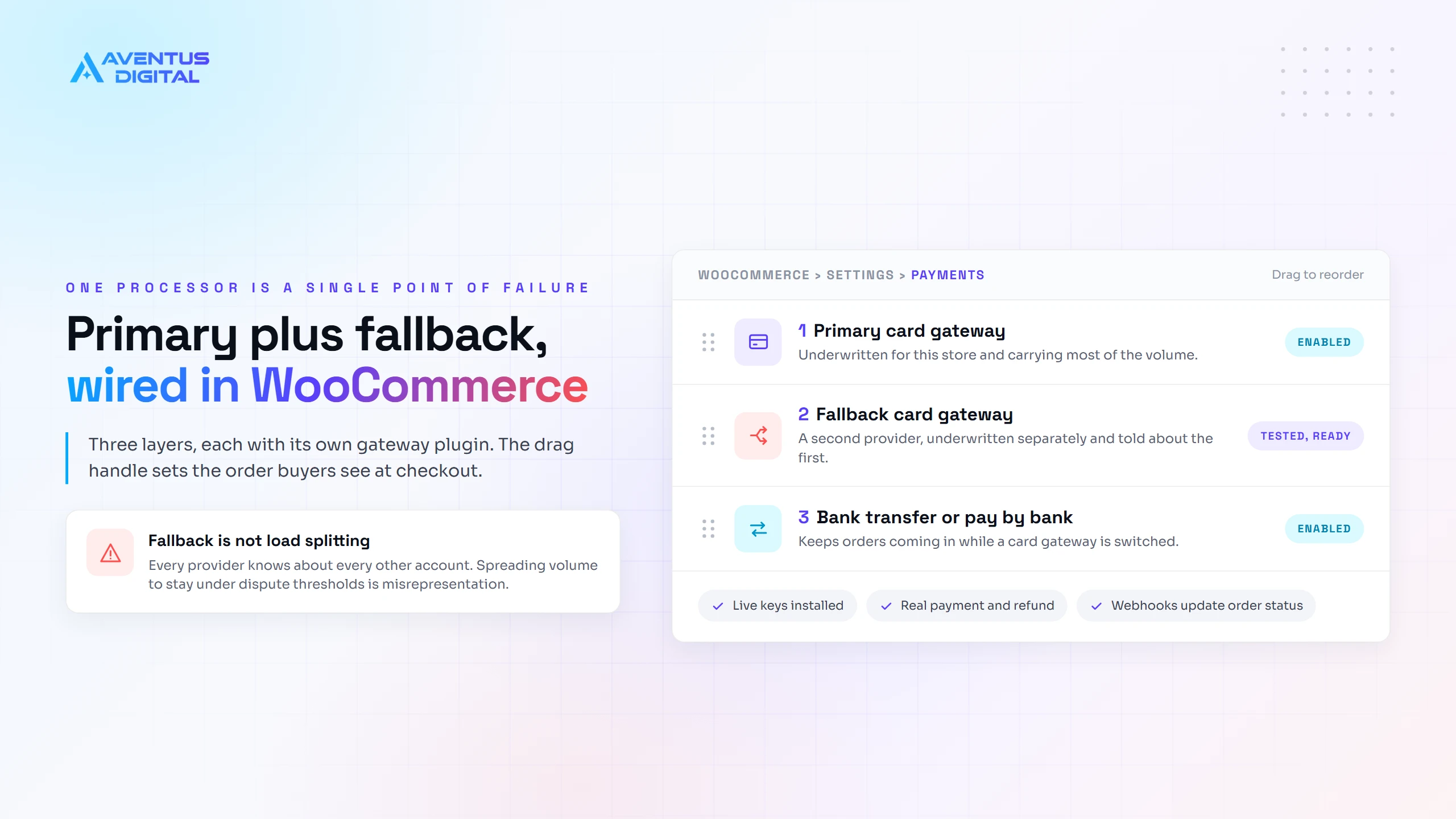
One processor is a single point of failure. If it reviews the account, raises the reserve or exits the category, the checkout stops that day. The setup we build has three layers:
- Primary card gateway: the account underwritten for this store, carrying most of the volume.
- Fallback card gateway: a second provider, underwritten separately and told about the first, tested and ready to switch on.
- Non-card method: bank transfer or pay by bank, so orders can still come in during a switch.
In WooCommerce, each provider runs as its own gateway plugin under WooCommerce, Settings, Payments. The WooCommerce settings documentation explains that the drag handle sets the order in which payment methods appear at checkout. We install the fallback with live keys, run a real transaction and a refund through it, confirm its webhooks update order status, then leave it enabled or switched off according to that provider’s terms.
Fallback is not the same as spreading volume. Splitting sales across accounts to keep each one under a dispute threshold, or putting orders through another business’s merchant account, is misrepresentation. The Visa Core Rules (April 2026) treat transactions that do not come from a real sale between a cardholder and the merchant as laundering, and list it as grounds for a permanent ban. Mastercard keeps terminated merchants on its MATCH list for five years under its Security Rules and Procedures. Every provider should know about every other account you run.
Where we come in: every ecommerce website we build in this sector ships with both gateway slots wired and tested before launch, plus a one page runbook that shows your team exactly which settings change during a switch and in what order.
Questions to ask before you sign, including the ones that reveal a reseller
Ask these in writing and keep the answers with your merchant agreement.
- Who is the acquiring bank, and whose name is on the agreement?
- Are you the acquirer, a payment facilitator, or an ISO or agent? Visa’s rules define a payment facilitator as an entity that contracts with an acquirer on behalf of sponsored merchants.
- Will I have my own merchant ID, or sit as a sub-merchant under yours?
- What is the reserve: the percentage, rolling or fixed, how many days, and when is it reviewed?
- When are funds settled, and how long can you hold them if the account closes?
- Which billing descriptor and merchant category code will the account use?
- Are there monthly minimums, setup fees or fees per dispute?
Three answers tell you that you are talking to a reseller: they cannot name the bank until you sign, they want an application fee before underwriting starts, or they promise approval. None of those is automatically wrong, but each one means the real decision sits with someone you have not met.
Where we come in: we stay out of the commercial negotiation. What we give you is the website side in writing: the page list, every policy URL, the descriptor and a reviewer login if the acquirer asks for one, so the answers you give on the application match what the underwriter finds.
What good looks like six months in, not just at approval
Providers compete on price at approval. The account that was worth choosing shows up six months later. A healthy setup at that point looks like this:
- Fraud and disputes well under 0.7%, the level at which Visa flags your acquirer.
- Settlements arriving on the agreed schedule, with no unexplained holds.
- A reserve review in the calendar, with clean trading history to support a reduction.
- A store that still matches what was approved, with new products and copy checked before they go live.
- A fallback gateway that has been tested within the last quarter.
Where we come in: our website maintenance plans, from £49 a month, keep the gateway plugins, checkout and order emails updated and tested, and flag any content change that would take the store away from what the underwriter approved.
What every peptide store build from Aventus includes
Whichever processor you end up with, the store is the part you control. Every build includes:
- A self-hosted WooCommerce checkout with primary and fallback gateway slots, tested with live transactions.
- Policy pages, a billing descriptor and order emails that match each other and the application.
- An underwriting pack: page list, policy URLs and a checkout screenshot set.
- Product page templates built for research supply presentation, with the COA archive in your own media library.
- SEO, GEO and AEO built in from day one, on a fast Flatsome build.
Builds start at £399, full custom stores from £1,999, fixed price and quoted before work begins, and most go live in two to three weeks. See the full specification on our peptide websites page.
Peptide and research supply ecommerce
Get a quote for a compliant RUO peptide website
See the builds, the full specification and what is included, then request a fixed price quote. If you already have a site, send us the URL and we will tell you what is triggering the declines before you spend anything.
Fixed price from £399. Website work only: we do not arrange or guarantee payment processing.
Already trading and weighing up a processor? Start with a free website audit so you know what an underwriter will see. If the store needs rebuilding before you apply, our website redesign route covers it. If you are launching, ask for a free 72 hour homepage mockup and see the store before you commit.
You Might Also Like
- Peptide websites: how we build and maintain research peptide stores, with pricing.
- Getting approved for payments: the eight checkpoints underwriting works through.
- Selling peptides on Shopify: why hosted stores lose the checkout first.
- Building a compliant peptide website: the full build guide for 2026.
- Website maintenance: keeping gateways, plugins and checkout tested every month.

Author
Zubayed Feroz
Founder of Aventus Digital
General website guidance, not legal or financial advice. Requirements vary by product and jurisdiction and they change, so take advice from a qualified solicitor on your own catalogue. Underwriting criteria are set by individual acquirers: we do not arrange or guarantee payment processing. Named services are referenced for comparison only, correct to the best of our knowledge on the date below.
Published 22 September 2026. Last reviewed 22 September 2026.
Frequently Asked Questions
Who processes payments for peptide stores?
Mostly high-risk acquirers, reached directly or through an ISO or reseller. Mainstream facilitators exclude the category in their published lists as at September 2026: Stripe prohibits incorrectly labelled research chemicals and WooPayments names peptides outright. Some stores add bank transfer or pay by bank alongside cards.
What rates should I expect?
Higher than standard. PaymentCloud publishes an average high-risk rate of 3.49% to 3.95% (July 2026), against 1.5% + 20p for standard UK cards on Stripe. Many acquirers do not publish pricing at all, so get every fee in a written quote before you sign.
What is a rolling reserve?
A percentage of each day’s sales held back for a set period, then released day by day as it ages out. PayPal’s own example is 10% held on a 90 day rolling basis, and high-risk providers publish 5% to 10% for 90 to 180 days. Ask when it will be reviewed.
Can a peptide store accept cards at all?
Some can, through an acquirer that underwrites the category knowingly and approves that specific store. Nobody can guarantee approval, and it depends heavily on how the website presents the business. Where cards are not available, bank transfer and pay by bank keep orders coming in.
Do I need a backup gateway?
Yes. A second provider, underwritten separately and told about your primary account, stops one review from closing your checkout. It is there for continuity, never for splitting volume to stay under dispute thresholds. We wire and test both on every peptide store we build.
Can I add a card surcharge in the UK to cover higher fees?
Not on consumer cards. Since 13 January 2018, regulation 6A of the Consumer Rights (Payment Surcharges) Regulations 2012 has stopped payees charging a fee for payment by consumer card. Commercial cards are treated differently, so take advice on your own customer base.
Is a high-risk ISO the same as a payment processor?
No. An ISO refers you to an acquirer and manages the relationship, but the acquirer underwrites the account, holds the reserve and settles your funds. Ask any ISO to name its acquiring bank before you sign.
Related Blogs
Which Hosting Is Best for Peptide Websites?
Short answer: Hostinger is what we put research peptide stores on, and our link takes [...]
Oct
Is It Legal to Sell Research Peptides in the UK? The MHRA Line, Explained for Store Owners
Short answer: selling research peptides in the UK is lawful in itself, and it stops [...]
Oct
How to Start a Peptide Business in 2026: Costs and Steps
Short answer: to start a peptide business you register the company, open the bank account, [...]
Oct
Best Ecommerce Platform for a Peptide Store (2026)
Short answer: the best ecommerce platform for peptides is a self-hosted WooCommerce store. Hosted platforms [...]
Oct
The peptide merchant account application pack that gets approved first time
Short answer: a peptide merchant account is won on evidence, not on wording. Underwriting opens [...]
Sep
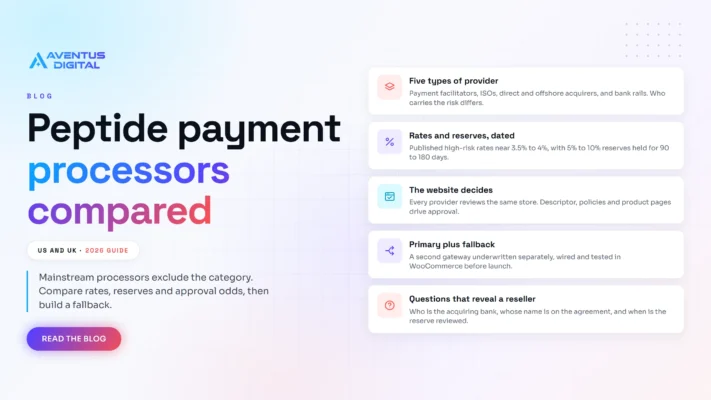
Peptide Payment Processors Compared: US and UK 2026
Short answer: mainstream processors such as Stripe, PayPal and WooPayments exclude the category, so a [...]
Sep
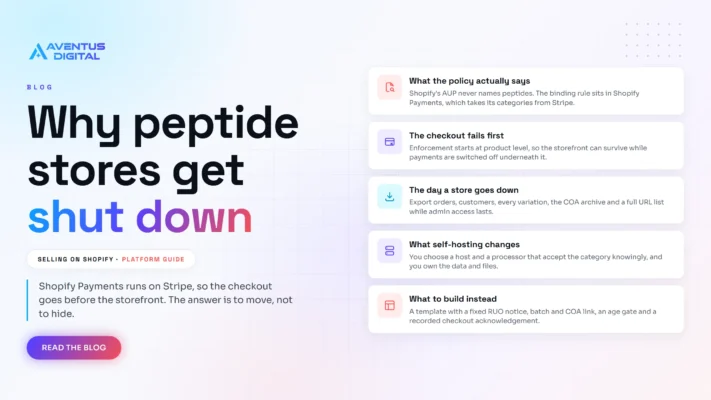
Selling Peptides on Shopify: Why Stores Get Shut Down
Short answer: not for long. You can open a store and sell peptides on Shopify, [...]
Sep
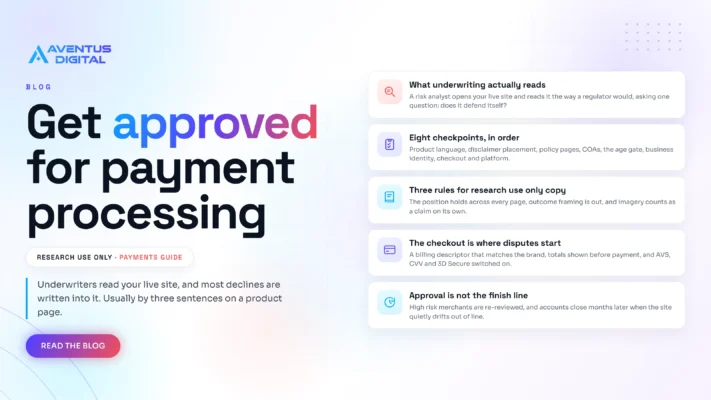
Peptide website compliance and how to get approved for payments
Short answer: peptide website compliance is decided on four things. A research use only position [...]
Sep