
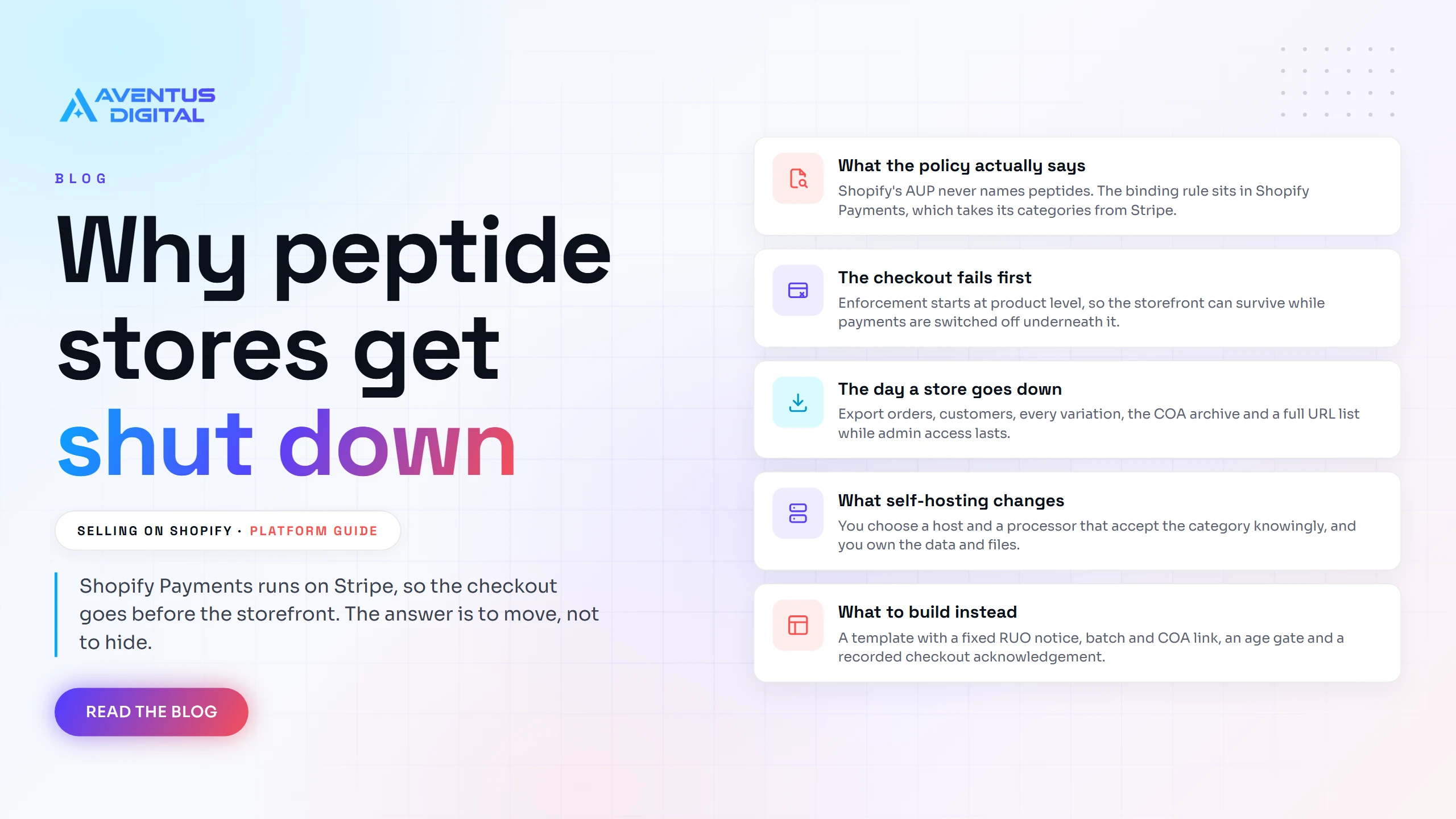
Selling peptides on Shopify: why stores get shut down (and the WooCommerce setup that doesn’t)
Short answer: not for long. You can open a store and sell peptides on Shopify, but Shopify Payments runs on Stripe, and Stripe restricts pharmaceuticals and prohibits incorrectly labelled research chemicals. The storefront can survive review while the checkout is switched off. The lasting fix is a self-hosted WooCommerce store with a processor that underwrites the category knowingly.
When a suspended store owner calls us, the first thing we ask for is not the logo or the product list. It is the COA folder. One US store we built keeps 30 certificate PDFs in its own media library for 21 products, with separate purity and endotoxin reports for each batch, every file named by batch and test date. On a hosted platform, that archive lives on someone else’s servers. Most owners only find out how much it matters on the day the account closes.
Aventus Digital builds and maintains WooCommerce stores for research peptide brands across the UK, the US and the EU, including Crew Labs, Zyvara Life and Solix Labs. We have delivered 600+ websites across 40+ countries in 7+ years. We are the website partner, not the legal adviser. Responsibility for your products, your claims and your regulatory position sits with you as the business owner.
Can you sell peptides on Shopify? What the policy actually says
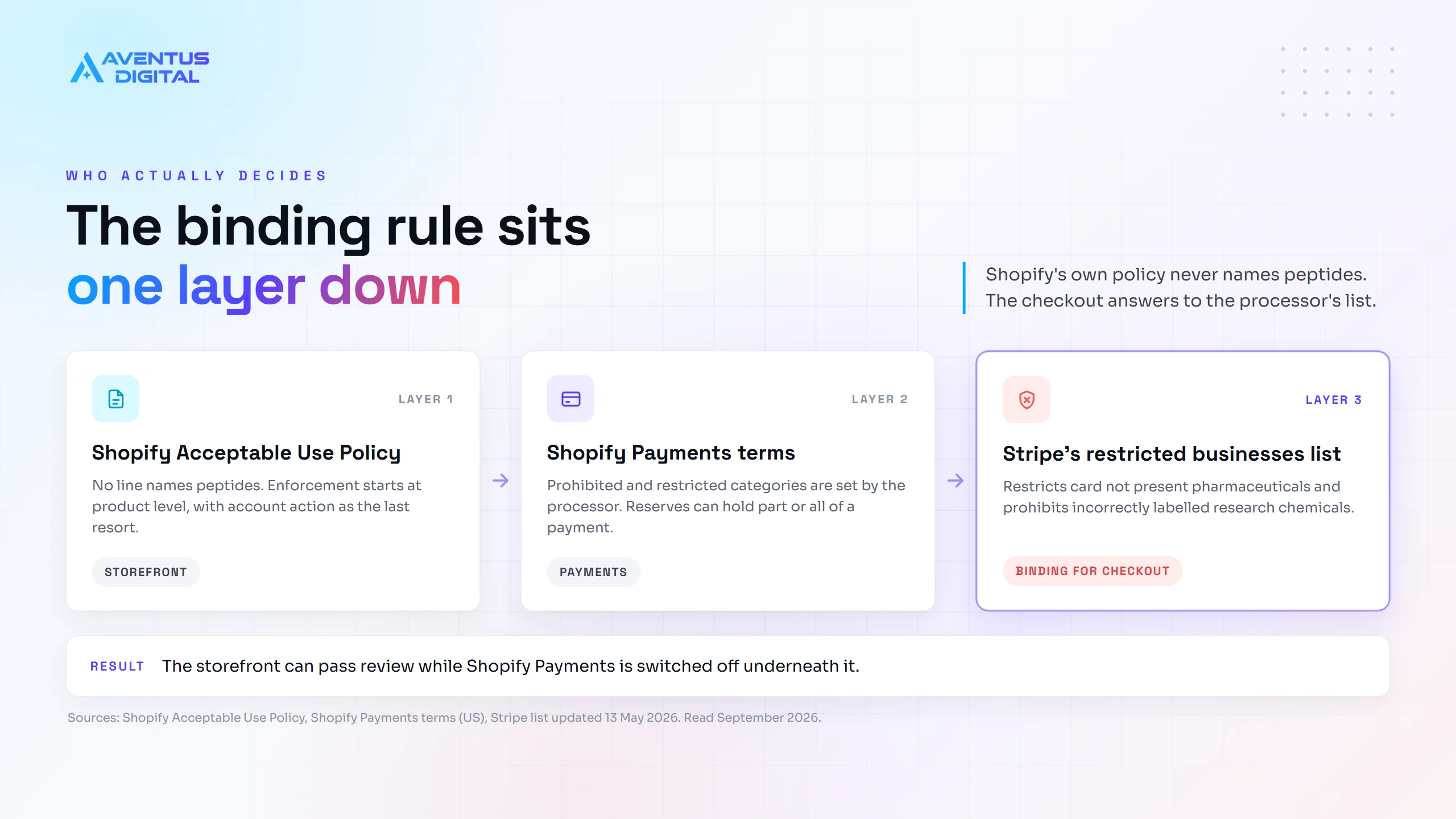
Shopify’s Acceptable Use Policy does not carry a line that names peptides. It says you cannot use Shopify for anything that is illegal where you do business, and it describes enforcement as starting at the product level, with account level action as a last resort. Read on its own, that sounds survivable.
The binding rule sits one layer down. The Shopify Payments terms say the prohibited and restricted business categories are set by each payment processor. That processor is Stripe, and Stripe’s prohibited and restricted businesses list (last updated 13 May 2026) restricts card not present pharmaceuticals and prohibits incorrectly labelled research chemicals.
Whether a catalogue falls into those categories is decided by how the store presents itself, not by the label on the vial. In the UK, the Human Medicines Regulations 2012 turn on intent and presentation, and the MHRA treats website copy as in scope. In the US, the FDA issued warning letters to Gram Peptides (March 2026) and Wholesale Peptide (June 2026) after reviewing their websites. That is the position as at September 2026.
In practice, enforcement tends to start from one of four places:
- A payments risk review, often after the first spike in volume or the first large payout.
- A run of chargebacks or disputes, which puts the account in front of a human reviewer.
- A product or content review of titles, images, descriptions and reviews.
- Outside attention, including reports and public warning letters that turn up in search.
None of this is a reason to reword listings to get past a reviewer. A store that only stays open by hiding what it sells is misrepresenting itself to its platform and its processor. The answer is to move, not to hide.
Where we come in: before any rebuild, we read the store the way a reviewer would. Our SEO and GEO audit goes through every product title, description, image, review and policy page, and flags anything that reads as consumer supply. That list becomes the content brief for the new store, so it starts clean instead of carrying the old problems across. You can see how those findings shape a build on our research peptide store builds page.
Why the Shopify peptides ban hits the checkout first
Most owners expect the storefront to go first. In our experience it is usually the other way round. Because Shopify enforces the Acceptable Use Policy at the product level first, a store can pass review and keep its theme, domain and catalogue while Shopify Payments is switched off underneath it.
The Shopify Payments terms explain what that means for money. Shopify can set up a reserve account and hold part, or all, of the funds from a transaction for a period. If the payments agreement is terminated, you must stop taking card payments immediately, and the processor can keep holding funds it considers necessary to cover chargebacks, refunds and disputes. Those terms apply as at September 2026.
Switching to a third party gateway on Shopify does not solve the underlying problem. The new provider runs its own underwriting, most Shopify plans add a transaction fee when you do not use Shopify Payments, and the store still sits on a platform whose processor has already ruled on the category. We cover the underwriting side in detail in our guide to getting a peptide website approved for payments.
Where we come in: every ecommerce website we build for this sector is gateway agnostic. We wire a primary and a fallback gateway slot into WooCommerce, test both with live transactions before launch, and store the buyer’s checkout acknowledgement against each order. If one processor exits, the checkout does not go with it.
| Checkpoint | Hosted Shopify storeWhat fails | Self-hosted WooCommerceWhat passes | How Aventus builds itOn every peptide store |
|---|---|---|---|
| Payment gateway | Tied to Shopify Payments and Stripe’s category rules. Third party gateways add a fee on most plans. | Any processor that underwrites the category with full disclosure of what you sell. | Primary and fallback gateway slots, both tested with live transactions before launch. |
| COA files | Stored in the platform’s file area, tied to the account. | Stored in your own media library and your own backups. | A COA field on every product, batch named PDFs and a searchable COA library page. |
| Product template | Theme limits on custom fields and fixed page blocks. | Full control of fields, layout and what each template can display. | A Flatsome template with a fixed RUO notice, batch number, COA link and no open benefit copy area. |
| Age gate and acknowledgement | Depends on third party apps and checkout access. | Built into the theme and the checkout directly. | Site entry age gate plus a required checkout checkbox saved to each order. |
| Data and exports | CSV exports available while the account is live. | You hold the database, the files and the server access. | Nightly off-site backups of the database and media on every maintenance plan. |
| Hosting | The platform decides, under one policy for everyone. | You choose a host whose terms accept the category. | We check the host’s acceptable use terms before a single page is built. |
| Platform and processor terms change, so check each provider’s current policy before you commit. This is website guidance, not legal advice. Responsibility for your products, claims and regulatory position sits with you as the business owner. | |||
The day a store goes down: orders, customers, catalogue and COAs
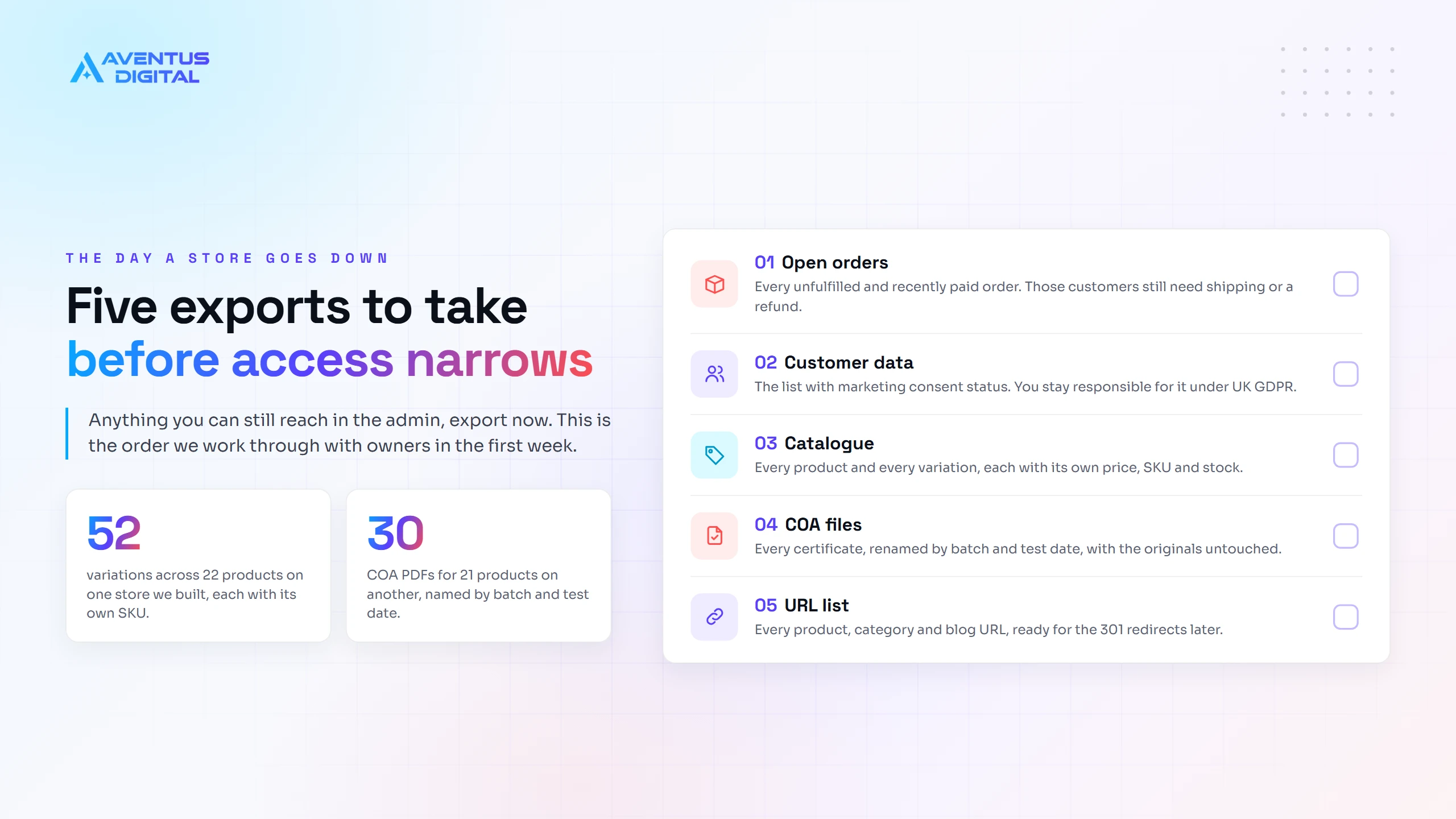
When the payments account or the store is suspended, the clock starts. Anything you can still reach in the admin, export now, before access narrows further. This is the order we work through with owners in that first week:
- Open orders. Export every unfulfilled and recently paid order with order number, date, items and shipping details. Those customers still need their order shipped or refunded, whatever happens to the account.
- Customer data. Export the customer list with marketing consent status. You remain responsible for that data under UK GDPR, and the ICO is the regulator for how you move and use it.
- Catalogue. Export products with every variant. A store like Crew Labs runs 22 products with 52 variations, and each variation carries its own price, SKU and stock. That is the data that takes longest to rebuild by hand.
- COA files. Download every certificate, rename each one by batch and test date, and keep the originals untouched. Assume any file hosted on the platform goes when the account goes.
- URLs. Save a full list of product, category and blog URLs. You will need it for redirects later, and it is much harder to rebuild from memory.
One thing we will not help with: opening a new Shopify store under a different name or entity to carry on trading. That is misrepresentation to the platform and the processor, it tends to end in a second, faster termination, and it puts the next processor application at risk.
Where we come in: our website maintenance plans, from £49 a month, keep nightly off-site copies of the database, the media library and the COA archive. On a self-hosted store, no single supplier decision can take your order history or your certificates with it.
What self-hosting changes, and what it doesn’t
WooCommerce is not a loophole. The same regulators read the site, and the host and the processor still have rules. What changes is who you depend on, and whether they said yes knowing exactly what you sell.
- Choice of host. You pick a host whose acceptable use terms accept the category, rather than living under one platform’s policy for every merchant it serves.
- Choice of gateway. You apply to processors that underwrite the category, with full disclosure, and you can run a fallback so one decision does not stop trading.
- Control of content. Your product copy, images, COAs and legal pages live on your own server, in your own backups.
- Control of templates. You decide what fields a product page shows, which means the research use only notice, batch number and COA link can be fixed into the template instead of typed per product.
The trade off is honest. A self-hosted store needs updates, security and backups, and someone has to own that work. The research use only notice also only holds up when the whole site is consistent with it. A disclaimer on one page does not outweigh product pages that read like consumer supply, which is the point both the MHRA and the FDA make through how they judge presentation. Our guide on how to build a compliant peptide website covers that consistency in detail.
Where we come in: if you already have a WooCommerce store that is not holding up, a website redesign is often cheaper than a rebuild. We keep the domain, the orders and the customer accounts, and rework the templates, content and checkout around them.
The shape of a migration off Shopify
A migration is its own project, and we cover the full step by step process, including redirects and search rankings, in a separate migration guide. At a high level it runs in this order:
- Freeze content changes on the old store and take the full export set above.
- Line up hosting and a processor application before the build finishes, not after.
- Build the new templates first, then import the catalogue, variations and COAs into them.
- Map every old URL to its new home with 301 redirects, so search traffic follows the move.
- Test checkout end to end with the live gateway, then switch the domain and submit the new sitemap in Google Search Console.
Where we come in: send us your store URL for a free website audit. It comes back within 48 hours with the URL map, the catalogue size, what reads as consumer supply, and a fixed price for the move.
What to build instead, section by section
This is the structure we build for research peptide brands in Flatsome and WooCommerce every day. Each part has one job: to make the store read, consistently, as a supplier of research materials to laboratories and institutions.
- Homepage. Who you supply, how batches are tested and where the COAs live. No lifestyle imagery, no consumer framing.
- Category pages. Plain catalogue structure with short, factual introductions that search engines and AI search can read.
- Product template. Name, specification, batch number, COA link and a fixed research use only notice, with no free text area for benefit copy.
- COA library. One searchable page listing every certificate by product and batch, linked from each product.
- About and contact. The legal entity name, registered address and a working business email, visible without digging.
- Legal pages. Terms, a research use only policy, privacy, shipping and refunds, written for your jurisdiction by your own adviser.
- Age gate and checkout acknowledgement. An entry gate, plus a required checkbox that is saved against every order.
- EU listings. If you sell into the EU, the General Product Safety Regulation (EU) 2023/988, applying since 13 December 2024, requires the responsible person, manufacturer details, product identifier, an image and any warnings in the listing itself. UK sellers count as non EU sellers here.
Where we come in: we show this structure before you commit. Ask for a free 72 hour homepage mockup and you will see your own catalogue in the layout above, then decide. See recent builds and the full specification on our peptide websites page.
What every Aventus peptide store includes
Every build we deliver for this sector comes with the same foundations, whatever the size of the catalogue:
- WooCommerce on Flatsome, with a product template carrying a fixed RUO notice, batch number and COA link.
- A searchable COA library and batch named certificate files you own.
- An age gate and a required checkout acknowledgement saved to each order.
- Primary and fallback gateway slots, tested before launch.
- Legal page templates ready for your adviser’s wording.
- SEO, GEO and AEO built in from day one, with 301 redirects mapped on any migration.
- Nightly off-site backups once the store is on a maintenance plan.
Builds start at £399, and full custom stores from £1,999. Every project is fixed price and quoted before work begins, and most go live in two to three weeks. That comes from a team with 1,200+ completed orders, 700+ five star reviews and a top rated Fiverr history behind it.
Peptide and research supply ecommerce
Get a quote for a compliant RUO peptide website
See the builds, the full specification and what is included, then request a fixed price quote. If you already have a site, send us the URL and we will tell you what is triggering the declines before you spend anything.
Fixed price from £399. Website work only: we do not arrange or guarantee payment processing.
If your store is still trading, start with a free website audit and know where you stand within 48 hours. If you already run WooCommerce and it needs rebuilding, look at our website redesign route. If you are starting fresh after a suspension, ask for a free 72 hour homepage mockup and see the new store before you pay for it.
You Might Also Like
- Peptide websites by Aventus Digital: our builds, the full specification and a fixed price quote.
- How to build a compliant peptide website in 2026: the order to build it in, from claims to checkout.
- Peptide website compliance and payment approval: the checkpoints an underwriter works through on your site.
- Website maintenance plans: updates, security and off-site backups from £49 a month.
- Free website audit: a clear list of what to fix, back within 48 hours.

Author
Zubayed Feroz
Founder of Aventus Digital
General website guidance, not legal or financial advice. Requirements vary by product and jurisdiction and they change, so take advice from a qualified solicitor on your own catalogue. Underwriting criteria are set by individual acquirers: we do not arrange or guarantee payment processing. Named services are referenced for comparison only, correct to the best of our knowledge on the date below.
Published 21 September 2026. Last reviewed 21 September 2026.
Frequently Asked Questions
Can you sell peptides on Shopify?
You can open the store, but it is unlikely to last. Shopify Payments uses the category rules of its processor, Stripe, which restricts pharmaceuticals and prohibits incorrectly labelled research chemicals. Most peptide stores lose the checkout long before they lose the storefront, which is why we build them on self-hosted WooCommerce instead.
Why did Shopify suspend my store?
Suspensions usually follow a payments risk review, a run of disputes, a content review of your listings, or an outside report. Shopify’s notice will name the policy it relied on, so read it closely and export your data while you still have admin access. For anything touching your legal position, speak to your own solicitor.
Does a research use only disclaimer keep a store inside Shopify’s rules?
No. Platforms, processors and regulators such as the MHRA and the FDA judge the whole presentation of a store, not the label. A disclaimer only holds up when every page is consistent with it, and it is never a way to stay on a platform that does not accept the category.
What happens to my balance if Shopify Payments is terminated?
Under the Shopify Payments terms, funds are paid out subject to the processor’s terms, and the processor can keep holding what it considers necessary to cover chargebacks, refunds and disputes. Shopify can also hold funds in a reserve account. How long depends on your account, so ask Shopify support directly and take financial advice if the sums are large.
Is WooCommerce actually safer, or just different?
Different, in a way that matters. The same laws apply, but you choose a host and a processor that accept the category knowingly, you can run a fallback gateway, and you own the data and files. The trade off is that someone has to maintain it, which is what our website maintenance plans cover.
Can I open a new Shopify store under a different name?
We would not advise it and we will not build one. Re-opening under a new name or entity to keep trading on a platform that has ruled on the category is misrepresentation, and it puts future processor applications at risk. Move to a setup where the platform and processor know what you sell.
How long does it take to move a peptide store to WooCommerce?
Most of our builds go live in two to three weeks. The longest parts are usually the catalogue with its variations and the COA archive, not the design. Processor approval runs on its own timeline, so apply while the build is under way.
Will I lose my Google rankings when I move?
Not if the move is planned. Keep your domain, map every old URL to its new page with 301 redirects, and submit the new sitemap in Google Search Console on launch day. A free website audit gives you that URL list before you start.
Related Blogs
Which Hosting Is Best for Peptide Websites?
Short answer: Hostinger is what we put research peptide stores on, and our link takes [...]
Oct
Is It Legal to Sell Research Peptides in the UK? The MHRA Line, Explained for Store Owners
Short answer: selling research peptides in the UK is lawful in itself, and it stops [...]
Oct
How to Start a Peptide Business in 2026: Costs and Steps
Short answer: to start a peptide business you register the company, open the bank account, [...]
Oct
Best Ecommerce Platform for a Peptide Store (2026)
Short answer: the best ecommerce platform for peptides is a self-hosted WooCommerce store. Hosted platforms [...]
Oct
The peptide merchant account application pack that gets approved first time
Short answer: a peptide merchant account is won on evidence, not on wording. Underwriting opens [...]
Sep
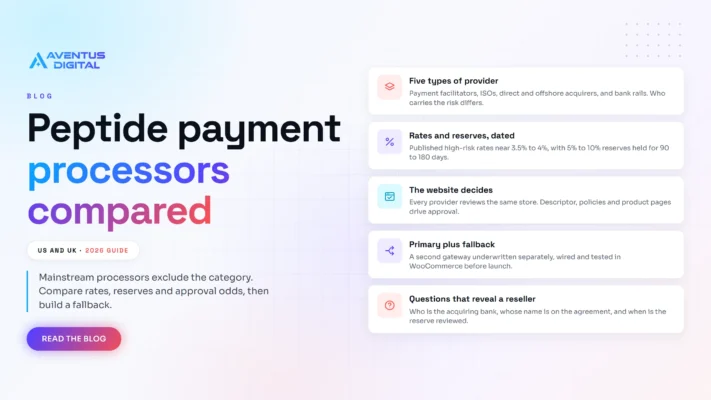
Peptide Payment Processors Compared: US and UK 2026
Short answer: mainstream processors such as Stripe, PayPal and WooPayments exclude the category, so a [...]
Sep
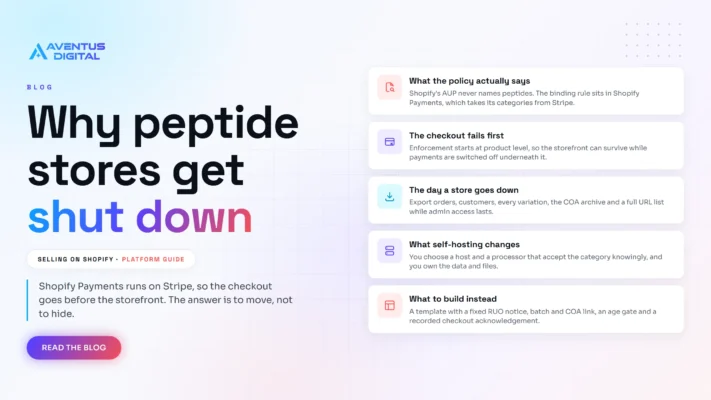
Selling Peptides on Shopify: Why Stores Get Shut Down
Short answer: not for long. You can open a store and sell peptides on Shopify, [...]
Sep
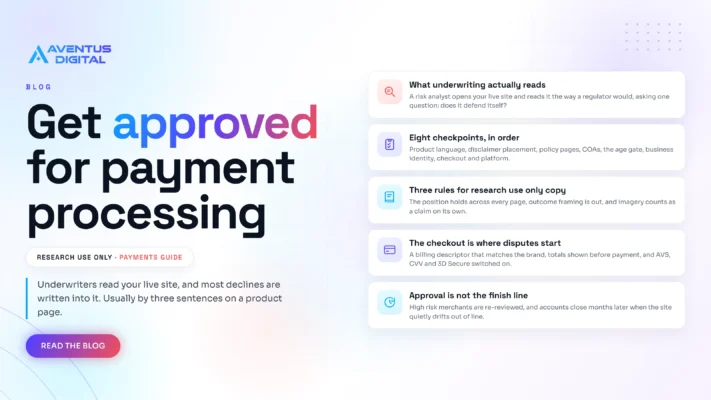
Peptide website compliance and how to get approved for payments
Short answer: peptide website compliance is decided on four things. A research use only position [...]
Sep