
Peptide website compliance: how to get approved for payment processing
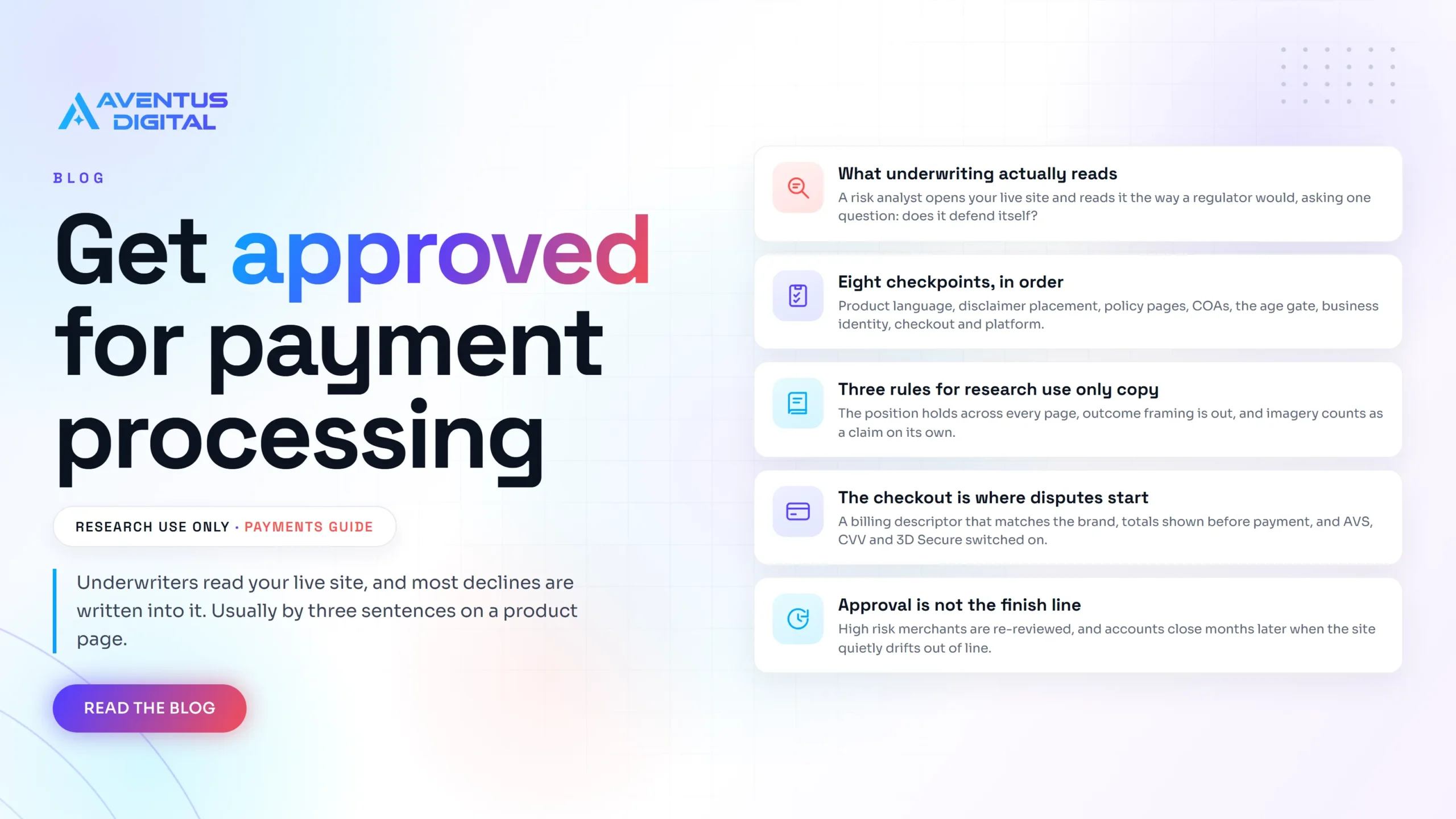
Short answer: peptide website compliance is decided on four things. A research use only position that holds on every page, complete and findable policy pages, published certificates of analysis, and a checkout that tells the customer exactly what they are buying and being charged. Underwriters read your live site. Most declines are written into it.
Nearly every peptide business that comes to us has already been declined once, usually with no reason given. The bank statements were clean. The problem was three sentences on a product page.
Aventus Digital builds research supply stores for a living. Crew Labs, Zyvara Life, Solix Labs, Endura Research and Vyon Biolabs are all ours, with 600 plus websites delivered across 40 plus countries in 7 plus years. We are the website partner, not your legal adviser, and responsibility for your products and claims sits with you.
What an underwriter is actually doing when they open your site
Underwriting is not a form check. A risk analyst reads your live site the way a regulator would: homepage, product pages, terms, refund and shipping policies, company details, checkout, blog. They are answering one question. If this merchant is challenged by a card scheme or a regulator, does the site defend itself, or hand over the evidence?
High risk does not mean illegitimate. It means more exposure to chargebacks, regulatory attention and disputes, so the bank wants proof you have thought about all three. Aggregators such as Stripe and PayPal decline fastest because they onboard first and review later. Their published position on prohibited and restricted businesses puts unlicensed pharmaceutical and nutraceutical products in scope, and settlements are usually held before you are told why.
The UK layer sits on top, and most guides skip it because they are written for the US market:
- Many peptides are treated as medicinal products by the MHRA. Selling, supplying or advertising a medicinal product to the public without a marketing authorisation is an offence
- Marketing claims are policed by the Advertising Standards Authority
- Data handling falls under the Information Commissioner’s Office
Where we come in: our free SEO and GEO audit is run as a page by page compliance read on peptide projects, checking every URL for the language that triggers a decline. Findings back within 48 hours, as a fix list in priority order rather than a score.
The eight checkpoints underwriting works through
| Checkpoint | Gets you declinedWhat they find | Gets you throughWhat they need | How Aventus builds itOn every peptide store |
|---|---|---|---|
| Product page language | Dosing, cycles, reconstitution steps, or outcome words such as recovery, fat loss or anti ageing | Research framing only. Reference the study, never the buyer’s result | Full catalogue run against a claims checklist before launch, then re-checked at every content update |
| Disclaimer placement | One line buried on a single page, missing from half the catalogue | Product page beside the add to cart button, footer, checkout, and the order confirmation email | Rendered from product fields, so item number forty physically cannot publish without it |
| Policy pages | Missing, generic, or three clicks deep behind a tiny footer link | Terms, privacy, refunds, shipping and contact, all one click from every page, in plain English | Structured footer plus a compliance URL sheet handed over at launch for your application |
| Certificates of analysis | None at all, or a static page last updated eight months ago | Current third party lab documents, tied to the batch the customer is actually buying | Searchable batch lookup wired into the product record, PDFs hosted on your own domain |
| Age and eligibility gate | Absent, or an app that blocks Googlebot and quietly kills your organic traffic | A gate that confirms age and researcher status before the catalogue opens | Verifies human visitors while staying fully crawlable, so compliance does not cost you rankings |
| Business identity | Free email address, no company number, details that differ between site and application | Registered name, company number, address and a monitored contact route, identical everywhere | Single source of truth across footer, contact page, checkout and schema, plus email on your own domain |
| Checkout and billing | A billing descriptor nobody recognises, and recurring charges disclosed in the small print | Descriptor matching the brand, totals and shipping shown before payment, easy cancellation | Checkout mapped end to end, AVS and CVV on, receipts and confirmations tested with a live order |
| Platform and hosting | A hosted platform that can suspend the store, taking site, data and checkout together | Sitewide HTTPS on infrastructure you control, with gateway choice that is genuinely yours | Self hosted WooCommerce on hosting registered in your name, admin handed over at launch |
| Requirements vary between acquirers and change over time, so confirm current terms with your own provider. This is website guidance, not legal advice. Responsibility for your products, claims and regulatory position sits with you as the business owner. | |||
That entire right hand column is standard on every build listed on our peptide websites page, not an optional compliance package sold on top.
The three rules of research use only language
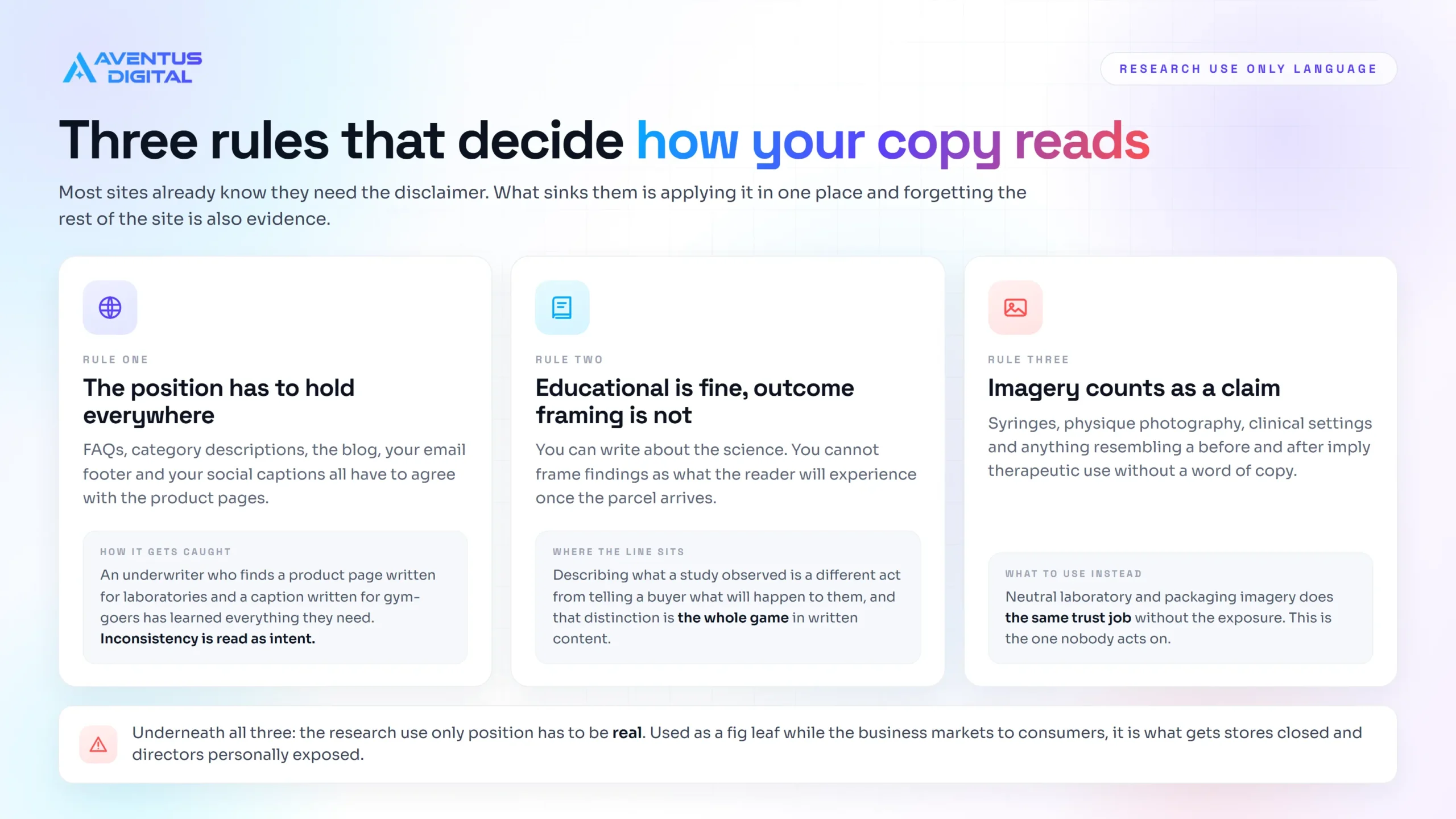
Most sites know they need the disclaimer. What sinks them is applying it in one place and forgetting the rest of the site is also evidence.
- The position has to hold everywhere. FAQs, category descriptions, blog, email footer and social captions all have to agree with your product pages. An underwriter who finds a product page written for laboratories and a social caption written for gym-goers has learned everything they need to know
- Educational content is allowed, outcome framing is not. Describing what a study observed is a different act from telling a buyer what will happen to them, and that distinction is the whole game in written content
- Imagery counts as a claim. Syringes, physique photography, clinical settings and anything resembling a before and after imply therapeutic use without a single word of copy. Neutral laboratory and packaging imagery does the same trust job without the exposure
Underneath all three sits the point that matters most. The research use only position has to be real. Using the wording as a fig leaf while the business markets to consumers for personal use is what gets stores closed, funds frozen and directors personally exposed. If that is the actual model, no website build fixes it, and it is not work we take on.
Where we come in: on our ecommerce websites the compliance language stops being free text. Purity, storage, batch and the not for human consumption statement come from structured fields and render automatically, then the claims checklist runs across descriptions, categories, blog and image library together, because the site is judged as one document.
Checkout, chargebacks and the part most merchants get wrong
Your checkout is underwritten as closely as your product pages, because it is where disputes are born.
- Billing descriptor. If the name on the bank statement does not obviously match the brand, you generate disputes from people who simply do not recognise the charge. Those count against you regardless of fault, and chargeback ratio is the number that ends accounts
- Costs before payment. Full total, shipping and delivery expectation shown before the customer pays, not after
- Subscriptions in plain sight. Recurring amount, interval and cancellation route visible at the point of purchase rather than recoverable from the terms page
- Basic fraud tooling on. AVS and CVV checks, velocity limits to stop card testing, 3D Secure where your gateway supports it. None of it is exotic, and its absence is what stands out
- A visible support route. The cheapest chargeback prevention there is. A customer who can reach you complains to you. A customer who cannot complains to their bank
Where we come in: we place a real test order before handover and follow it through the descriptor, confirmation email, receipt, tracking notification and refund path. Broken confirmation emails are one of the most common issues we find on sites built elsewhere, and they convert directly into disputes.
Never misrepresent the business to your processor
There is a well travelled set of shortcuts in this sector, and any guide that leaves them unmentioned is doing you a disservice. Miscoding the merchant category so the account reads as generic supplements. Running a clean shopfront for the underwriter while the real catalogue sits behind a login. Splitting transactions across shell sites. Processing through somebody else’s approved account.
All of it is misrepresentation to a financial institution. The realistic outcomes are held settlements, a terminated account, placement on the MATCH list which makes card processing considerably harder to obtain for five years, and personal liability for whoever signed the application.
We will not build any of it, and there is a practical argument alongside the legal one. A genuinely compliant site with a complete document pack usually clears underwriting faster than a disguised one clears review, and the workaround has to keep working forever.
Approval is not the finish line
Acquirers re-review high risk merchants periodically, and accounts are closed months after a successful application because the site drifted. A new product goes up without its disclaimer. A blog post uses outcome language. COAs stop being updated as batches rotate. A plugin update breaks the age gate.
Compliance on a peptide store is a maintained state, not a launch task. That is the biggest structural difference between this category and normal ecommerce, and why our website maintenance plans from £49 a month cover COA publishing and compliance checks alongside the usual updates, backups and monitoring.
Your pre-application checklist
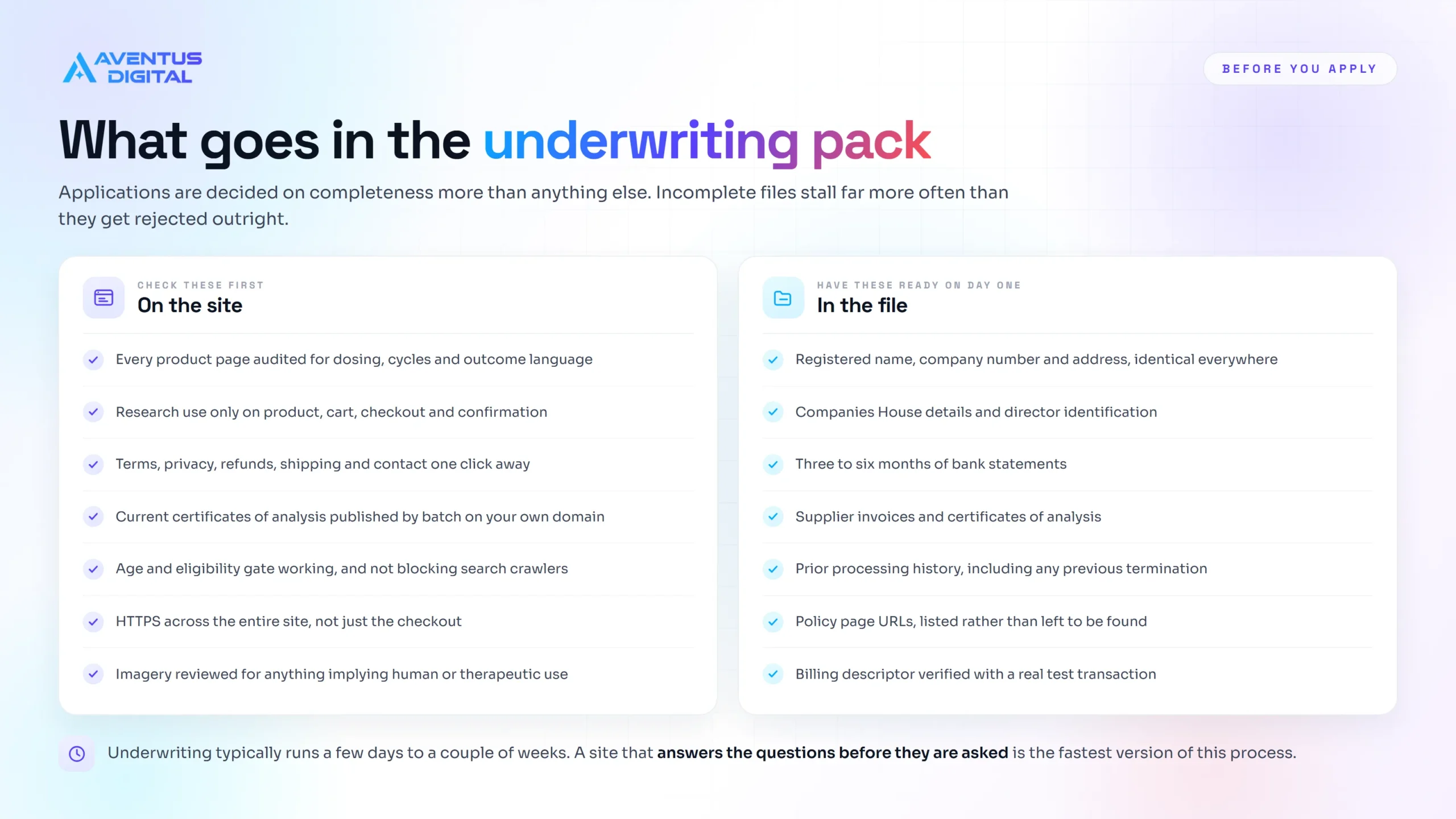
Applications are decided on completeness more than anything else. Work through this before you submit.
- Every product page audited for dosing, cycles and outcome language, including older listings nobody has looked at in a year
- Research use only statements on product, cart, checkout and order confirmation
- Terms, privacy, refunds, shipping and contact live and findable in one click
- Current certificates of analysis published by batch on your own domain
- Age gate working, and confirmed not to be blocking search crawlers
- HTTPS across the entire site, not just the checkout
- Company name, number, address and contact details identical on the site, the checkout and the application
- Billing descriptor matching the brand, verified with a real test transaction
- AVS, CVV and velocity checks enabled, 3D Secure where available
- Imagery reviewed for anything implying human or therapeutic use
- Underwriting pack ready: Companies House details, director ID, three to six months of bank statements, supplier invoices, COAs, prior processing history and policy URLs
Underwriting typically runs a few days to a couple of weeks depending on the acquirer and how complete your file is. Incomplete applications stall far more often than they are rejected outright.
Get a quote for a compliant RUO peptide website
Peptide and research supply ecommerce is a niche we build in repeatedly rather than occasionally, which is the only reason the compliance structure, the age gate, the COA system and the payment readiness are standard rather than paid extras. Every build includes:
- Self hosted WooCommerce on hosting registered in your name, admin login and training handed over at launch
- RUO labelling rendered from product fields at product, cart, checkout and order confirmation
- Age and eligibility gate that verifies humans while staying fully crawlable
- COA lookup searchable by batch, PDFs on your own domain
- Terms, refund, shipping and privacy pages drafted for the sector
- A full claims read across catalogue, categories, blog and image library before launch
- A compliance URL sheet at handover, ready to paste into your application
- SEO, GEO and AEO configured during the build, not sold as an upsell later
Builds start at £399, with full custom stores from £1,999, fixed price and quoted before work begins. Most go live in two to three weeks.
Peptide and research supply ecommerce
Get a quote for a compliant RUO peptide website
See the builds, the full specification and what is included, then request a fixed price quote. If you already have a site, send us the URL and we will tell you what is triggering the declines before you spend anything.
Fixed price from £399. Website work only: we do not arrange or guarantee payment processing.
If your site has already been declined, the reason is usually visible on three product pages. Send us the URL for a free SEO and GEO audit and you will have the findings within 48 hours. If you are rebuilding, a website redesign carries your content across and maps every existing URL to its new equivalent with a 301 redirect. Starting from scratch, we will build you a free mockup of your homepage within 72 hours with no obligation to go further.
You Might Also Like
- Peptide websites the builds, the compliance structure, and what is included.
- How to build a compliant peptide website in 2026
- Ecommerce websites how we build WooCommerce stores that are ready for underwriting.
- How much does a website cost in the UK in 2026? every figure, with nothing hidden.
- What is GEO? The UK business owner’s guide the plain English primer on getting cited by AI.

Author
Zubayed Feroz
Founder of Aventus Digital
General website guidance, not legal or financial advice. Requirements vary by product and jurisdiction and they change, so take advice from a qualified solicitor on your own catalogue. Underwriting criteria are set by individual acquirers: we do not arrange or guarantee payment processing. Named services are referenced for comparison only, correct to the best of our knowledge on the date below.
Published 1 September 2026. Last reviewed 1 September 2026.
Frequently Asked Questions
Why do Stripe and PayPal decline peptide websites?
Both treat unlicensed pharmaceutical and nutraceutical products as restricted, and both onboard first then review later. The decline usually arrives after an automated risk review reads your live product pages and finds dosing language or outcome claims. Because they are aggregators rather than dedicated acquirers, settlements are often held before you are given a reason.
Can my peptide website be approved if it was shut down before?
Often, yes, provided the original cause is genuinely fixed rather than hidden. Start by identifying what triggered it, which is usually product page language, missing policy pages or an incomplete document file. A prior termination will come up in the new application, so the route through is a corrected site and a complete pack rather than a fresh company name.
Do I have to delete all my educational content?
No, and you should not, because good research content is one of the strongest trust signals you have. What has to change is the framing. Describe what a study observed rather than what the reader will experience, keep the research use only position consistent across every post, and review older articles as carefully as new ones.
Does research use only wording protect a peptide seller?
Only when the position is real. If the rest of the site markets products for human use, an RUO line in the footer offers no protection with the MHRA, the ASA, or your acquirer. The wording has to match the actual business model, the customer base and every product page. Take your own legal advice on your specific catalogue.
Do peptide websites need an age gate?
An age and eligibility gate is standard on research supply stores and underwriters look for it. It has to be configured so it verifies human visitors without blocking search engine crawlers, otherwise you lose your organic traffic while fixing a compliance issue. It is one of the most common technical mistakes we correct on peptide sites.
Is Shopify allowed for a peptide website?
Not with their own payment product, and the deeper issue is that a hosted platform can suspend the store under its acceptable use terms, taking the site, the customer data and the checkout together. Self hosted WooCommerce keeps all three under your control, so changing acquirer is a gateway swap rather than a rebuild. That is what we build peptide stores on.
What is a certificate of analysis and does my site need one?
A COA is the third party lab document showing identity and purity for a specific batch. Publishing them, searchable by batch number and hosted on your own domain, is the strongest trust signal on the site for buyers and underwriters alike. It needs to sit inside the product data rather than on a static page, and it has to stay current as stock rotates.
Will my site be reviewed again after approval?
Yes. Acquirers re-review high risk merchants periodically, and accounts are closed months after approval when a site drifts. New products published without disclaimers, blog posts using outcome language, and COAs that stop being updated are the usual causes. Compliance here is a maintained state rather than a launch task.
How long does peptide underwriting take?
Usually a few days to a couple of weeks, depending on the acquirer and how complete your file is. Incomplete applications stall far more often than they get rejected outright, so the fastest route is a site that answers the questions before they are asked and a document pack ready on day one.
What does a compliant peptide website cost?
Our ecommerce builds start at £399, with full custom stores from £1,999, all fixed price. Ongoing website maintenance starts at £49 a month and covers updates, backups, security and keeping COA documents published as batches change. You can request a quote on our peptide websites page.
Do you handle the legal side as well?
No. We are the website partner, not your legal adviser. We build the structure that supports a compliant position and we flag language that will cause you problems, but responsibility for your products, your claims and your regulatory position sits with you. Take proper advice on your specific catalogue before you launch.
Related Blogs
Which Hosting Is Best for Peptide Websites?
Short answer: Hostinger is what we put research peptide stores on, and our link takes [...]
Oct
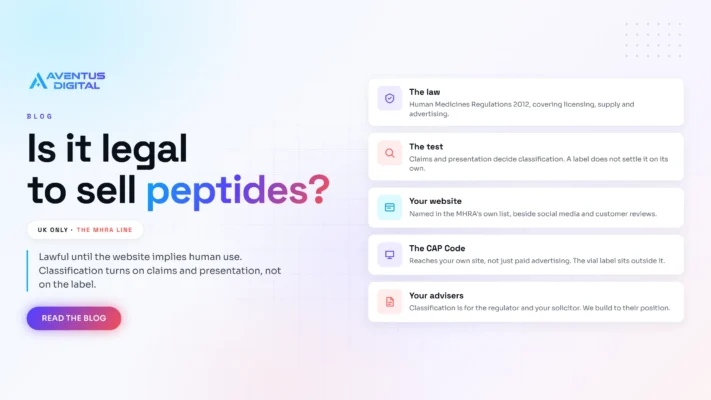
Is It Legal to Sell Research Peptides in the UK? The MHRA Line, Explained for Store Owners
Short answer: selling research peptides in the UK is lawful in itself, and it stops [...]
Oct
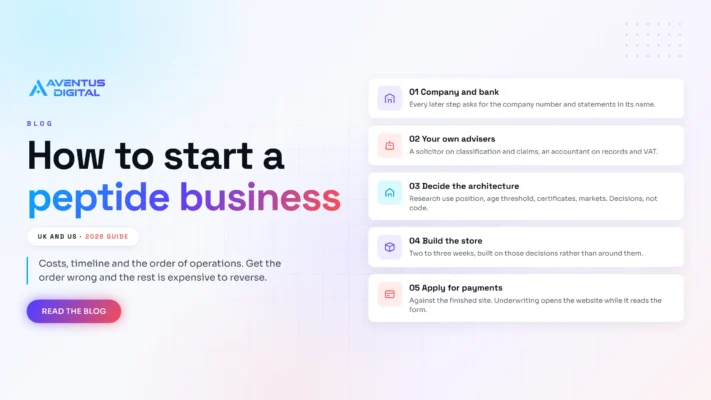
How to Start a Peptide Business in 2026: Costs and Steps
Short answer: to start a peptide business you register the company, open the bank account, [...]
Oct
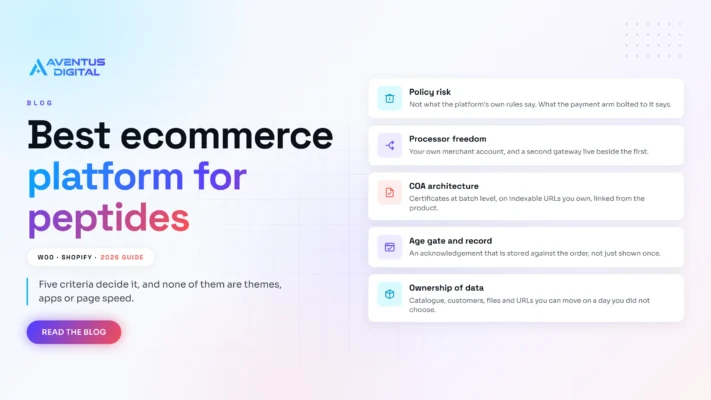
Best Ecommerce Platform for a Peptide Store (2026)
Short answer: the best ecommerce platform for peptides is a self-hosted WooCommerce store. Hosted platforms [...]
Oct
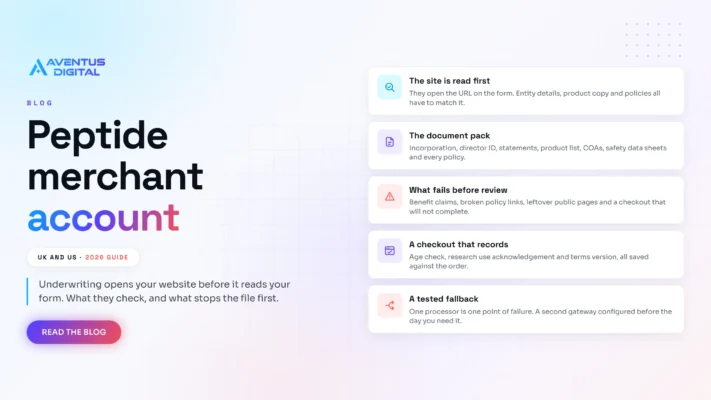
The peptide merchant account application pack that gets approved first time
Short answer: a peptide merchant account is won on evidence, not on wording. Underwriting opens [...]
Sep
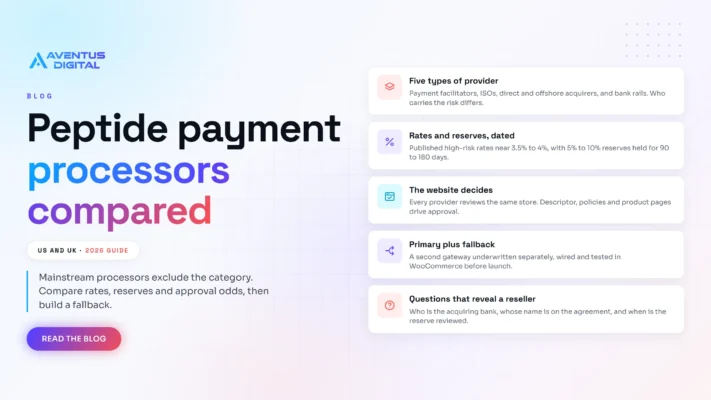
Peptide Payment Processors Compared: US and UK 2026
Short answer: mainstream processors such as Stripe, PayPal and WooPayments exclude the category, so a [...]
Sep
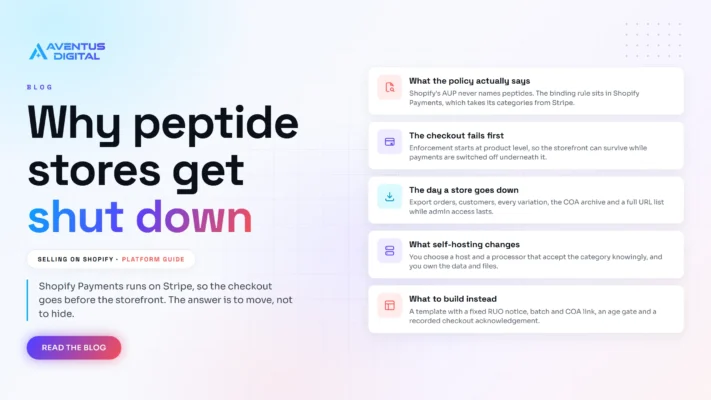
Selling Peptides on Shopify: Why Stores Get Shut Down
Short answer: not for long. You can open a store and sell peptides on Shopify, [...]
Sep

Peptide website compliance and how to get approved for payments
Short answer: peptide website compliance is decided on four things. A research use only position [...]
Sep