
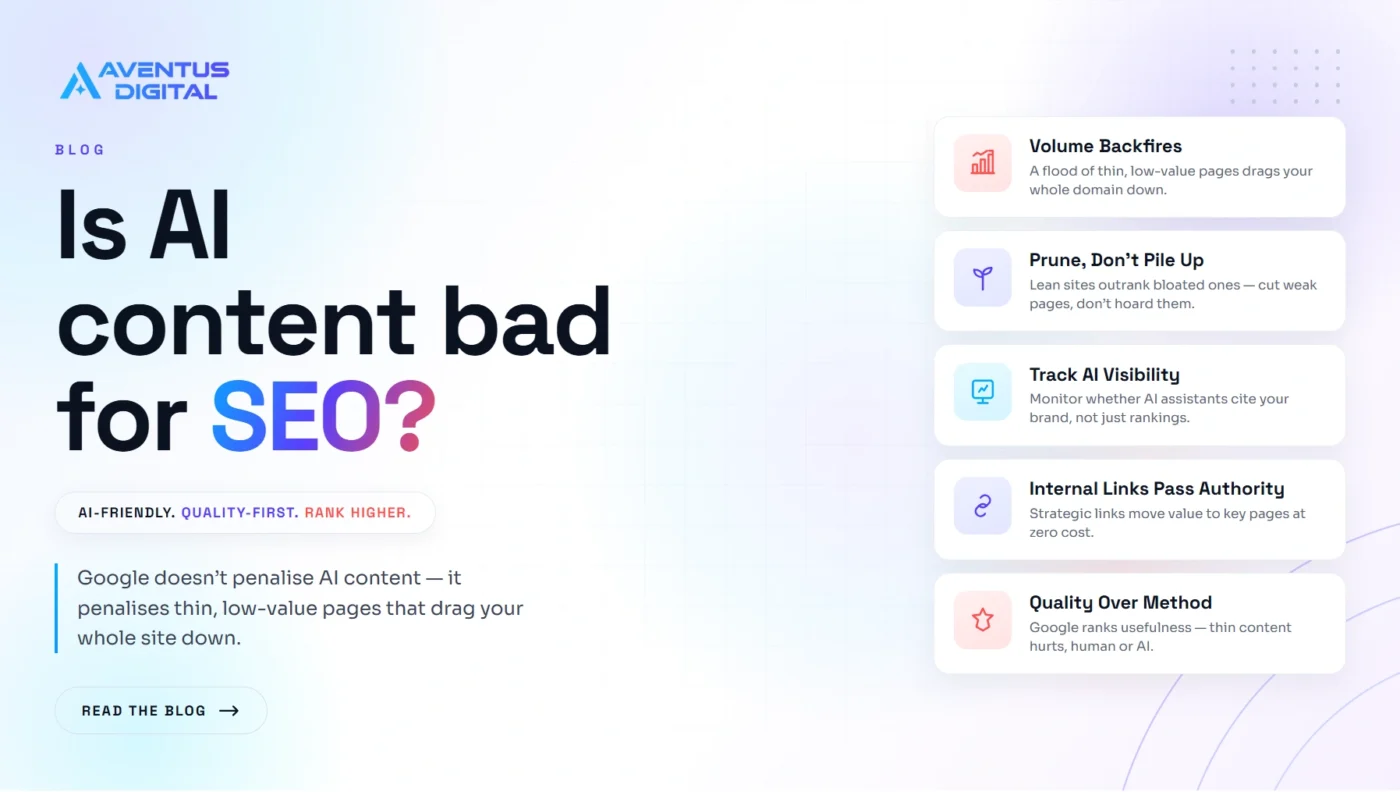
Is AI content bad for SEO?
Short answer: no, AI content is not bad for SEO on its own. Google does not penalise a page for being written with AI. What hurts your rankings is volume.
When AI makes content cheap, the temptation is to publish more of it, and a flood of thin, low value pages is exactly what drags a whole domain down. So the real question is not whether to use AI. It is how to stay visible when everyone else is using it to publish more.
The sites gaining ground right now are not publishing the most. They publish less, track more, and connect what they already have. Here is how to do the same.
Ask is AI content bad for SEO and most people expect a clean yes or no. The honest answer is that it depends entirely on what you do with it. Almost every AI SEO tool on the market has the same single move, which is to publish more. More posts, more pages, more thin content rotting away in your sitemap.
Google is paying attention. When a large share of your pages add little real value, a few things happen:
- Crawl budget gets spent on pages that should never have existed
- Your genuinely useful content waits longer to be crawled, indexed, and ranked
- Trust in your whole domain slowly erodes
That is not a content strategy. It is a slow motion penalty you pay in instalments. The fix is not less ambition, it is more discipline, and it comes down to three decisions: what you keep, what you track, and what you connect.
Keep: Prune the Pages Dragging You Down
The teams winning right now are not the ones publishing the most. They are the ones pruning the hardest.
Pruning means auditing every page and being honest about whether it earns its place. If a page has no traffic, no rankings, no backlinks, and no clear purpose, it is not neutral. It is a tax on the rest of your site.
Thin, slow, or outdated pages do more than waste crawl budget. They quietly cost you customers too.
Start with your indexing health:
- Open Google Search Console and compare pages indexed against pages submitted
- Find pages that are crawled but not indexed, which is usually a thin content signal
- Identify duplicate, outdated, or near empty pages
- For each one, decide: improve it, merge it, redirect it, or remove it
A lean site with twenty strong pages will almost always outperform a bloated one with two hundred weak ones. Less to crawl means your best content gets found faster.
When a tired page is worth saving, a focused website redesign usually beats another patch. And once your site is lean, keeping it that way is its own job. Ongoing website maintenance stops the bloat creeping back in.
Track: Measure Your Visibility in AI Answers
Search is no longer just ten blue links. More and more, people get their answer straight from an AI summary or an assistant like ChatGPT, Gemini, or Google’s AI Overviews. If your brand is not being cited there, you are invisible to a growing share of your market, and you might not even know it. We unpack how those AI answers choose their sources in is SEO still relevant for AI search?.
This is where GEO and AEO come in, generative engine optimisation and answer engine optimisation. The principle is simple. If you cannot track it, you cannot improve it. It is also why the question is AI content bad for SEO misses half the story: AI is not only changing how content is made, it is changing where people read the answer.
What to keep an eye on:
- Whether AI assistants mention or cite your brand for the questions that matter to you
- Which competitors are being cited in your place
- The questions where you should be the obvious answer but are not
- How your visibility shifts as you publish and prune
Traditional rankings still matter, but they are now only half the picture. The brands that measure their AI visibility today will own the answers tomorrow. A combined free SEO and GEO audit is the fastest way to see where you stand on both.
Connect: The Best Links are Already on Your Site
Everyone obsesses over building backlinks. Meanwhile, the most valuable link opportunity is usually one you already control, which is the internal link.
Internal links help Google find your content, understand how your pages relate, and decide which ones matter most. Done well, they pass authority from your strongest pages to the ones you want to grow.
A few simple rules:
- Link from high authority pages to the ones you are trying to rank
- Use clear, descriptive anchor text rather than “click here”
- Group related content into proper topic clusters, with one main page supported by deeper articles
- Fix orphan pages that nothing else on your site links to
You do not need to wait for someone else to link to you. The next best link is already sitting inside your own site. The same discipline applies when we build: every website design we deliver ships with a clean internal link structure from day one.
So, is AI Content Bad for SEO?
No. AI content is not bad for SEO, but using AI as a volume machine usually is. Used well, AI helps you research, draft, and ship faster. Used to flood your sitemap, it buries your best work under pages no one needs.
Keep the pages that earn their place. Track where you show up, including inside AI answers. Connect everything into a structure that Google and AI assistants can actually follow. Do that, and AI becomes an advantage rather than a liability.
At Aventus Digital, our free SEO and GEO audit shows you exactly which pages are helping, which are hurting, and where you stand in both Google and AI answers. We are a team of top rated specialists with over seven years of experience helping UK and international businesses get found. Book your free website audit and we will show you where the easy wins are.
You Might Also Like
- Is SEO still relevant for AI search? how AI Overviews choose the sources they cite.
- What is GEO? The UK business owner’s guide the plain English primer on getting cited by AI.
- 5 signs your website is costing you customers the quality signals that quietly lose you sales.
- Why is my website not showing on Google?
- WordPress vs Wix & Squarespace: which is better for a UK small business?

Author
Zubayed Feroz
Founder of Aventus Digital
Frequently Asked Questions
Is AI content bad for SEO?
No. AI content is not bad for SEO by default, because Google ranks pages on quality and usefulness, not on how they were produced. The risk appears when AI is used to publish a high volume of thin pages, which wastes crawl budget and weakens trust in your whole site. If you are unsure which of your pages help and which hurt, a free SEO and GEO audit will show you.
Does Google penalise AI generated content?
No. Google’s guidance focuses on helpful, people first content rather than the method of creation. Low value content can be demoted whether a human or an AI wrote it, so the goal is value, not avoiding AI.
How much content is too much for SEO?
There is no fixed number. It is about ratio, not raw volume. If a large share of your pages have no traffic, no rankings, and no clear purpose, you have too much. A leaner site of strong pages will usually outperform a bloated one, and ongoing website maintenance keeps it that way.
What is content pruning?
Content pruning is reviewing every page and deciding whether to improve it, merge it, redirect it, or remove it. It frees up crawl budget and focuses your authority on the pages that actually earn rankings. When a page is worth saving but tired, a focused website redesign is often the better route.
How do I check if my pages are indexed by Google?
Use the Page indexing report in Google Search Console. It shows which pages are indexed, which are crawled but not indexed (usually a thin content signal), and which were never discovered.
Why are my pages crawled but not indexed?
It is almost always a quality or value signal rather than a technical fault. Google crawled the page, decided it did not add enough, and chose not to index it. Strengthening the content or merging it into a stronger page usually fixes it, and a free website audit will pinpoint which pages are affected.
What is GEO (generative engine optimisation)?
GEO is optimising your site so AI assistants like ChatGPT, Gemini, and Perplexity discover, trust, and cite you when people ask relevant questions. SEO earns you a place on the page; GEO earns you the place in the answer. New to the term? Our guide what is GEO? The UK business owner’s guide explains it in plain English, and our combined SEO and GEO audit covers both.
How do I get my business cited in AI answers like Google’s AI Overviews?
Publish clear, well structured, genuinely useful content, mark it up with schema, and build authority signals such as reviews, mentions, and citations. Then track which questions already surface you and which surface your competitors. We explain how AI answers pick their sources in is SEO still relevant for AI search?, and a GEO audit measures exactly where you stand.
Do internal links really help SEO?
Yes. Internal links help Google find your content, understand how your pages relate, and decide which matter most. They pass authority from your strongest pages to the ones you want to grow, and they cost nothing to add. Every website design we build ships with a clean internal link structure from day one.
Can Aventus Digital audit my site for AI search readiness?
Yes. Our combined SEO and GEO audit reviews your indexing health, content structure, technical SEO, brand authority, and visibility across both Google and AI answers, then gives you a prioritised plan you keep whether or not you hire us. Get in touch to book it.
Related Blogs
Which Hosting Is Best for Peptide Websites?
Short answer: Hostinger is what we put research peptide stores on, and our link takes [...]
Oct
Is It Legal to Sell Research Peptides in the UK? The MHRA Line, Explained for Store Owners
Short answer: selling research peptides in the UK is lawful in itself, and it stops [...]
Oct
How to Start a Peptide Business in 2026: Costs and Steps
Short answer: to start a peptide business you register the company, open the bank account, [...]
Oct
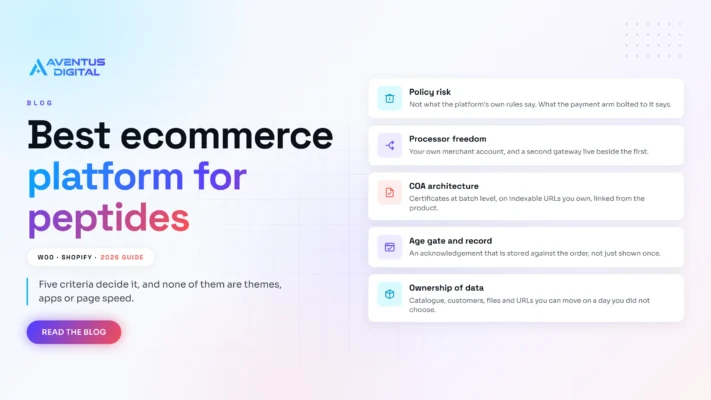
Best Ecommerce Platform for a Peptide Store (2026)
Short answer: the best ecommerce platform for peptides is a self-hosted WooCommerce store. Hosted platforms [...]
Oct
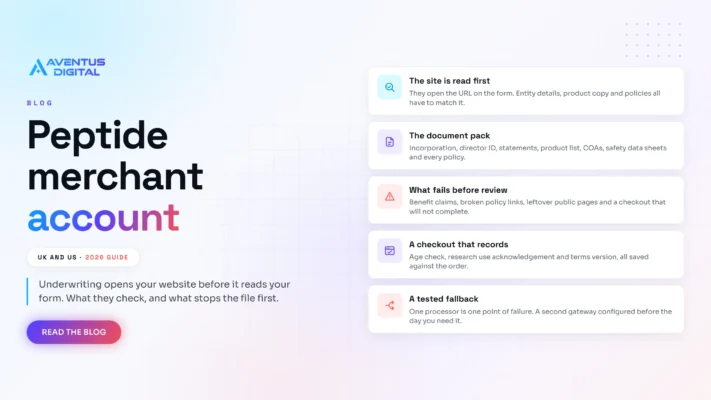
The peptide merchant account application pack that gets approved first time
Short answer: a peptide merchant account is won on evidence, not on wording. Underwriting opens [...]
Sep
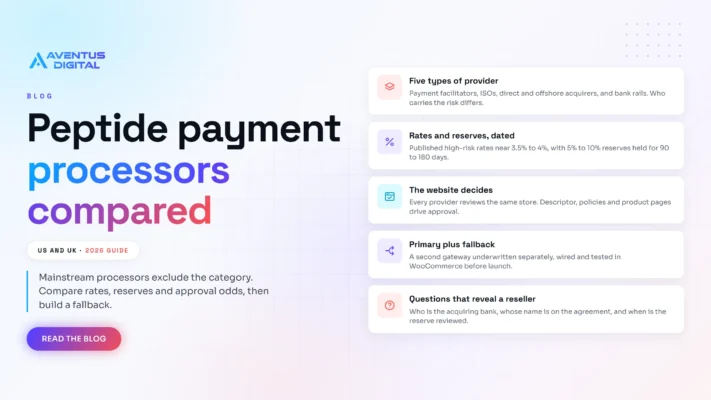
Peptide Payment Processors Compared: US and UK 2026
Short answer: mainstream processors such as Stripe, PayPal and WooPayments exclude the category, so a [...]
Sep
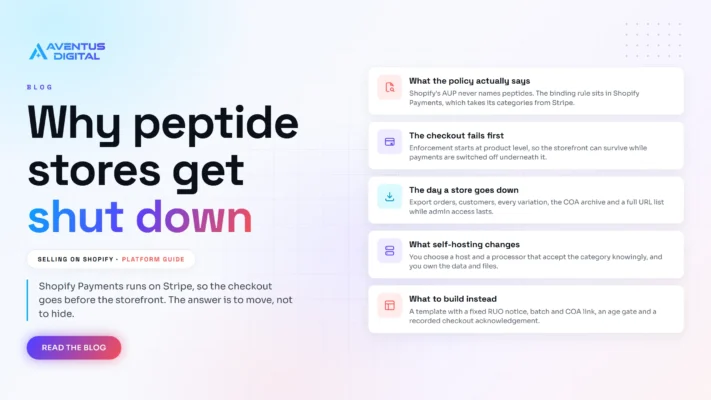
Selling Peptides on Shopify: Why Stores Get Shut Down
Short answer: not for long. You can open a store and sell peptides on Shopify, [...]
Sep
Peptide website compliance and how to get approved for payments
Short answer: peptide website compliance is decided on four things. A research use only position [...]
Sep