
Why is my website not showing on Google?
You built your website, you typed your business name into Google, and nothing came up. It is a horrible feeling, and it is far more common than most people think. If you are asking why is my website not showing on Google, the honest answer is usually simple. Google has not indexed the site yet, or something on the site is quietly blocking it. Below we walk through the real reasons this happens to new UK sites, and the exact checks that get you found.
Most new websites do not show on Google because they have not been indexed yet. Google needs to crawl, understand and store your pages before anyone can find them. A brand new site can take days or weeks. Check your indexing status in Google Search Console first, then fix anything blocking it.
The most common reasons a new site stays hidden
There is rarely one dramatic fault. It is usually one of a short list of ordinary ones. These are the reasons we see most often when a UK business tells us their site has gone missing.
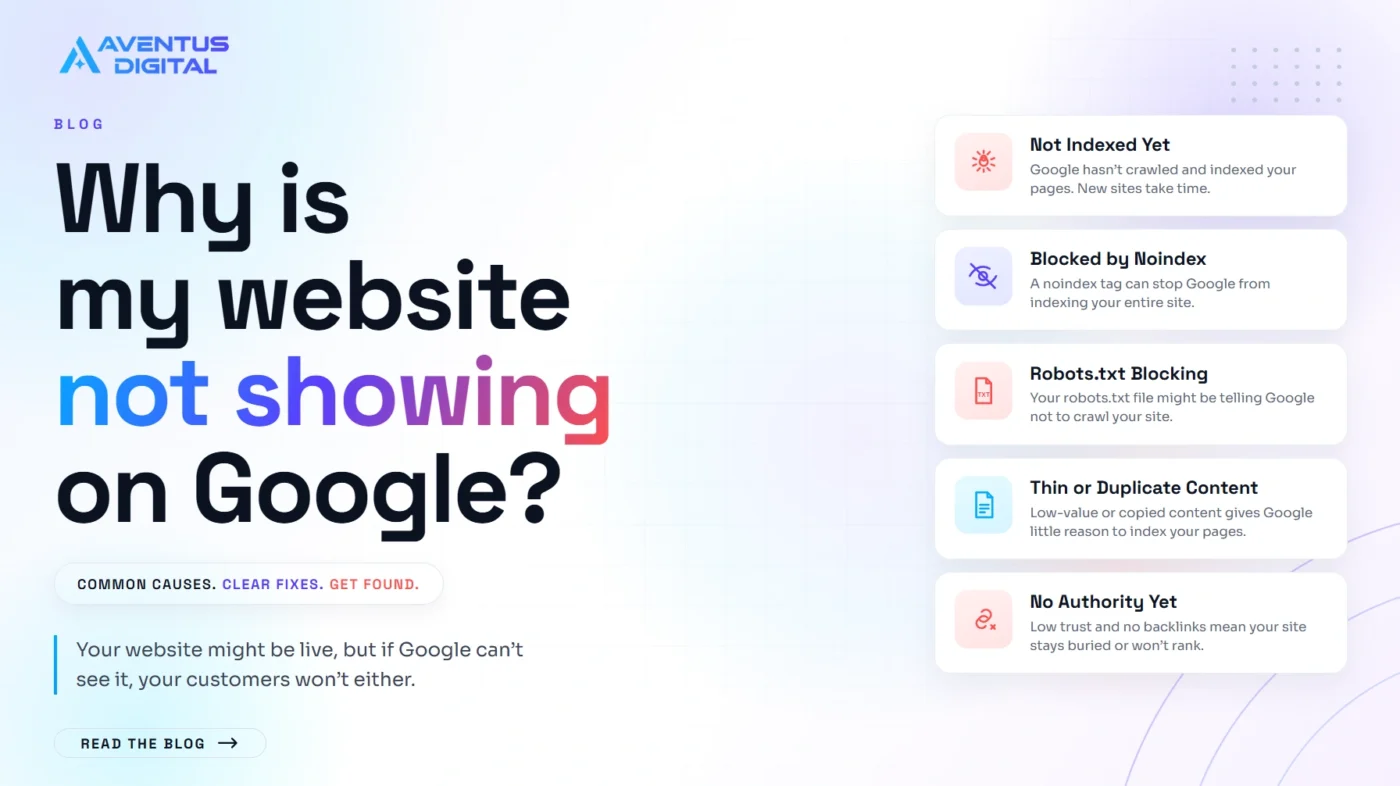
- Your site is simply too new. Google has to find, crawl and index every page before it can appear. A fresh domain with no history and no links sits at the back of the queue.
- Google has not indexed your pages yet. Crawled is not the same as indexed. A page can be visited and still left out of the index if Google judges it thin, duplicate or low value.
- A noindex tag is switched on. Many website builders and WordPress plugins ship with a “discourage search engines” setting. If that box is ticked, Google will politely stay away from the whole site.
- Robots.txt is blocking the crawler. One stray line in your robots.txt file can tell Google not to crawl anything at all.
- Your content is thin or copied. Pages with a couple of lines of text, or copy lifted straight from a supplier, give Google little reason to keep them.
- You have no authority yet. Sometimes the page is indexed but buried on page five, which feels the same as not showing at all. That is a trust and relevance problem, not an indexing one.
How long does Google take to index a new site?
There is no fixed number, and anyone who promises one is guessing. In our experience a healthy new page is often indexed within a few days to a couple of weeks. A brand new domain with little content and no links can take longer, sometimes four to eight weeks, before most of its pages settle into the index.
Two things speed this up more than anything else: publishing genuinely useful content, and earning a few honest links from other websites. Hitting the “Request indexing” button over and over does not help as much as people hope. Google indexes on quality and trust signals, not on how many times you ask.
How do I get my website on Google?
Getting listed is free, and it is not complicated. Google explains the essentials in its own guide to getting on Google. Here is the order we work through with clients.
- Set up Google Search Console and verify your site. This free tool shows you exactly what Google sees, including which pages are indexed and which are not.
- Submit your sitemap. A sitemap lists every page you want found. In WordPress an SEO plugin such as Yoast creates one for you, usually at yoursite.co.uk/sitemap.xml. Google explains the process in its help article on building and submitting a sitemap.
- Check for a noindex tag and your robots.txt. Make sure nothing is telling Google to stay out before you go any further.
- Use the URL Inspection tool on your key pages, then request indexing once. Once is enough. Repeated requests do not move you up any queue.
- Publish, then keep publishing. A site that grows with useful content gets crawled more often and indexed faster.
Why is my site indexed but not ranking?
This is a different problem, and it is worth naming clearly. If your pages sit in the index but never appear for the searches that matter, the issue is not visibility. It is competition and trust. The usual causes are:
- The keyword is too competitive for a young site to win yet.
- The content does not match what the searcher actually wants.
- Very few links point to you, so Google has little reason to trust you over older rivals.
- The on-page basics, meaning titles, headings and internal links, are not pointing Google at the right topics.
The fix here is not more indexing requests. It is better content, clearer structure and steady authority building. That is exactly what a proper audit uncovers.
How Aventus Digital helps
We have taken plenty of sites from invisible to found, including our own. Our SEO and GEO Audit checks indexing, crawlability, content quality and technical health in one pass, then hands you a prioritised list of fixes written in plain English. We look at classic Google search and at how AI tools such as ChatGPT, Gemini and Perplexity see you, because both matter now.
With 650 plus five star reviews behind us and 7 plus years of experience, we know the difference between a site that is genuinely broken and one that just needs a little time and a few honest signals. If you would rather not guess, we will tell you precisely why your site is hidden and what to do about it.
You Might Also Like
- Is SEO still relevant for AI search? how AI Overviews choose the sources they cite.
- What is GEO? The UK business owner’s guide the plain English primer on getting cited by AI.
- 5 signs your website is costing you customers the quality signals that quietly lose you sales.
- WordPress vs Wix & Squarespace: which is better for a UK small business?

Author
Zubayed Feroz
Founder of Aventus Digital
Frequently Asked Questions
Why is my website not appearing on Google?
Usually because Google has not indexed it yet, or something is blocking the crawler. New sites take time to appear, and a stray noindex tag or robots.txt rule can hide a whole site. Check your indexing status in Google Search Console first, then look for anything telling Google to stay away.
How long does it take Google to index a new site?
There is no fixed time. A healthy new page is often indexed within a few days to a couple of weeks, while a brand new domain with little content can take four to eight weeks. Publishing useful content and earning a few honest links speeds it up more than repeatedly requesting indexing.
How do I get my website on Google?
Set up Google Search Console, verify your site, and submit your sitemap. Make sure no noindex tag or robots.txt rule is blocking the crawler, then use the URL Inspection tool to request indexing on your key pages once. After that, keep publishing genuinely useful content so Google crawls you more often.
Why is my site indexed but not ranking?
Being indexed only means Google knows your page exists. Ranking depends on relevance, content quality and trust, so a young site with few links often sits far down the results. The fix is better content, clearer structure and steady authority building, not more indexing requests.
How do I submit my site to Google Search Console?
Go to Google Search Console, add your site as a property, and verify ownership using a DNS record, an HTML tag or your Google Analytics account. Once verified, submit your sitemap under the Sitemaps report so Google can find all your pages. You will then be able to see your indexing status and any errors.
Related Blogs
Which Hosting Is Best for Peptide Websites?
Short answer: Hostinger is what we put research peptide stores on, and our link takes [...]
Oct
Is It Legal to Sell Research Peptides in the UK? The MHRA Line, Explained for Store Owners
Short answer: selling research peptides in the UK is lawful in itself, and it stops [...]
Oct
How to Start a Peptide Business in 2026: Costs and Steps
Short answer: to start a peptide business you register the company, open the bank account, [...]
Oct
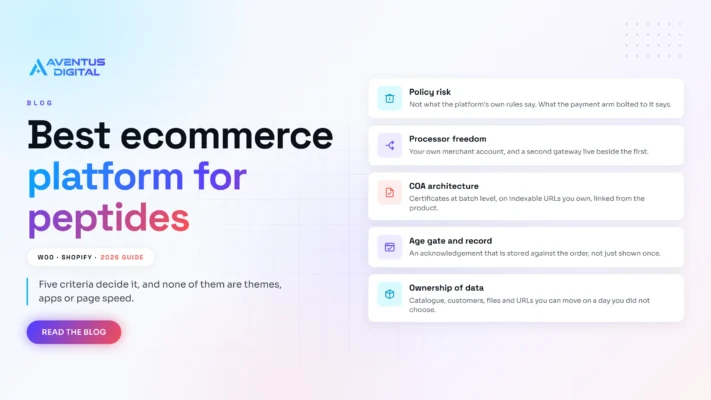
Best Ecommerce Platform for a Peptide Store (2026)
Short answer: the best ecommerce platform for peptides is a self-hosted WooCommerce store. Hosted platforms [...]
Oct
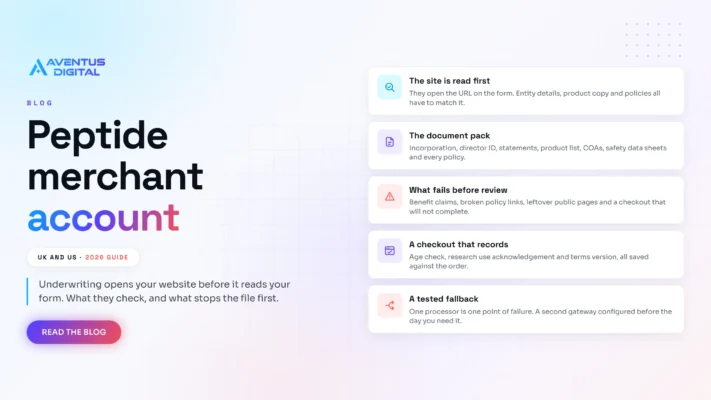
The peptide merchant account application pack that gets approved first time
Short answer: a peptide merchant account is won on evidence, not on wording. Underwriting opens [...]
Sep
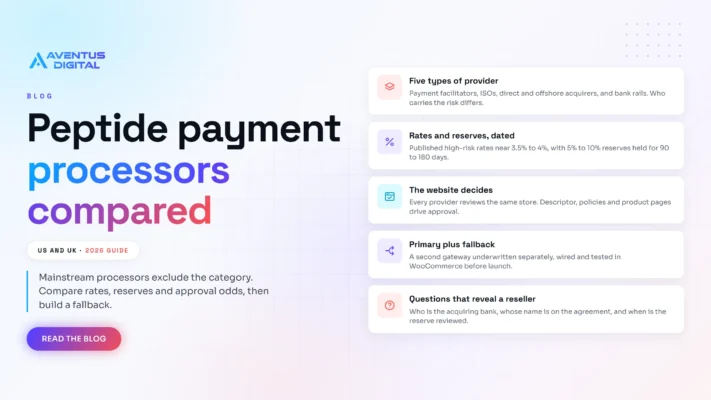
Peptide Payment Processors Compared: US and UK 2026
Short answer: mainstream processors such as Stripe, PayPal and WooPayments exclude the category, so a [...]
Sep
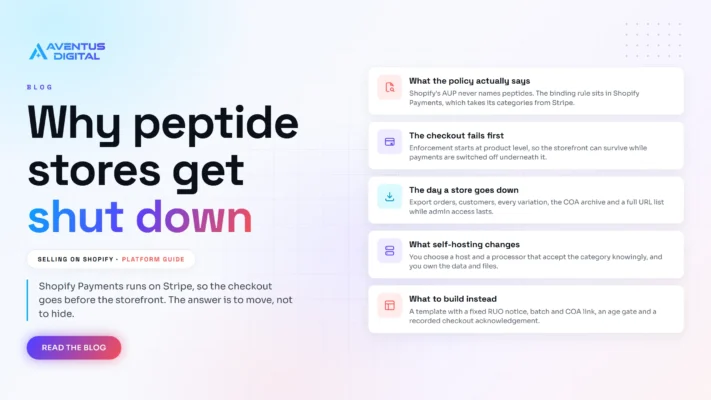
Selling Peptides on Shopify: Why Stores Get Shut Down
Short answer: not for long. You can open a store and sell peptides on Shopify, [...]
Sep
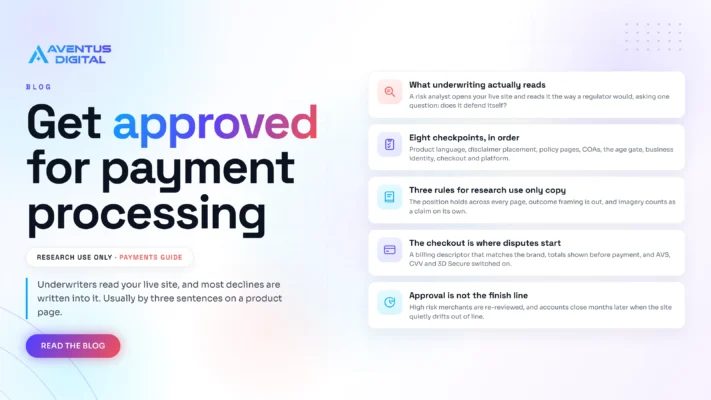
Peptide website compliance and how to get approved for payments
Short answer: peptide website compliance is decided on four things. A research use only position [...]
Sep