
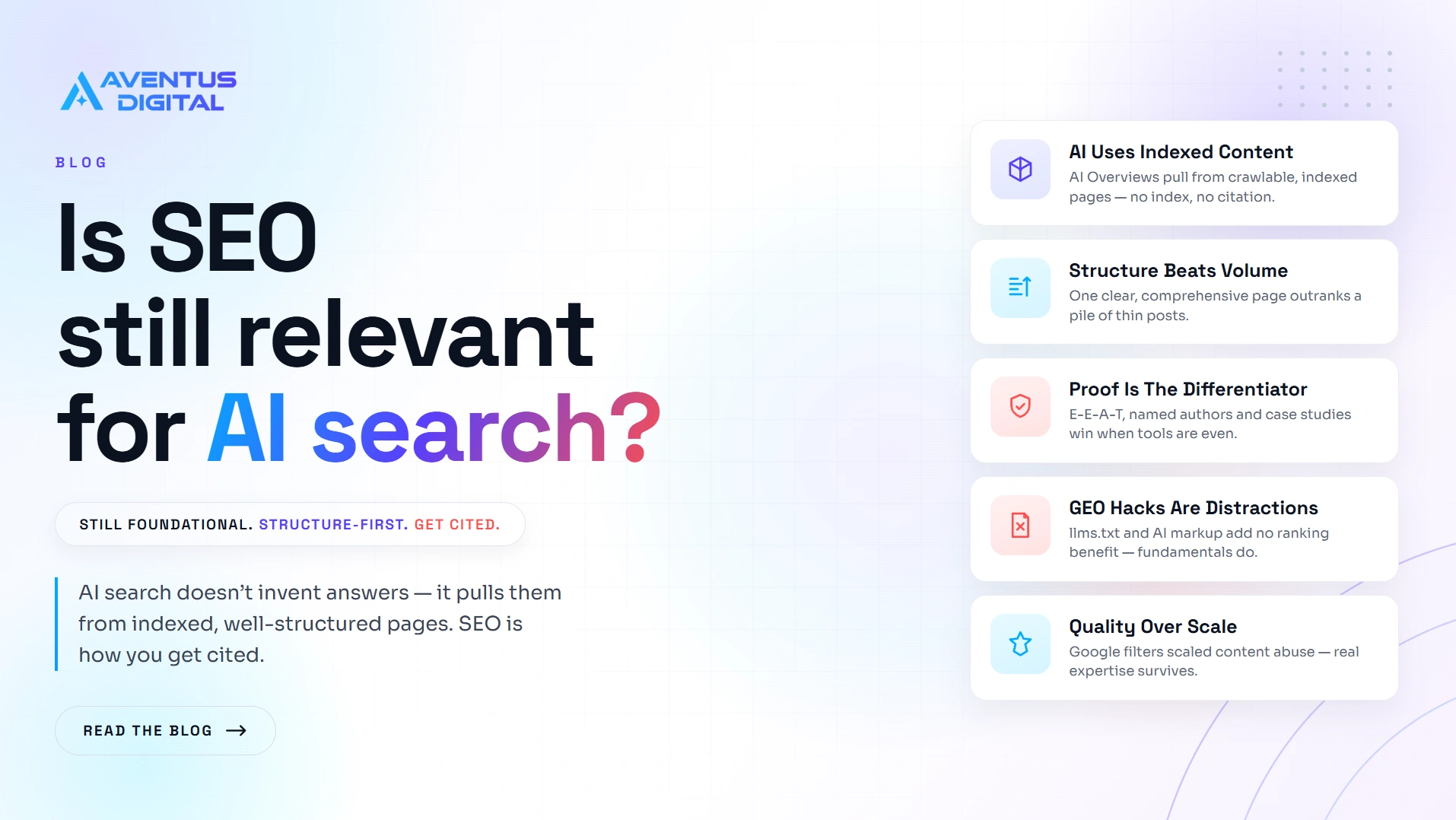
Is SEO Still Relevant For Generative AI Search?
Yes. The fundamentals that always made SEO work now decide whether AI search engines surface and cite you. At Aventus Digital we build SEO and GEO into every project from the first brief, so the foundation is right from day one.
How Google’s AI Search Actually Works
AI Overviews do not invent answers. They pull from indexed pages using Retrieval-Augmented Generation, so the basics still gate everything:
- If a page is not crawlable, indexed and clearly structured, it cannot be cited.
- Google uses a query fan-out technique, turning one question into several related searches behind the scenes.
- One well-organised page that answers the core question and its sub-questions beats ten thin, disconnected posts.
In short, AI search rewards the same clean foundations it always has, just with far less room for error. We build every Aventus Digital site to be crawlable, well-structured and answer-led from the first brief, so it is ready to be cited rather than skipped over.
What Google’s move to an answer engine changes
At Google I/O 2026 the era of ten blue links was declared over, with AI answers placed on top (TechCrunch):
- Links still appear, but they are demoted below the AI answer.
- AI Overviews reach over 2.5 billion people a month, and AI Mode has passed 1 billion users.
- Even with perfect SEO, Google shows only a handful of sources and an answer engine cites fewer, so trust and proof decide who wins the slot.
The honest takeaway is that visibility is getting scarcer, not easier, even as the tools get better. We plan for that scarcity from day one, structuring your pages and the proof behind them so you are the source Google feels safe putting its own name next to.
What Google Says You Don’t Need To Do
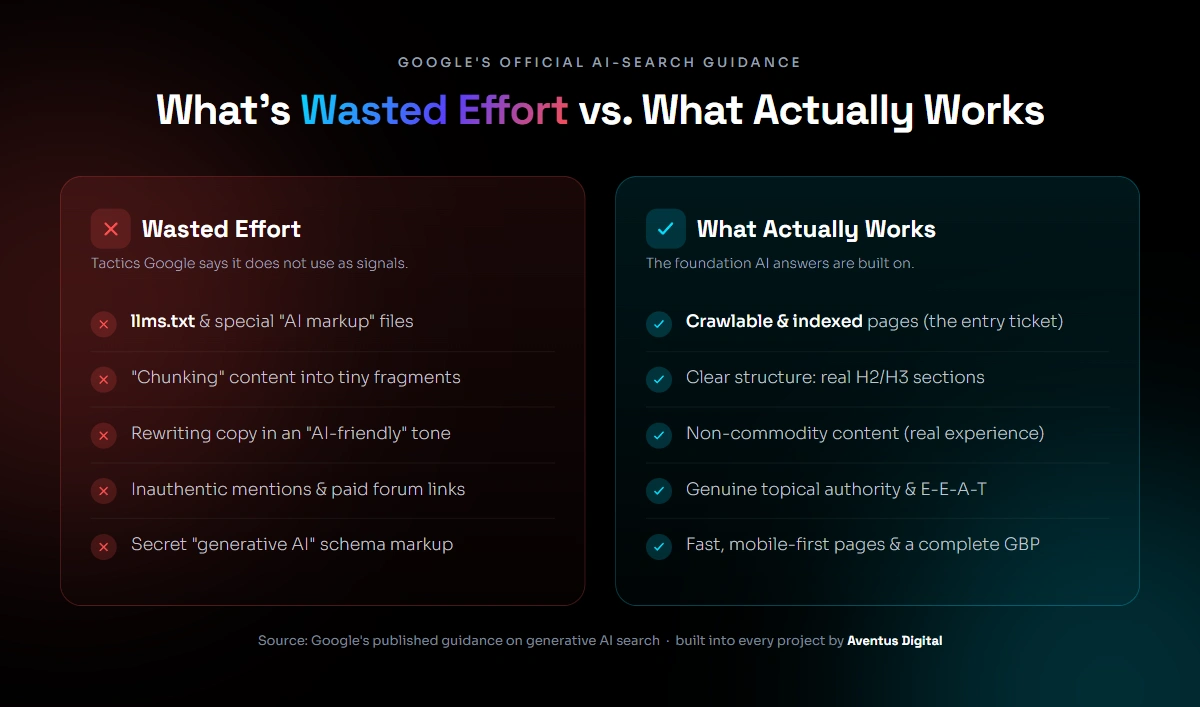
Per Google’s AI features guidance, these waste time and budget:
- txt files or special AI markup (not treated as signals).
- “Chunking” content into tiny fragments.
- Rewriting in a special “AI-friendly” tone.
- Chasing inauthentic mentions or paid forum links.
- Special schema for generative AI.
Put simply, most so-called GEO hacks are a distraction dressed up as strategy. Our SEO and GEO Audit ignores the noise and focuses only on what Google can actually index and cite, so your time and budget go where they move the needle.
Why Google Penalises Manipulated and Mass-Produced Content
Google does not penalise content for being AI (b confirms AI-assisted content can rank). It targets scaled content abuse: volume published to game rankings, no matter who or what wrote it.
- The March 2026 core update made scaled content abuse a top enforcement target, and thin AI page farms lost heavy traffic.
- “Best in the industry” puff and keyword-stuffed posts work briefly, then get filtered out.
- The fix: add genuine expertise, check every fact, and never publish at volume just to rank.
The pattern is consistent: Google rewards effort and originality, and filters out shortcuts. We treat AI as a research and drafting aid, then add the expertise, fact-checking and real proof a model cannot invent, so your content stays on the right side of every update.
GEO, AEO and SEO: How They Work Together
GEO and AEO are extensions of SEO, not replacements (Search Engine Journal notes Google frames them as still SEO):
- GEO structures content so AI engines surface and cite you: clear answers, extractable facts, a visible author, structured FAQs.
- AEO makes sure the exact questions customers ask have a trustworthy answer wherever an AI looks. Most people now search by asking questions, not typing keywords.
- Map the real questions per topic and answer each one directly.
- Publish those answers across your website, Google Business Profile and socials so they reinforce each other.
- Back every claim with an EEAT signal and real case studies.
- Our SEO and GEO Audit reviews both the SEO floor and the GEO layer in one pass.
Together these are not three separate jobs but one connected discipline. Aventus Digital builds SEO, GEO and AEO into the same workflow, so your site ranks, gets cited, and answers the questions your customers are actually asking, all from a single coherent plan.
Technical SEO Is The Entry Ticket
You cannot be cited if you are not indexed. The non-negotiables:
- Crawlable, with no stray noindex tags or blocked URLs in robots.txt.
- Content rendered server-side, or JavaScript that runs before Googlebot reads it.
- Fast on mobile (Google scores Core Web Vitals on mobile data).
- No significant duplicate content.
- A complete, accurate Google Business Profile if you are local.
None of these are glamorous, but each one is a gate your content has to pass before it can perform. Our Website Maintenance plans keep these checks running every month, so a quiet technical fault never costs you weeks of lost visibility.
What it means for local businesses
For local queries the AI blends your profile, your site and third-party mentions. Highest-leverage moves:
- Accurate categories and a complete service description.
- Genuine, recent reviews.
- Consistent business details everywhere you appear.
For a local business these basics are the fastest route to being recommended by AI in your area. Our work with trades and local services bakes local schema, service-area pages and profile optimisation into every project, so you show up when nearby customers ask.
Proof Is The New Differentiator
When everyone has the same AI tools, the thing that cannot be copied is proof. Put E-E-A-T signals everywhere, not just an about page:
- Named authors with real credentials.
- Genuine reviews and clear contact details.
- Case studies with real stats and change.
- EEAT signals naturally laid out throughout your website
When skills and tools are evenly matched, proof is what tips the decision, for a human reader and an AI alike. We design every Aventus Digital site to show its evidence in plain sight, and we hold our own claims to the same standard rather than asking you to take them on trust.
Will You Lose Clicks To AI Answers?
Selectively, depending on the query:
- Informational queries (“what is X”) lose clicks to AI Overviews over time.
- Commercial and transactional queries still convert, because people want to see real work and make contact.
- A 2025 Pew Research study found a traditional result was clicked on just 8% of searches that showed an AI summary, versus 15% without one.
So the smart move is to defend your informational content while making your commercial pages convert. We structure your site so the pages that win the click also turn those visitors into enquiries, not just impressions on a screen.
The One Thing To Do Next
Start with an audit that covers the technical and content layers together. Our SEO and GEO Audit shows where you stand, what blocks AI visibility, and the highest-priority fixes. Not a retainer, a document you can act on now.
Get your Free SEO and GEO AuditYou Might Also Like
- What is GEO? The UK business owner’s guide the plain English primer on getting cited by AI.
- 5 signs your website is costing you customers the quality signals that quietly lose you sales.
- Why is my website not showing on Google?
- Why is my website slow? 9 causes and how to fix them

Author
Zubayed Feroz
Founder of Aventus Digital
Frequently Asked Questions
Is SEO still worth investing in now that AI tools like ChatGPT and Google AI Overviews are changing how people search?
Yes. Google has confirmed that foundational SEO practices remain the basis for visibility in AI-generated results. Indexed pages, clear structure and high-quality content are still what decide whether your site appears, whether a human or an AI is surfacing the answer.
What is GEO and how is it different from traditional SEO?
GEO (Generative Engine Optimisation) is about how well your content surfaces inside AI-generated responses. Traditional SEO focuses on ranking in a list of links; GEO focuses on whether AI tools pull from your content when composing an answer. The good news: the same practices that improve SEO, unique content, clear structure and real expertise, also improve GEO.
What kind of content does Google’s AI actually favour?
Content that reflects genuine expertise and first-hand experience. This maps directly to Google’s E-E-A-T standard (Experience, Expertise, Authoritativeness, Trustworthiness). Generic “tips” articles written from common knowledge are increasingly filtered out, while content offering a perspective readers can’t easily find elsewhere is rewarded.
Do I need to do anything special to my website to show up in AI search results?
No. Google has stated clearly that files like llms.txt, AI-specific markup and content “chunking” have no effect on AI search visibility. What matters is that your pages are indexed, crawlable and free of duplicate content. If your site has foundational technical issues, those need to be resolved first.
Do I need a brand-new website to perform well in AI search, or can my existing site be improved?
Often your existing site can be improved without starting over. If the foundations are sound, targeted fixes to structure, content and technical SEO are usually enough. When a site runs on an outdated theme or has deeper structural problems, a website redesign tends to be the more cost-effective route. Both our website design and redesign work build SEO and GEO in from the first brief, so the foundation is right from day one.
Should we be creating more content to keep up with AI search trends?
Volume isn’t the answer. Google explicitly flags scaled content creation as a spam risk when it prioritises quantity over quality. A small number of well-researched, experience-driven articles will outperform a high volume of generic posts. If you’re unsure where to focus, start with the questions your customers actually ask, and answer them better than anyone else can.
Related Blogs
Which Hosting Is Best for Peptide Websites?
Short answer: Hostinger is what we put research peptide stores on, and our link takes [...]
Oct
Is It Legal to Sell Research Peptides in the UK? The MHRA Line, Explained for Store Owners
Short answer: selling research peptides in the UK is lawful in itself, and it stops [...]
Oct
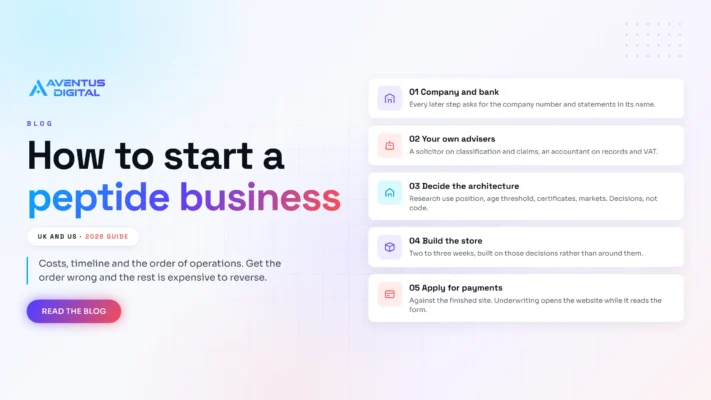
How to Start a Peptide Business in 2026: Costs and Steps
Short answer: to start a peptide business you register the company, open the bank account, [...]
Oct
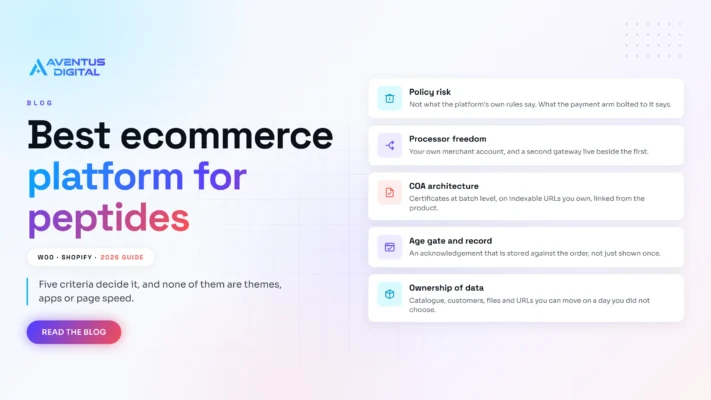
Best Ecommerce Platform for a Peptide Store (2026)
Short answer: the best ecommerce platform for peptides is a self-hosted WooCommerce store. Hosted platforms [...]
Oct
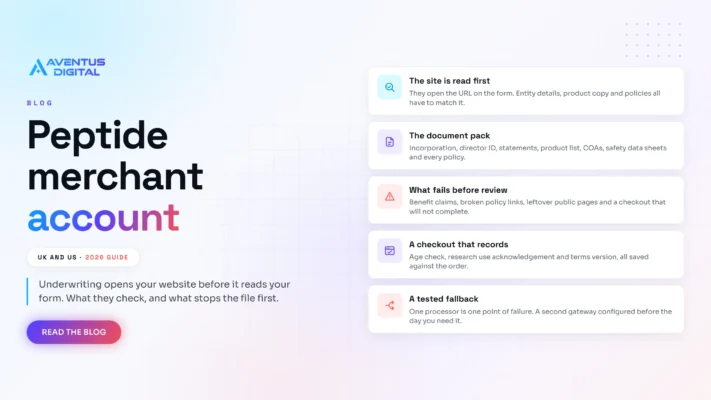
The peptide merchant account application pack that gets approved first time
Short answer: a peptide merchant account is won on evidence, not on wording. Underwriting opens [...]
Sep
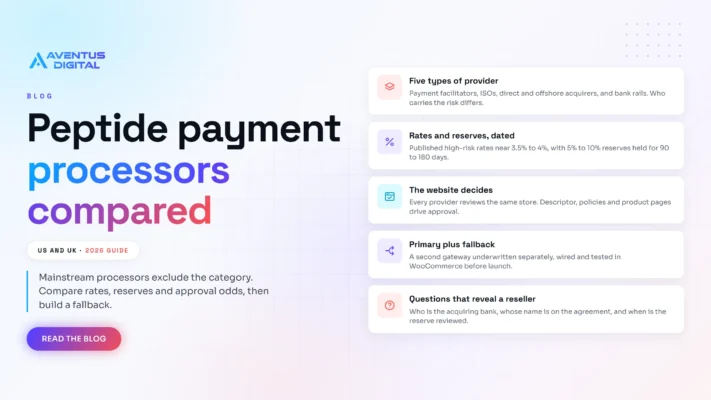
Peptide Payment Processors Compared: US and UK 2026
Short answer: mainstream processors such as Stripe, PayPal and WooPayments exclude the category, so a [...]
Sep
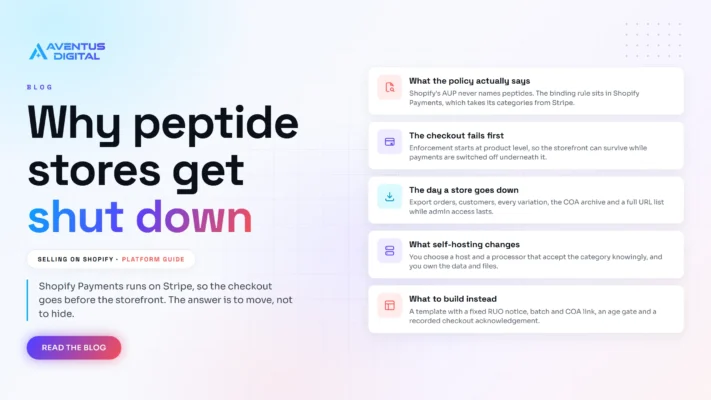
Selling Peptides on Shopify: Why Stores Get Shut Down
Short answer: not for long. You can open a store and sell peptides on Shopify, [...]
Sep
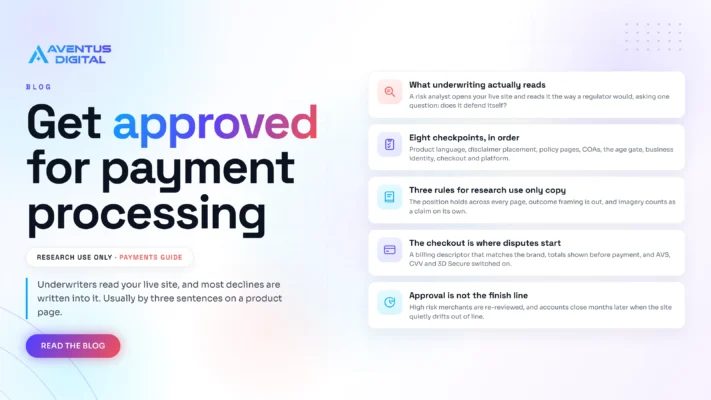
Peptide website compliance and how to get approved for payments
Short answer: peptide website compliance is decided on four things. A research use only position [...]
Sep